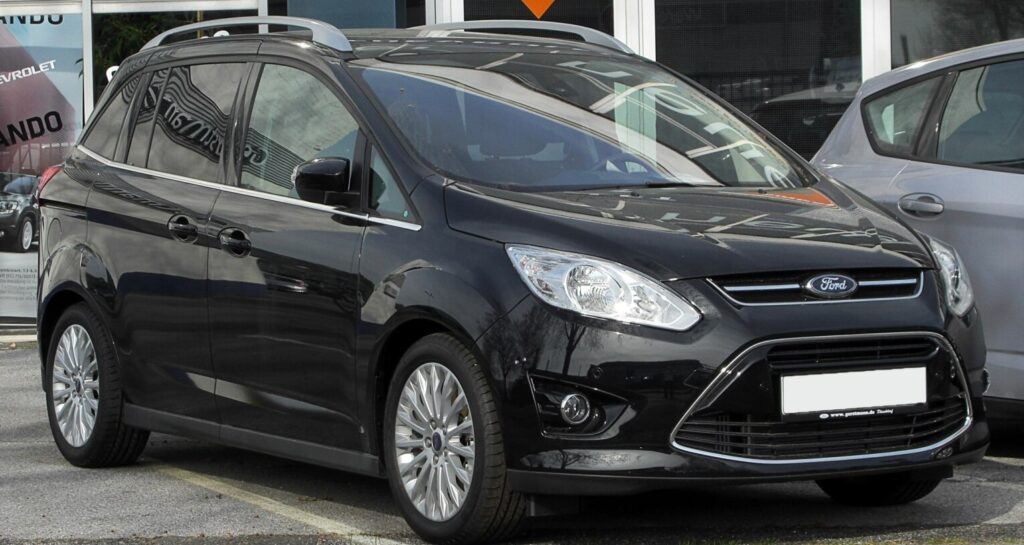
The Ford Grand C-MAX 1.6 Duratorq TDCi, producing 95 horsepower, was a popular variant of Ford’s compact multi-purpose vehicle (MPV) sold primarily in Europe from 2010 to 2015. Positioned as an entry-level to mid-range offering within the Grand C-MAX lineup, it catered to families seeking an affordable and fuel-efficient seven-seater. This model occupied a crucial space in Ford’s strategy to provide practical and economical transportation solutions in a competitive segment. It was part of the second generation C-MAX, internally designated as the C2 platform.
Technical Specifications
| Brand | Ford |
| Model | C-MAX |
| Generation | Grand C-MAX |
| Type (Engine) | 1.6 Duratorq TDCi (95 Hp) DPF |
| Start of production | 2010 |
| End of production | 2015 |
| Powertrain Architecture | Internal Combustion engine |
| Body type | MPV |
| Seats | 7 |
| Doors | 5 |
| Fuel consumption (urban) | 5.5 l/100 km (42.8 US mpg) |
| Fuel consumption (extra urban) | 4.3 l/100 km (54.7 US mpg) |
| Fuel consumption (combined) | 4.7 l/100 km (50 US mpg) |
| CO2 emissions | 124 g/km |
| Fuel Type | Diesel |
| Acceleration 0 – 100 km/h | 14.3 sec |
| Acceleration 0 – 62 mph | 14.3 sec |
| Acceleration 0 – 60 mph | 13.6 sec |
| Maximum speed | 166 km/h (103.15 mph) |
| Emission standard | Euro 5 |
| Weight-to-power ratio | 15.8 kg/Hp |
| Weight-to-torque ratio | 6.5 kg/Nm |
| Power | 95 Hp |
| Torque | 230 Nm (169.64 lb.-ft.) |
| Engine layout | Front, Transverse |
| Engine Model/Code | T3DB |
| Engine configuration | Inline |
| Fuel injection system | Diesel Commonrail |
| Engine aspiration | Turbocharger, Intercooler |
| Engine oil capacity | 3.8 l (4.02 US qt | 3.34 UK qt) |
| Coolant capacity | 7.3 l (7.71 US qt | 6.42 UK qt) |
| Kerb Weight | 1504 kg (3315.75 lbs.) |
| Max. weight | 2200 kg (4850.17 lbs.) |
| Max load | 696 kg (1534.42 lbs.) |
| Trunk (boot) space – minimum | 56 l (1.98 cu. ft.) |
| Trunk (boot) space – maximum | 1706 l (60.25 cu. ft.) |
| Fuel tank capacity | 60 l (15.85 US gal | 13.2 UK gal) |
| Length | 4520 mm (177.95 in.) |
| Width | 1828 mm (71.97 in.) |
| Height | 1684 mm (66.3 in.) |
| Minimum turning circle | 11.2 m (36.75 ft.) |
| Drivetrain | Front wheel drive |
| Number of gears | 6 gears, manual transmission |
| Assisting systems | ABS (Anti-lock braking system) |
Powertrain & Engine Architecture
The heart of this Grand C-MAX variant is the 1.6-liter Duratorq TDCi diesel engine, specifically the T3DB engine code. This engine is a four-cylinder, inline configuration, utilizing a common-rail direct fuel injection system. This system, supplied by Bosch, allowed for precise fuel delivery and optimized combustion, contributing to both fuel efficiency and reduced emissions. The engine also features a turbocharger with an intercooler, enhancing power output by forcing more air into the cylinders. The Duratorq engine family was known for its robust construction and relatively simple design, making it easier to maintain compared to some of its more complex competitors. The 6-speed manual transmission was the standard offering, chosen for its balance of fuel economy and driver engagement. The transmission’s gear ratios were tuned to maximize the engine’s torque output at lower speeds, aiding in everyday drivability.
Driving Characteristics
The 95 horsepower output and 230 Nm (169.64 lb.-ft.) of torque delivered by the 1.6 Duratorq TDCi resulted in a practical, if not particularly exhilarating, driving experience. Acceleration from 0-60 mph took around 13.6 seconds, and top speed was limited to 103.15 mph. While slower than higher-powered versions of the Grand C-MAX, such as those equipped with the 2.0-liter TDCi engine, the 1.6 offered sufficient power for typical daily driving and highway cruising. The manual transmission allowed for good control over the engine’s power band, but required more driver involvement than an automatic. The focus was clearly on fuel economy, with combined fuel consumption figures reaching around 50 US mpg. The suspension was tuned for comfort, prioritizing ride quality over sporty handling.
Equipment & Trim Levels
The 1.6 Duratorq TDCi Grand C-MAX typically came equipped with a reasonable level of standard features. These included air conditioning, power windows, power mirrors, a basic audio system with USB connectivity, and ABS brakes. Higher trim levels, such as Titanium, added features like alloy wheels, upgraded interior trim, automatic headlights and rain-sensing wipers, and a more advanced infotainment system. Optional extras included a panoramic sunroof, rear parking sensors, and a navigation system. Interior upholstery was typically cloth, with higher trims offering partial leather options. The dashboard layout was functional and user-friendly, with a clear instrument cluster and logically placed controls.
Chassis & Braking
The Grand C-MAX featured a front-wheel-drive layout with independent front suspension (MacPherson struts) and a semi-independent rear suspension (twist beam). This setup provided a good balance of ride comfort and handling. The braking system consisted of ventilated front disc brakes and drum brakes on the rear wheels. ABS (Anti-lock Braking System) was standard, enhancing safety during emergency braking situations. The steering was a rack and pinion system, providing precise and responsive steering feel. Stabilizer bars were fitted to both the front and rear axles to reduce body roll during cornering.
Market Reception & Comparison
The Ford Grand C-MAX 1.6 Duratorq TDCi was generally well-received by automotive critics as a practical and economical family vehicle. It was praised for its spacious interior, fuel efficiency, and comfortable ride. However, some critics noted its relatively modest performance compared to rivals. Compared to the 2.0-liter TDCi versions, the 1.6 offered lower running costs but sacrificed some power and refinement. Against competitors like the Renault Scenic and Citroen C4 Picasso, the Grand C-MAX offered a competitive package in terms of space, practicality, and value for money. The 1.6 TDCi was particularly popular with buyers who prioritized fuel economy and affordability over outright performance.
Legacy
The 1.6 Duratorq TDCi engine proved to be a reliable and durable powertrain, although like any diesel engine, it required regular maintenance, including oil changes and filter replacements. The diesel particulate filter (DPF) could be a potential source of issues if the vehicle was primarily used for short trips, as it required periodic regeneration. In the used car market, the Grand C-MAX 1.6 Duratorq TDCi remains a popular choice for families seeking an affordable and practical MPV. Its fuel efficiency and relatively low maintenance costs continue to make it an attractive option, even years after production ceased. The engine’s robust design and readily available parts contribute to its long-term reliability and affordability.