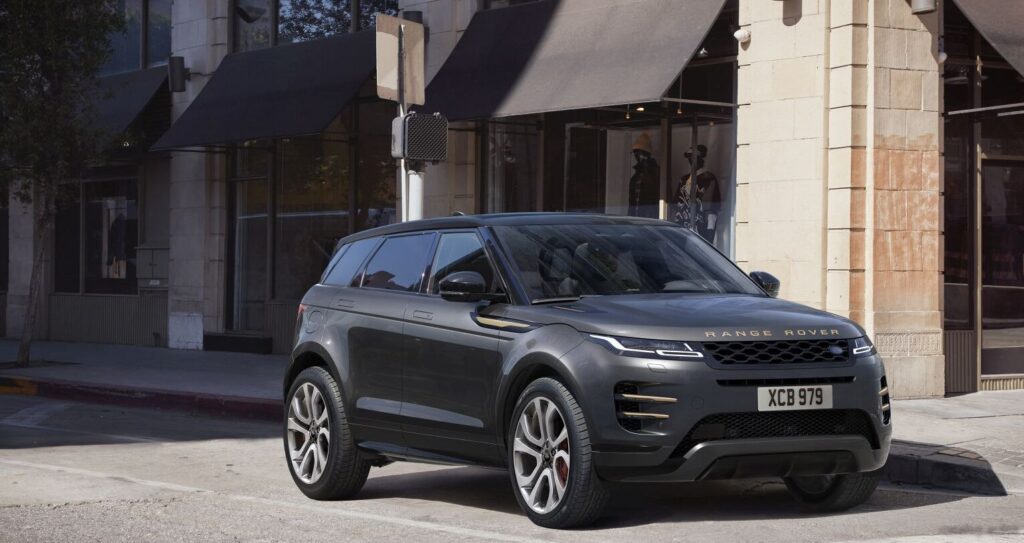
The Land Rover Range Rover Evoque II 2.0 Td4 (150 hp) Mild Hybrid AWD Automatic represents a key variant within the second generation of the Evoque, produced from 2019 to 2020. Positioned as a more fuel-efficient and accessible entry point into the Evoque range, this model combined a 2.0-liter turbocharged diesel engine with a 48-volt mild hybrid system and a nine-speed automatic transmission, coupled with Land Rover’s renowned all-wheel-drive capability. It aimed to balance the Evoque’s signature style and off-road prowess with improved economy and lower running costs, appealing to a broader customer base in the premium compact SUV segment.
Technical Specifications
| Brand | Land Rover |
| Model | Range Rover Evoque |
| Generation | Range Rover Evoque II |
| Type (Engine) | 2.0 Td4 (150 Hp) Mild Hybrid AWD Automatic |
| Start of production | 2019 |
| End of production | 2020 |
| Powertrain Architecture | MHEV (Mild Hybrid Electric Vehicle) |
| Body type | SUV |
| Seats | 5 |
| Doors | 5 |
| Fuel consumption (combined) | 5.6 l/100 km (42 US mpg, 50.4 UK mpg, 17.9 km/l) |
| CO2 emissions | 149 g/km |
| Fuel Type | Diesel |
| Acceleration 0 – 100 km/h | 11.2 sec |
| Acceleration 0 – 62 mph | 11.2 sec |
| Acceleration 0 – 60 mph | 10.6 sec |
| Maximum speed | 196 km/h (121.79 mph) |
| Emission standard | Euro 6 |
| Weight-to-power ratio | 12.6 kg/Hp |
| Weight-to-torque ratio | 5 kg/Nm |
| Power | 150 Hp @ 2400 rpm |
| Power per litre | 75 Hp/l |
| Torque | 380 Nm @ 1750-2500 rpm (280.27 lb.-ft.) |
| Engine layout | Front, Transverse |
| Engine Model/Code | Ingenium / 204DTD |
| Engine displacement | 1999 cm3 (121.99 cu. in.) |
| Number of cylinders | 4 |
| Engine configuration | Inline |
| Cylinder Bore | 83 mm (3.27 in.) |
| Piston Stroke | 92.35 mm (3.64 in.) |
| Compression ratio | 15.5:1 |
| Number of valves per cylinder | 4 |
| Fuel injection system | Diesel Commonrail |
| Engine aspiration | Turbocharger, Intercooler |
| Valvetrain | DOHC |
| Engine oil capacity | 6.5 l (6.87 US qt, 5.72 UK qt) |
| Coolant capacity | 11.2 l (11.83 US qt, 9.85 UK qt) |
| Kerb Weight | 1891 kg (4168.94 lbs.) |
| Trunk (boot) space – minimum | 591 l (20.87 cu. ft.) |
| Trunk (boot) space – maximum | 1383 l (48.84 cu. ft.) |
| Fuel tank capacity | 65 l (17.17 US gal, 14.3 UK gal) |
| AdBlue tank capacity | 17.2 l (4.54 US gal, 3.78 UK gal) |
| Permitted trailer load with brakes (12%) | 2000 kg (4409.25 lbs.) |
| Permitted trailer load without brakes | 750 kg (1653.47 lbs.) |
| Length | 4371 mm (172.09 in.) |
| Width | 1904 mm (74.96 in.) |
| Width with mirrors folded | 1996 mm (78.58 in.) |
| Width including mirrors | 2100 mm (82.68 in.) |
| Height | 1649 mm (64.92 in.) |
| Wheelbase | 2681 mm (105.55 in.) |
| Front track | 1626 mm (64.02 in.) |
| Rear track | 1632 mm (64.25 in.) |
| Front overhang | 880 mm (34.65 in.) |
| Rear overhang | 810 mm (31.89 in.) |
| Ride height (ground clearance) | 212 mm (8.35 in.) |
| Drag coefficient (Cd) | 0.32 |
| Minimum turning circle | 11.6 m (38.06 ft.) |
| Approach angle | 25.0° |
| Departure angle | 30.6° |
| Ramp-over angle | 20.7° |
| Climb angle | 45.0° |
| Wading depth | 600 mm (23.62 in.) |
| Drive wheel | All wheel drive (4×4) |
| Number of gears | 9 |
| Gearbox type | Automatic transmission |
| Front suspension | Independent type McPherson |
| Rear suspension | Independent multi-link suspension |
| Assisting systems | ABS (Anti-lock braking system) |
| Steering type | Steering rack and pinion |
| Power steering | Electric |
| Tires size | 225/65 R17; 235/65 R17; 235/60 R18; 235/50 R20; 245/45 R21 |
| Wheel rims size | 7.0J x 17; 8.0J 18; 8.0J x 20; 8.0J x 21 |
Powertrain & Engine Architecture
At the heart of the Evoque II 2.0 Td4 lies Land Rover’s Ingenium engine family. Specifically, the 204DTD engine is a 2.0-liter inline-four cylinder diesel, utilizing a turbocharger and intercooler to produce 150 horsepower at 2400 rpm and 380 Nm (280 lb-ft) of torque between 1750 and 2500 rpm. The engine employs a sophisticated diesel commonrail fuel injection system for precise fuel delivery and optimized combustion. The valvetrain is a dual overhead camshaft (DOHC) design, contributing to efficient valve control. The mild hybrid system, a 48-volt setup, incorporates a belt-integrated starter generator (BiSG) that assists the engine during acceleration and enables smoother start-stop functionality, improving fuel economy. This powertrain is paired with a ZF-sourced nine-speed automatic transmission, known for its wide gear ratios and smooth shifting characteristics.
Driving Characteristics
The 150 hp output and automatic transmission configuration of this Evoque variant deliver a comfortable and refined driving experience, prioritizing ease of use over outright performance. Acceleration from 0-60 mph takes around 10.6 seconds, and while not particularly quick, it’s adequate for everyday driving. The nine-speed automatic transmission is programmed for fuel efficiency, with taller gear ratios in the higher gears. This results in a relaxed cruising experience on the highway, but may require more frequent downshifts when overtaking or climbing hills. Compared to the higher-powered diesel variants (like the 180 hp or 240 hp models) or the petrol options, the 2.0 Td4 feels less responsive. However, the mild hybrid system does provide a noticeable boost during initial acceleration. The all-wheel-drive system provides excellent traction in various conditions, making it a capable vehicle for both on-road and light off-road use.
Equipment & Trim Levels
The 2.0 Td4 Automatic typically came equipped with a respectable level of standard features. These generally included automatic climate control, a touchscreen infotainment system with navigation, Bluetooth connectivity, and a suite of safety features such as autonomous emergency braking and lane departure warning. Interior upholstery was typically cloth or a combination of cloth and leatherette. Optional extras included leather seats, a panoramic sunroof, premium audio systems, and advanced driver-assistance features like adaptive cruise control and blind-spot monitoring. Trim levels varied by market, but generally offered progressive upgrades in terms of interior materials, exterior styling, and technology features.
Chassis & Braking
The Evoque II utilizes a robust chassis with independent suspension all around – McPherson struts at the front and a multi-link setup at the rear. This configuration provides a good balance between ride comfort and handling. The 2.0 Td4 variant typically featured disc brakes on all four wheels, although some base models may have had rear drum brakes. Anti-lock Braking System (ABS) was standard. Stabilizer bars were fitted front and rear to reduce body roll during cornering. The suspension tuning was geared towards comfort, but still provided a reasonably controlled driving experience.
Market Reception & Comparison
The Range Rover Evoque II 2.0 Td4 (150 hp) Mild Hybrid Automatic was generally well-received by critics as a practical and efficient entry point into the Evoque range. It offered a good balance of style, comfort, and fuel economy. Compared to the higher-powered diesel variants, it was more affordable to purchase and run, but sacrificed some performance. Fuel economy figures of around 42 US mpg combined were competitive for its class. Reliability reports have been generally positive, with the Ingenium engine proving to be a durable and dependable unit. However, like all modern vehicles, it’s important to maintain the car according to the manufacturer’s recommendations to avoid potential issues.
Legacy
The 2.0 Td4 Mild Hybrid powertrain has proven to be a relatively reliable unit, and well-maintained examples continue to be sought after in the used car market. The combination of fuel efficiency, all-wheel-drive capability, and the Range Rover badge makes it an appealing option for buyers looking for a stylish and practical compact SUV. While not the fastest or most luxurious Evoque variant, it represents a sensible and well-rounded choice for those prioritizing value and running costs.