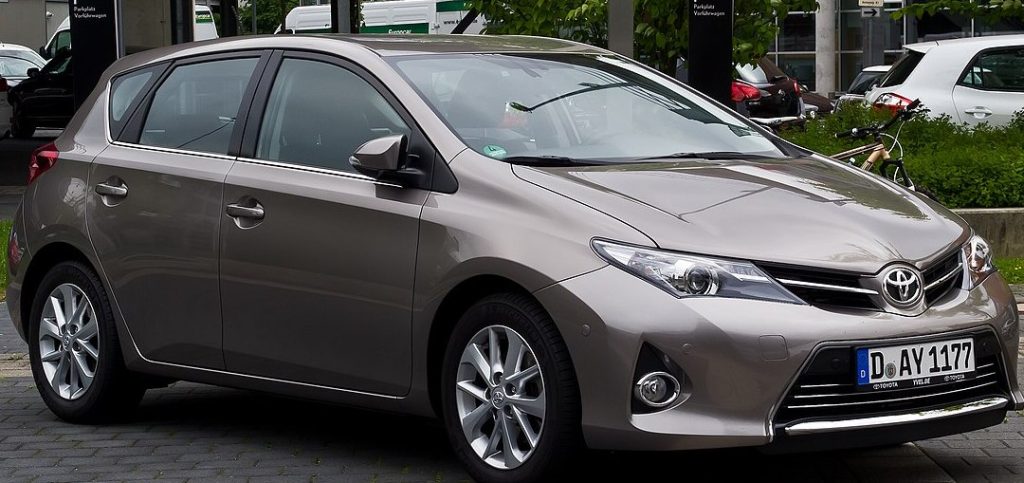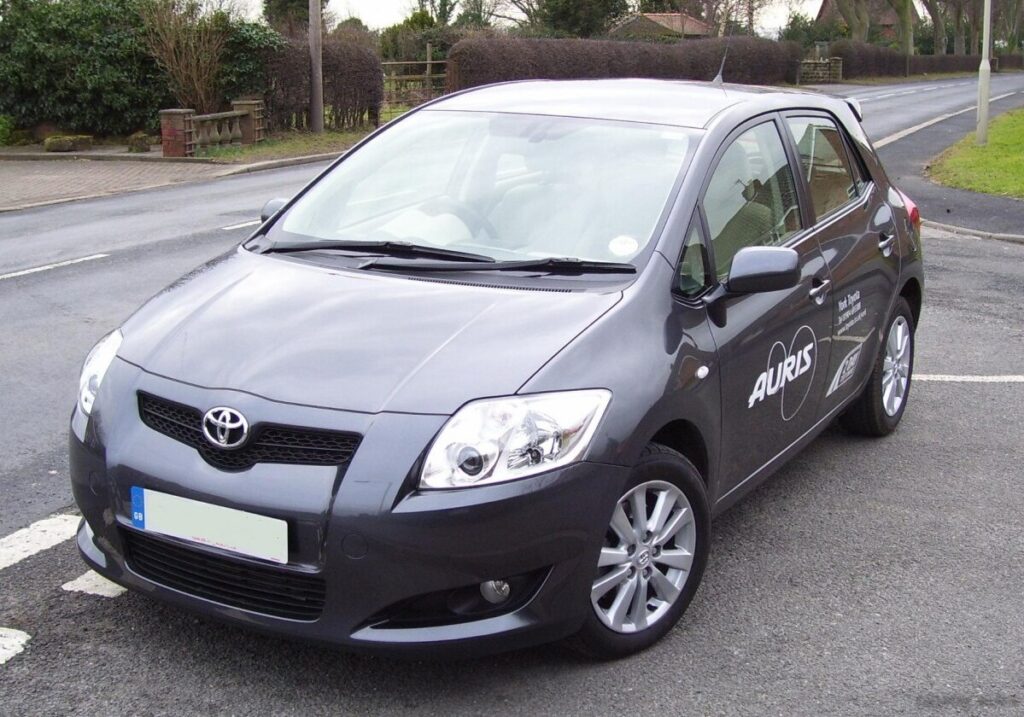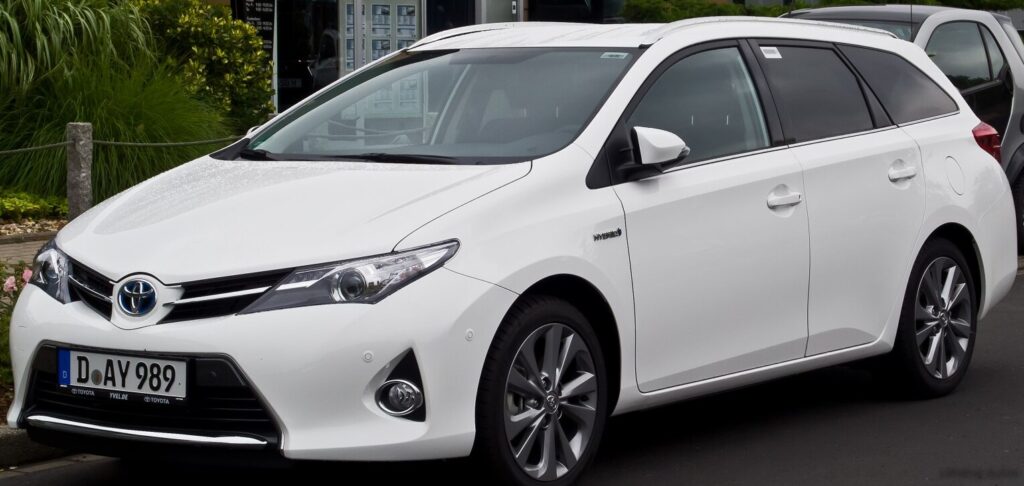
The Toyota Auris II Touring Sports 1.33 Dual VVT-i, produced from 2012 to 2015, was a practical and fuel-efficient station wagon aimed at the European market. Part of the E180 series Auris, the Touring Sports (estate) body style offered increased cargo capacity compared to the hatchback version. This particular variant, equipped with the 1NR-FE 1.33-liter engine producing 100 horsepower, served as an entry-level option within the Auris II lineup, prioritizing affordability and economy over outright performance. It was positioned below the 1.6L Valvematic and diesel variants, appealing to buyers seeking a no-frills, reliable family vehicle.
Technical Specifications
| Brand | Toyota |
| Model | Auris |
| Generation | Auris II Touring Sports |
| Type (Engine) | 1.33 Dual VVT-i (100 Hp) |
| Start of production | 2012 |
| End of production | 2015 |
| Powertrain Architecture | Internal Combustion engine |
| Body type | Station wagon (estate) |
| Seats | 5 |
| Doors | 5 |
| Fuel consumption (urban) | 7.1 l/100 km (33.1 US mpg) |
| Fuel consumption (extra urban) | 4.8 l/100 km (49 US mpg) |
| Fuel consumption (combined) | 5.6 l/100 km (42 US mpg) |
| Fuel Type | Petrol (Gasoline) |
| Acceleration 0 – 100 km/h | 13.2 sec |
| Acceleration 0 – 62 mph | 13.2 sec |
| Acceleration 0 – 60 mph | 12.5 sec |
| Maximum speed | 175 km/h (108.74 mph) |
| Emission standard | Euro 5 J |
| Weight-to-power ratio | 11.8 kg/Hp |
| Weight-to-torque ratio | 9.2 kg/Nm |
| Power | 100 Hp @ 6000 rpm |
| Torque | 128 Nm @ 3800-3800 rpm (94.41 lb.-ft.) |
| Engine layout | Front, Transverse |
| Engine Model/Code | 1NR-FE |
| Engine displacement | 1329 cm3 (81.1 cu. in.) |
| Number of cylinders | 4 |
| Engine configuration | Inline |
| Cylinder Bore | 72.5 mm (2.85 in.) |
| Piston Stroke | 80.5 mm (3.17 in.) |
| Compression ratio | 11.5:1 |
| Number of valves per cylinder | 4 |
| Fuel injection system | Multi-port manifold injection |
| Engine aspiration | Naturally aspirated engine |
| Valvetrain | DOHC – Dual VVT-i |
| Engine oil capacity | 3.4 l (3.59 US qt | 2.99 UK qt) |
| Coolant capacity | 5.7 l (6.02 US qt | 5.02 UK qt) |
| Kerb Weight | 1175 kg (2590.43 lbs.) |
| Max. weight | 1765 kg (3891.16 lbs.) |
| Max load | 590 kg (1300.73 lbs.) |
| Trunk (boot) space – minimum | 530 l (18.72 cu. ft.) |
| Fuel tank capacity | 50 l (13.21 US gal | 11 UK gal) |
| Length | 4560 mm (179.53 in.) |
| Width | 1760 mm (69.29 in.) |
| Height | 1460 mm (57.48 in.) |
| Wheelbase | 2600 mm (102.36 in.) |
| Front track | 1535 mm (60.43 in.) |
| Rear track | 1535 mm (60.43 in.) |
| Minimum turning circle | 10.4 m (34.12 ft.) |
| Drivetrain Architecture | Front wheel drive |
| Number of gears | 6 gears, manual transmission |
| Front suspension | Independent, type McPherson with coil spring and anti-roll bar |
| Rear suspension | Torsion |
| Front brakes | Ventilated discs |
| Rear brakes | Disc |
| Assisting systems | ABS (Anti-lock braking system) |
| Steering type | Steering rack and pinion |
INTRODUCTION
The Toyota Auris II Touring Sports, launched in 2012, represented Toyota’s attempt to capture a larger share of the European compact estate market. Building upon the success of the Auris hatchback, the Touring Sports offered a more practical alternative with a significantly larger cargo area. The 1.33 Dual VVT-i variant was a key component of the range, designed to appeal to budget-conscious buyers who prioritized fuel efficiency and low running costs. It was built on the Toyota New Global Architecture (TNGA) platform, though the initial E180 series Auris predated the full implementation of TNGA. This model year was a transitional period for Toyota, incorporating updated styling and improved interior materials compared to the first generation Auris.
Powertrain & Engine Architecture
The heart of the Auris II Touring Sports 1.33 was the 1NR-FE engine, a 1.328-liter (81.1 cubic inches) inline-four cylinder gasoline engine. This engine featured Toyota’s Dual VVT-i (Variable Valve Timing-intelligent) technology, which optimized valve timing on both the intake and exhaust sides for improved efficiency and power delivery. The 1NR-FE utilized multi-port fuel injection and a compression ratio of 11.5:1. The engine produced 100 horsepower at 6000 rpm and 128 Nm (94.41 lb-ft) of torque between 3800 and 3800 rpm. The engine was paired with a six-speed manual transmission, which was the standard offering for this trim level. The transmission was chosen for its balance of fuel efficiency and driver engagement, although an optional Multidrive S continuously variable transmission (CVT) was available.
Driving Characteristics
The 1.33L engine, while adequate for everyday driving, wasn’t known for its blistering performance. Acceleration from 0 to 62 mph (0-100 km/h) took around 13.2 seconds, and the top speed was 175 km/h (108.74 mph). The six-speed manual transmission helped to keep the engine in its optimal power band, but drivers often needed to downshift for overtaking maneuvers. Compared to the 1.6L Valvematic engine, the 1.33 felt noticeably less powerful, especially when fully loaded. However, the 1.33 offered a smoother and more linear power delivery, making it easier to drive in urban environments. The suspension provided a comfortable ride, prioritizing passenger comfort over sporty handling.
Equipment & Trim Levels
The 1.33 Dual VVT-i trim typically came with a reasonable level of standard equipment. This included air conditioning, power steering, electric front windows, a CD player with auxiliary input, and ABS brakes. Safety features such as multiple airbags and stability control were also standard. Higher trim levels offered upgrades like alloy wheels, a touchscreen infotainment system, rear parking sensors, and climate control. Interior upholstery was typically cloth, with a functional and durable design. The dashboard layout was straightforward and easy to use, with a focus on ergonomics.
Chassis & Braking
The Auris II Touring Sports utilized a McPherson strut front suspension and a torsion beam rear suspension. This setup provided a good balance of ride comfort and handling. The front brakes were ventilated discs, while the rear brakes were solid discs. ABS (Anti-lock Braking System) was standard, enhancing braking performance and safety. The steering was a rack and pinion system, providing precise and responsive steering feel. The weight distribution was relatively balanced, contributing to stable handling characteristics.
Market Reception & Comparison
The Auris II Touring Sports 1.33 Dual VVT-i was generally well-received by critics for its fuel efficiency, practicality, and reliability. However, some reviewers noted its lack of outright performance and somewhat basic interior. Compared to rivals like the Volkswagen Golf Estate and Ford Focus Estate, the Auris offered a more affordable price point but lacked the same level of refinement. Fuel economy was a strong point, with combined figures around 5.6 l/100 km (42 US mpg), making it an attractive option for drivers covering long distances. Reliability was also a key strength, with Toyota’s reputation for building durable and dependable vehicles.
Legacy
The Toyota Auris II Touring Sports 1.33 Dual VVT-i remains a popular choice in the used car market, particularly for buyers seeking a reliable and economical estate car. The 1NR-FE engine is known for its longevity and relatively low maintenance costs. While not the most exciting car to drive, it offers a practical and dependable solution for families and individuals who prioritize fuel efficiency and affordability. Common issues are relatively minor, often relating to wear and tear on suspension components or routine maintenance items. The Auris II Touring Sports, in general, has established a reputation as a solid and dependable vehicle, contributing to Toyota’s continued success in the European market.