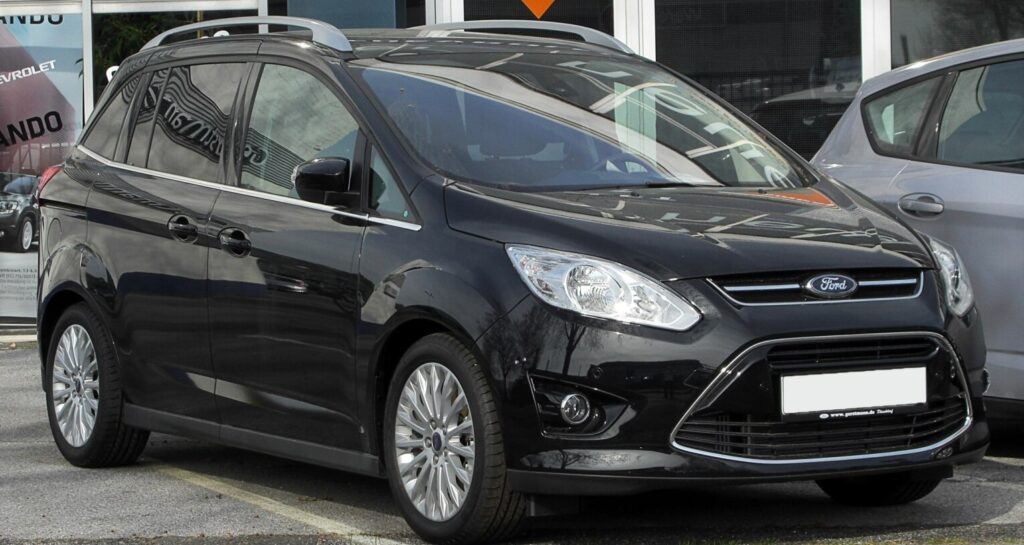
The Ford Grand C-MAX 2.0 Duratorq TDCi with 163 horsepower and a six-speed automatic transmission was a significant offering in the European and, to a lesser extent, North American MPV (Multi-Purpose Vehicle) market from 2010 to 2015. Positioned as a mid-range to upper-mid-range trim within the Grand C-MAX lineup, it catered to families needing seven-passenger capability combined with reasonable fuel efficiency and performance. This variant represented Ford’s attempt to balance practicality, economy, and driving enjoyment in a competitive segment. It was built on the C2 platform, shared with the Ford Focus, and aimed to provide a more spacious and versatile alternative to traditional compact vans.
Technical Specifications
| Brand | Ford |
| Model | C-MAX |
| Generation | Grand C-MAX |
| Type (Engine) | 2.0 Duratorq TDCi (163 Hp) DPF Automatic |
| Start of production | 2010 |
| End of production | 2015 |
| Powertrain Architecture | Internal Combustion engine |
| Body type | MPV |
| Seats | 7 |
| Doors | 5 |
| Fuel consumption (urban) | 7.1 l/100 km (33.1 US mpg) |
| Fuel consumption (extra urban) | 4.9 l/100 km (48 US mpg) |
| Fuel consumption (combined) | 5.7 l/100 km (41.3 US mpg) |
| CO2 emissions | 149 g/km |
| Fuel Type | Diesel |
| Acceleration 0 – 100 km/h | 9.8 sec |
| Acceleration 0 – 62 mph | 9.8 sec |
| Acceleration 0 – 60 mph | 9.3 sec |
| Maximum speed | 204 km/h (126.76 mph) |
| Emission standard | Euro 5 |
| Weight-to-power ratio | 10 kg/Hp |
| Weight-to-torque ratio | 4.8 kg/Nm |
| Power | 163 Hp |
| Torque | 340 Nm (250.77 lb.-ft.) |
| Engine layout | Front, Transverse |
| Engine Model/Code | TXDB |
| Engine configuration | Inline |
| Fuel injection system | Diesel Commonrail |
| Engine aspiration | Turbocharger, Intercooler |
| Engine oil capacity | 5.7 l (6.02 US qt) |
| Coolant capacity | 8.5 l (8.98 US qt) |
| Kerb Weight | 1634 kg (3602.35 lbs.) |
| Max. weight | 2300 kg (5070.63 lbs.) |
| Max load | 666 kg (1468.28 lbs.) |
| Trunk (boot) space – minimum | 56 l (1.98 cu. ft.) |
| Trunk (boot) space – maximum | 1706 l (60.25 cu. ft.) |
| Fuel tank capacity | 60 l (15.85 US gal) |
| Length | 4520 mm (177.95 in.) |
| Width | 1828 mm (71.97 in.) |
| Height | 1684 mm (66.3 in.) |
| Minimum turning circle | 11.2 m (36.75 ft.) |
| Drivetrain | Front wheel drive |
| Number of gears | 6 |
| Gearbox type | Automatic transmission |
Powertrain & Engine Architecture
The heart of this Grand C-MAX variant is the 2.0-liter Duratorq TDCi diesel engine, specifically the TXDB engine code. This engine is a four-cylinder, inline diesel featuring common-rail direct injection and a variable geometry turbocharger with intercooling. The common-rail system, operating at very high pressures, allows for precise fuel metering and optimized combustion, contributing to both power and efficiency. The turbocharger helps to overcome the inherent limitations of diesel engines by forcing more air into the cylinders, boosting power output. The engine utilizes a 16-valve DOHC (Double Overhead Camshaft) valvetrain. Paired with this engine is a six-speed automatic transmission, a crucial component for appealing to a broader customer base seeking convenience over the engagement of a manual gearbox. This transmission was designed to provide smooth shifts and efficient power delivery, although it wasn’t known for being particularly sporty.
Driving Characteristics
The 163 horsepower and 340 Nm (250.77 lb-ft) of torque provided by the 2.0 Duratorq TDCi engine, when coupled with the six-speed automatic, resulted in a respectable, if not exhilarating, driving experience. Acceleration from 0-60 mph in around 9.3 seconds was adequate for everyday driving and highway merging. The automatic transmission, while smooth, did exhibit some typical characteristics of older torque-converter automatics – a slight delay in response and a tendency to hunt for gears in certain situations. Compared to the manual transmission versions of the same engine, the automatic offered less direct control and a slightly diminished sense of connection to the vehicle. However, it was significantly more convenient for urban driving and long journeys. Compared to the higher-output 170 hp version, the 163 hp model offered a slight fuel economy advantage, but at the cost of some performance.
Equipment & Trim Levels
The Grand C-MAX 2.0 Duratorq TDCi Automatic typically came equipped with a reasonable level of standard features. These included air conditioning, power windows and mirrors, a basic audio system with CD player, and ABS brakes. Higher trim levels, such as Titanium, added features like alloy wheels, automatic headlights and wipers, a more advanced audio system with Bluetooth connectivity, and parking sensors. Interior upholstery was typically cloth, with options for leather upgrades. The seven-seat configuration was standard, with the third-row seats folding flat into the floor when not in use, maximizing cargo space. Optional extras included a panoramic sunroof, navigation system, and rear entertainment system.
Chassis & Braking
The Grand C-MAX utilized a MacPherson strut front suspension and a multi-link rear suspension, providing a comfortable ride and decent handling characteristics. The suspension was tuned for comfort rather than outright sportiness, prioritizing ride quality over sharp cornering. Braking systems varied depending on the trim level, with lower trims often featuring disc brakes on the front and drum brakes on the rear. Higher trims typically had disc brakes all around. Anti-lock Braking System (ABS) was standard across the range. Stabilizer bars were fitted front and rear to reduce body roll during cornering.
Market Reception & Comparison
The Ford Grand C-MAX 2.0 Duratorq TDCi Automatic was generally well-received by automotive critics. It was praised for its spacious interior, versatile seating configuration, and reasonable fuel economy. However, some critics noted that the automatic transmission wasn’t as responsive as some competitors, and the interior materials weren’t quite as premium as those found in some other MPVs. Compared to other diesel-powered MPVs like the Volkswagen Touran or Renault Scenic, the Grand C-MAX offered a competitive package in terms of price, space, and fuel efficiency. The 1.6-liter diesel versions of the C-MAX were more fuel-efficient but offered significantly less performance, making the 2.0-liter a better choice for those who frequently carried a full load of passengers or traveled long distances.
Legacy
The 2.0 Duratorq TDCi engine, in various iterations, proved to be a relatively reliable powertrain. While not immune to issues like diesel particulate filter (DPF) clogging (a common problem with modern diesels), the engine itself was generally robust. The six-speed automatic transmission, while not the most advanced, also proved to be reasonably durable. Today, used examples of the Grand C-MAX 2.0 Duratorq TDCi Automatic can be found at affordable prices. They represent a practical and economical choice for families needing a spacious and versatile vehicle, but potential buyers should be aware of the potential for DPF issues and ensure that the vehicle has been properly maintained.