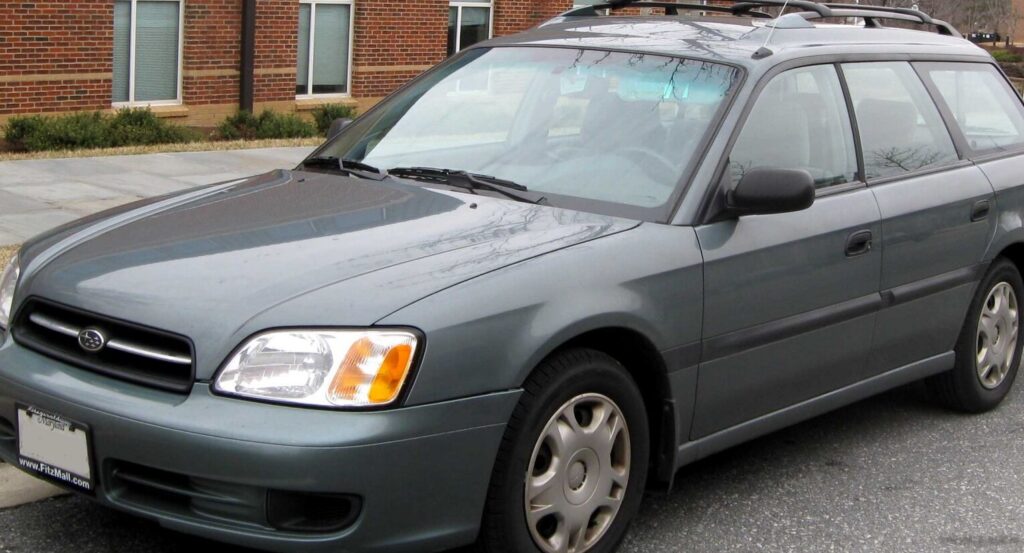
The Subaru Legacy III Station Wagon, specifically the 2.5-liter, 156 horsepower, all-wheel-drive variant (chassis codes BE/BH), was produced between 1998 and 2001. This model represented Subaru’s continued commitment to offering practical, reliable, and capable vehicles, particularly in markets where all-weather capability was highly valued. Positioned as a mid-range offering within the Legacy wagon lineup, it bridged the gap between the more economical 2.2-liter models and the performance-oriented turbocharged variants. The BE/BH generation marked a significant step forward in refinement and interior space compared to its predecessor, the Legacy II.
Technical Specifications
| Brand | Subaru |
| Model | Legacy |
| Generation | Legacy III Station Wagon (BE,BH) |
| Type (Engine) | 2.5 (156 Hp) AWD |
| Start of production | 1998 |
| End of production | 2001 |
| Powertrain Architecture | Internal Combustion engine |
| Body type | Station wagon (estate) |
| Seats | 5 |
| Doors | 5 |
| Fuel consumption (urban) | 12.5 l/100 km (18.8 US mpg, 22.6 UK mpg, 8 km/l) |
| Fuel consumption (extra urban) | 7.2 l/100 km (32.7 US mpg, 39.2 UK mpg, 13.9 km/l) |
| Fuel consumption (combined) | 9.1 l/100 km (25.8 US mpg, 31 UK mpg, 11 km/l) |
| CO2 emissions | 220 g/km |
| Fuel Type | Petrol (Gasoline) |
| Acceleration 0 – 100 km/h | 9.3 sec |
| Acceleration 0 – 62 mph | 9.3 sec |
| Acceleration 0 – 60 mph | 8.8 sec |
| Maximum speed | 203 km/h (126.14 mph) |
| Weight-to-power ratio | 9.3 kg/Hp, 108 Hp/tonne |
| Weight-to-torque ratio | 6.5 kg/Nm, 154.3 Nm/tonne |
| Power | 156 Hp @ 5600 rpm |
| Power per litre | 63.5 Hp/l |
| Torque | 223 Nm @ 3600 rpm (164.48 lb.-ft. @ 3600 rpm) |
| Engine layout | Front, Longitudinal |
| Engine Model/Code | EJ25 |
| Engine displacement | 2457 cm3 (149.94 cu. in.) |
| Number of cylinders | 4 |
| Engine configuration | Boxer |
| Cylinder Bore | 99.5 mm (3.92 in.) |
| Piston Stroke | 79 mm (3.11 in.) |
| Compression ratio | 10:1 |
| Number of valves per cylinder | 4 |
| Fuel injection system | Multi-port manifold injection |
| Engine aspiration | Naturally aspirated engine |
| Valvetrain | SOHC |
| Engine oil capacity | 4.5 l (4.76 US qt | 3.96 UK qt) |
| Coolant | 6.8 l (7.19 US qt | 5.98 UK qt) |
| Kerb Weight | 1445 kg (3185.68 lbs.) |
| Max. weight | 1980 kg (4365.15 lbs.) |
| Max load | 535 kg (1179.47 lbs.) |
| Trunk (boot) space – minimum | 528 l (18.65 cu. ft.) |
| Trunk (boot) space – maximum | 1646 l (58.13 cu. ft.) |
| Fuel tank capacity | 64 l (16.91 US gal | 14.08 UK gal) |
| Length | 4680 mm (184.25 in.) |
| Width | 1695 mm (66.73 in.) |
| Height | 1515 mm (59.65 in.) |
| Wheelbase | 2650 mm (104.33 in.) |
| Front track | 1460 mm (57.48 in.) |
| Rear (Back) track | 1455 mm (57.28 in.) |
| Ride height (ground clearance) | 165-155 mm (6.5 – 6.1 in.) |
| Minimum turning circle (turning diameter) | 11.5 m (37.73 ft.) |
| Drive wheel | All wheel drive (4×4) |
| Number of gears and type of gearbox | 5 gears, manual transmission |
| Front suspension | Independent type McPherson |
| Rear suspension | Independent multi-link suspension |
| Front brakes | Ventilated discs |
| Rear brakes | Disc |
| Assisting systems | ABS (Anti-lock braking system) |
| Steering type | Steering rack and pinion |
| Power steering | Hydraulic Steering |
| Tires size | 205/50 R16 |
| Wheel rims size | 6.5J x 16 |
Powertrain & Engine Architecture
The heart of this Legacy variant is the EJ25 2.5-liter naturally aspirated boxer-four engine. Subaru’s horizontally-opposed “boxer” configuration, where pistons move horizontally rather than vertically, provides inherent balance, reducing vibrations and contributing to a smoother driving experience. The EJ25 featured a single overhead camshaft (SOHC) design, operating four valves per cylinder. Fuel delivery was managed by a multi-port fuel injection system. This engine produced 156 horsepower at 5600 rpm and 223 Nm (164.48 lb-ft) of torque at 3600 rpm. The engine’s longitudinal mounting and the standard all-wheel-drive system contributed to the Legacy’s balanced handling characteristics. The five-speed manual transmission was the standard offering, providing direct control over the engine’s power.
Driving Characteristics
The 2.5-liter engine, paired with the five-speed manual transmission, offered a respectable level of performance for its time. Acceleration from 0-60 mph took approximately 8.8 seconds, and top speed was around 126 mph. While not a sports car, the Legacy provided sufficient power for everyday driving and highway cruising. The all-wheel-drive system instilled confidence in various weather conditions, providing enhanced traction and stability. Compared to the lower-powered 2.2-liter models, the 2.5-liter offered a noticeable improvement in responsiveness and overall driving enjoyment. However, it lacked the outright acceleration of the turbocharged variants. The manual transmission provided a more engaging driving experience than the optional four-speed automatic, which could feel somewhat sluggish.
Equipment & Trim Levels
The 2.5-liter AWD Legacy Wagon typically came with a reasonable level of standard equipment. This included power windows, power locks, air conditioning, and an AM/FM stereo. Higher trim levels offered features such as a sunroof, upgraded audio systems, leather upholstery, and alloy wheels. Interior materials were generally durable and functional, reflecting the Legacy’s focus on practicality. The dashboard layout was straightforward and user-friendly, with clearly labeled controls. Optional extras included a CD player, cruise control, and heated front seats.
Chassis & Braking
The Legacy III utilized an independent McPherson strut suspension in the front and an independent multi-link suspension in the rear. This setup provided a comfortable ride while maintaining good handling characteristics. The car was equipped with ventilated disc brakes in the front and solid disc brakes in the rear. Anti-lock braking system (ABS) was standard, enhancing safety by preventing wheel lockup during hard braking. The steering was rack-and-pinion with hydraulic power assistance, providing precise and responsive steering feel.
Market Reception & Comparison
The Subaru Legacy III Station Wagon, particularly the 2.5-liter AWD variant, was well-received by automotive critics for its practicality, reliability, and all-weather capability. It was often praised for its spacious interior, comfortable ride, and standard all-wheel-drive system. Fuel economy was considered average for its class, with combined fuel consumption around 25.8 US mpg. Compared to competitors like the Toyota Camry Wagon or Honda Accord Wagon, the Legacy offered a unique combination of features and performance, particularly its standard all-wheel drive. The 2.2-liter models were more affordable but lacked the power of the 2.5-liter, while the turbocharged variants were more expensive and targeted a different audience.
Legacy
The EJ25 engine, in its various iterations, proved to be a durable and reliable powerplant. While not immune to issues like head gasket failures (a common concern with early EJ-series engines), the EJ25 generally offered good long-term reliability with proper maintenance. Today, the BE/BH Legacy Wagon, especially well-maintained examples, holds a modest following among enthusiasts who appreciate its practicality, all-wheel-drive capability, and classic Subaru character. Parts availability remains relatively good, making it a viable option for those seeking a reliable and affordable used wagon. The 2.5-liter engine’s relatively simple design makes it easier to maintain and repair compared to more complex modern powertrains.