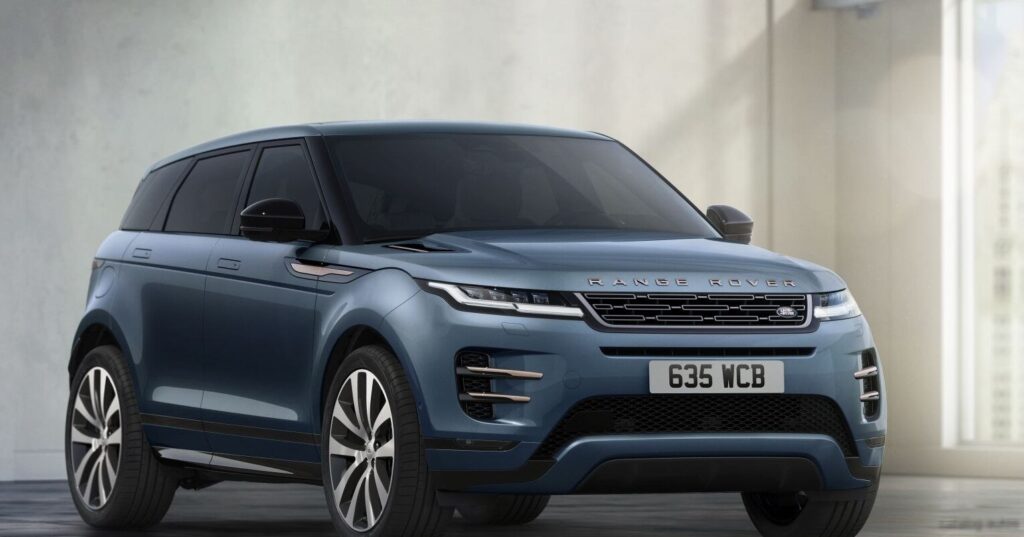
The Land Rover Range Rover Evoque II (facelift 2023) 2.0 D165 represents a key variant within the updated second-generation Evoque lineup, launched in June 2023. Positioned as a more accessible entry point into the Evoque range, this model combines a 2.0-liter turbocharged diesel engine producing 163 horsepower with a front-wheel-drive configuration. It caters to buyers prioritizing fuel efficiency and a lower price point within the premium compact SUV segment. The facelift brought styling updates and enhanced technology, but the D165 maintained the core appeal of the Evoque – a stylish and capable vehicle with a focus on design and modern features.
Technical Specifications
| Brand | Land Rover |
| Model | Range Rover Evoque |
| Generation | Range Rover Evoque II (facelift 2023) |
| Type (Engine) | 2.0 D165 (163 Hp) |
| Start of production | June, 2023 |
| Powertrain Architecture | Internal Combustion engine |
| Body type | SUV |
| Seats | 5 |
| Doors | 5 |
| Combined fuel consumption (WLTP) | 6-6.3 l/100 km (39.2 – 37.3 US mpg, 47.1 – 44.8 UK mpg, 16.7 – 15.9 km/l) |
| CO2 emissions (WLTP) | 156-166 g/km |
| Fuel consumption (economy) – combined (NEDC) | 5 l/100 km (47 US mpg, 56.5 UK mpg, 20 km/l) |
| CO2 emissions (NEDC) | 131 g/km |
| Fuel Type | Diesel |
| Acceleration 0 – 100 km/h | 10.1 sec |
| Acceleration 0 – 62 mph | 10.1 sec |
| Acceleration 0 – 60 mph | 9.5 sec |
| Maximum speed | 206 km/h (128 mph) |
| Emission standard | Euro 6d |
| Weight-to-power ratio | 10.5 kg/Hp, 95.2 Hp/tonne |
| Weight-to-torque ratio | 4.5 kg/Nm, 222 Nm/tonne |
| Power | 163 Hp @ 3750 rpm |
| Power per litre | 81.6 Hp/l |
| Torque | 380 Nm @ 1500-2500 rpm (280.27 lb.-ft. @ 1500-2500 rpm) |
| Engine layout | Front, Transverse |
| Engine Model/Code | Ingenium |
| Engine displacement | 1997 cm3 (121.86 cu. in.) |
| Number of cylinders | 4 |
| Engine configuration | Inline |
| Cylinder Bore | 83 mm (3.27 in.) |
| Piston Stroke | 92.31 mm (3.63 in.) |
| Compression ratio | 16.5:1 |
| Number of valves per cylinder | 4 |
| Fuel injection system | Diesel Commonrail |
| Engine aspiration | Turbocharger, Intercooler |
| Valvetrain | DOHC |
| Engine systems | Start & Stop System, Particulate filter |
| Kerb Weight | 1712 kg (3774.31 lbs.) |
| Trunk (boot) space – minimum | 591 l (20.87 cu. ft.) |
| Trunk (boot) space – maximum | 1383 l (48.84 cu. ft.) |
| Fuel tank capacity | 65 l (17.17 US gal | 14.3 UK gal) |
| AdBlue tank | 17.3 l (4.57 US gal | 3.81 UK gal) |
| Permitted trailer load with brakes (12%) | 1600 kg (3527.4 lbs.) |
| Permitted trailer load without brakes | 750 kg (1653.47 lbs.) |
| Length | 4371 mm (172.09 in.) |
| Width with mirrors folded | 1996 mm (78.58 in.) |
| Width including mirrors | 2100 mm (82.68 in.) |
| Height | 1649 mm (64.92 in.) |
| Wheelbase | 2681 mm (105.55 in.) |
| Front track | 1625 mm (63.98 in.) |
| Rear (Back) track | 1632 mm (64.25 in.) |
| Front overhang | 880 mm (34.65 in.) |
| Rear overhang | 810 mm (31.89 in.) |
| Ride height (ground clearance) | 212 mm (8.35 in.) |
| Drag coefficient (Cd) | 0.32 |
| Minimum turning circle (turning diameter) | 11.6 m (38.06 ft.) |
| Approach angle | 22.2° |
| Departure angle | 30.6° |
| Ramp-over (brakeover) angle | 20.7° |
| Wading depth | 530 mm (20.87 in.) |
| Drivetrain Architecture | The Internal combustion engine (ICE) drives the front wheels of the vehicle. |
| Drive wheel | Front wheel drive |
| Number of gears and type of gearbox | 6 gears, manual transmission |
| Front suspension | Independent, type McPherson with coil spring and anti-roll bar |
| Rear suspension | Independent multi-link spring suspension with stabilizer |
| Front brakes | Ventilated discs, 349 mm |
| Rear brakes | Disc, 300 mm |
| Assisting systems | ABS (Anti-lock braking system) |
| Steering type | Steering rack and pinion |
| Power steering | Electric Steering |
| Wheel rims size | 18; 19; 20; 21 |
INTRODUCTION
The 2023 Range Rover Evoque II D165 is a front-wheel-drive variant of the second-generation Evoque, which itself is built on the Premium Transverse Architecture (PTA) platform – Land Rover’s architecture designed for compact SUVs. Introduced as part of the facelift in June 2023, this model aimed to broaden the Evoque’s appeal by offering a more economical and accessible option. The D165 distinguishes itself from higher-spec Evoques through its engine output and drivetrain, targeting buyers who prioritize style and efficiency over outright performance. It slots into the lineup below the all-wheel-drive D200 and P300 models, offering a more budget-friendly entry point into the Range Rover family.
Powertrain & Engine Architecture
At the heart of the D165 is Land Rover’s Ingenium engine family, specifically the 2.0-liter four-cylinder turbocharged diesel (code: 16D200). This engine utilizes a common-rail direct injection system, delivering fuel at extremely high pressure for optimized combustion. The engine features a single turbocharger with an intercooler to enhance power and efficiency. The DOHC (Double Overhead Camshaft) valvetrain, with four valves per cylinder, contributes to efficient gas exchange. The engine is paired with a 6-speed manual transmission, sending power to the front wheels. This configuration prioritizes fuel economy over rapid acceleration. The Ingenium engine also incorporates a particulate filter to meet stringent Euro 6d emission standards, and a start/stop system further reduces fuel consumption in urban driving conditions.
Driving Characteristics
The 163 horsepower and 380 Nm (280 lb-ft) of torque delivered by the D165 powertrain provide adequate, but not exhilarating, performance. Acceleration from 0-60 mph takes around 9.5 seconds, and the top speed is 128 mph. The front-wheel-drive setup results in a noticeable difference in handling compared to the all-wheel-drive variants. While offering good grip in normal conditions, it lacks the traction and stability of its AWD siblings, particularly on slippery surfaces. The 6-speed manual transmission offers a reasonably engaging driving experience, but the gear ratios are tuned for fuel efficiency rather than sporty performance. Power delivery is linear, with peak torque available from 1500-2500 rpm, making it suitable for everyday driving and overtaking maneuvers. Compared to the more powerful D200, the D165 feels less responsive, especially at higher speeds.
Equipment & Trim Levels
The D165 typically comes with a generous level of standard equipment, reflecting its premium positioning. Standard features generally include LED headlights, a touchscreen infotainment system with Apple CarPlay and Android Auto compatibility, automatic climate control, and a suite of safety features such as autonomous emergency braking and lane keep assist. Interior upholstery is typically cloth or a combination of cloth and leatherette. Higher trim levels offer upgrades such as leather seats, a panoramic sunroof, and a premium sound system. Optional extras include adaptive cruise control, a head-up display, and various styling packages.
Chassis & Braking
The Evoque D165 utilizes an independent McPherson strut suspension at the front and an independent multi-link suspension at the rear, providing a comfortable ride quality. Stabilizer bars are fitted to both axles to reduce body roll during cornering. The braking system consists of ventilated discs at the front (349mm) and solid discs at the rear (300mm). ABS (Anti-lock Braking System) is standard, enhancing braking performance and stability. The front-wheel-drive configuration and lower weight compared to AWD models contribute to slightly improved fuel efficiency and reduced unsprung mass.
Market Reception & Comparison
The Range Rover Evoque D165 was generally well-received by critics as a stylish and efficient option within the compact SUV segment. However, some reviewers noted that the front-wheel-drive configuration and lower power output didn’t fully capture the Range Rover’s traditional all-terrain capabilities. Compared to the D200 and P300 models, the D165 offered significantly better fuel economy, achieving between 37.3 and 39.2 US mpg (combined WLTP). Its lower price point made it an attractive option for buyers prioritizing value and efficiency. However, the lack of all-wheel drive limited its appeal to those seeking a more capable vehicle for challenging conditions.
Legacy
The Ingenium engine family has proven to be relatively reliable, with the 2.0-liter diesel demonstrating good longevity when properly maintained. The D165 variant, while not as sought-after as the higher-performance models, represents a practical and economical entry point into Range Rover ownership. On the used car market, these models typically command lower prices than their AWD counterparts, making them an attractive option for budget-conscious buyers. Regular servicing, including oil changes and filter replacements, is crucial for maintaining the engine’s performance and reliability. The front-wheel-drive configuration simplifies maintenance compared to the more complex AWD systems found in other Evoque models.