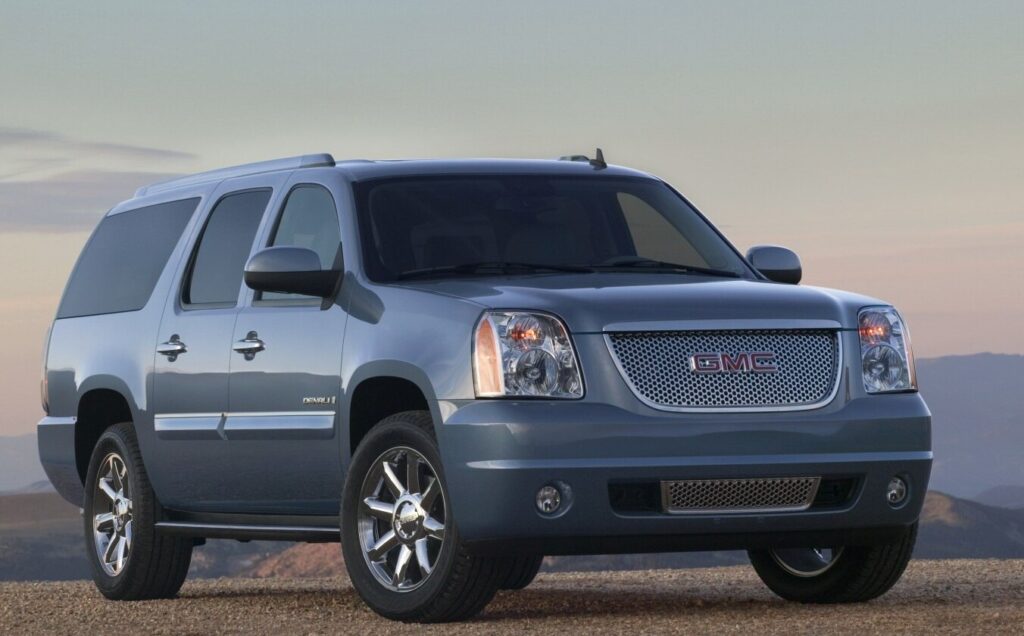
The GMC Yukon XL III, produced between 2007 and 2009, represented the third generation of the extended-length Yukon full-size SUV. Built on the GMT900 platform, shared with Chevrolet and Cadillac counterparts, the Yukon XL aimed to provide substantial passenger and cargo space alongside capable towing capacity. This particular variant, equipped with the 5.3-liter LY5 V8 engine paired with a four-speed automatic transmission, occupied a middle ground within the Yukon XL lineup, offering a balance between performance, fuel economy, and price. It served as a popular choice for families and those requiring a versatile vehicle for both daily driving and occasional heavy-duty tasks.
Technical Specifications
| Brand | GMC |
| Model | Yukon XL |
| Generation | Yukon XL III (GMT900) |
| Type (Engine) | 5.3 i V8 16V (320 Hp) Automatic |
| Start of production | 2007 |
| End of production | 2009 |
| Powertrain Architecture | Internal Combustion engine |
| Body type | SUV |
| Seats | 9 |
| Doors | 5 |
| Fuel consumption (urban) | 16.8 l/100 km (14 US mpg, 16.8 UK mpg) |
| Fuel consumption (extra urban) | 11.8 l/100 km (19.9 US mpg, 23.9 UK mpg) |
| Fuel Type | Petrol (Gasoline) |
| Weight-to-power ratio | 8 kg/Hp, 125.5 Hp/tonne |
| Weight-to-torque ratio | 5.5 kg/Nm, 180.9 Nm/tonne |
| Power | 320 Hp @ 5200 rpm |
| Power per litre | 60.1 Hp/l |
| Torque | 461 Nm @ 4200 rpm (340.02 lb.-ft. @ 4200 rpm) |
| Engine layout | Front, Longitudinal |
| Engine Model/Code | LY5 |
| Engine displacement | 5327 cm3 (325.07 cu. in.) |
| Number of cylinders | 8 |
| Engine configuration | V-engine |
| Cylinder Bore | 96 mm (3.78 in.) |
| Piston Stroke | 92 mm (3.62 in.) |
| Compression ratio | 9.9:1 |
| Number of valves per cylinder | 2 |
| Fuel injection system | Multi-port manifold injection |
| Engine aspiration | Naturally aspirated engine |
| Engine oil capacity | 5.7 l (6.02 US qt | 5.02 UK qt) |
| Coolant | 17.3 l (18.28 US qt | 15.22 UK qt) |
| Kerb Weight | 2549 kg (5619.58 lbs.) |
| Max. weight | 3265 kg (7198.09 lbs.) |
| Max load | 716 kg (1578.51 lbs.) |
| Trunk (boot) space – minimum | 1297 l (45.8 cu. ft.) |
| Trunk (boot) space – maximum | 3891 l (137.41 cu. ft.) |
| Fuel tank capacity | 117 l (30.91 US gal | 25.74 UK gal) |
| Permitted trailer load with brakes (12%) | 3221 kg (7101.09 lbs.) |
| Length | 5648 mm (222.36 in.) |
| Width | 2010 mm (79.13 in.) |
| Height | 1950 mm (76.77 in.) |
| Wheelbase | 3302 mm (130 in.) |
| Front track | 1732 mm (68.19 in.) |
| Rear (Back) track | 1702 mm (67.01 in.) |
| Ride height (ground clearance) | 227 mm (8.94 in.) |
| Minimum turning circle (turning diameter) | 13.1 m (42.98 ft.) |
| Drive wheel | Rear wheel drive |
| Number of gears and type of gearbox | 4 gears, automatic transmission |
| Front suspension | Independent, type McPherson with coil spring and anti-roll bar |
| Rear suspension | Independent multi-link suspension, Coil spring |
| Front brakes | Disc, 330×30 mm |
| Rear brakes | Disc, 345×20 mm |
| Assisting systems | ABS (Anti-lock braking system) |
| Steering type | Steering rack and pinion |
| Power steering | Electric Steering |
| Tires size | 255/70 R17 |
| Wheel rims size | 7.5J x 17 |
Powertrain & Engine Architecture
The heart of this Yukon XL variant was the 5.3-liter LY5 V8 engine. This engine, a member of GM’s Vortec family, featured a cast iron block with aluminum cylinder heads. It utilized a 9.9:1 compression ratio and a multi-port fuel injection system to deliver a respectable 320 horsepower and 461 lb-ft of torque. The LY5 was known for its durability and relatively straightforward maintenance. The four-speed 4L60E automatic transmission was the standard pairing. While not the most modern transmission by the late 2000s, it was a proven unit capable of handling the engine’s output and the Yukon XL’s substantial weight. The transmission featured electronically controlled shifting, offering a degree of adaptability to driving conditions.
Driving Characteristics
The 5.3L V8 and four-speed automatic combination provided adequate, though not exhilarating, performance. Acceleration from 0 to 60 mph typically took around 7.5-8.5 seconds, depending on load and road conditions. The automatic transmission’s gear ratios were geared more towards towing and cruising comfort than outright speed. Compared to the available 6.2-liter V8, the 5.3L felt noticeably less powerful, particularly when fully loaded or climbing steep inclines. However, it offered a significant improvement in fuel economy. The 4L60E transmission, while reliable, could sometimes feel sluggish during downshifts, and lacked the smoothness of more modern transmissions.
Equipment & Trim Levels
The Yukon XL in this configuration typically came standard with features such as air conditioning, power windows and locks, a CD player, and cloth upholstery. Higher trim levels, like the SLT, added features like leather seats, heated front seats, a premium sound system, and tri-zone climate control. Optional extras included a navigation system, rear-seat entertainment system, and power-adjustable pedals. The interior design was functional and spacious, prioritizing practicality over luxury.
Chassis & Braking
The Yukon XL III utilized a body-on-frame construction, providing a robust platform for towing and off-road capability. The front suspension consisted of an independent McPherson strut setup with coil springs and an anti-roll bar. The rear suspension employed an independent multi-link design, also with coil springs. This setup aimed to balance ride comfort with handling stability. Braking duties were handled by disc brakes on all four wheels, with ABS as standard. The rear brakes were slightly smaller in diameter than the front brakes.
Market Reception & Comparison
Critics generally praised the Yukon XL for its spacious interior, comfortable ride, and strong towing capacity. However, the 5.3L V8/4-speed automatic combination received mixed reviews. Some found it adequate for most tasks, while others criticized its lack of refinement and relatively poor fuel economy compared to newer SUVs. Compared to the 6.2L V8 Yukon XL, the 5.3L offered a lower price point and better fuel efficiency, making it a more attractive option for budget-conscious buyers. Against competitors like the Ford Expedition and Chevrolet Suburban, the Yukon XL held its own in terms of space and capability, but often lagged behind in terms of fuel economy and interior refinement.
Legacy
The LY5 5.3L V8 engine proved to be a durable and reliable powerplant, and many examples are still on the road today. The 4L60E transmission, while not without its flaws, is also generally considered to be a robust unit. However, like all older vehicles, the Yukon XL III is prone to age-related issues such as rust, suspension wear, and electrical problems. In the used car market, these Yukon XLs represent a relatively affordable option for those needing a large SUV with towing capacity. They remain popular with families, contractors, and anyone requiring a versatile vehicle for work and play.