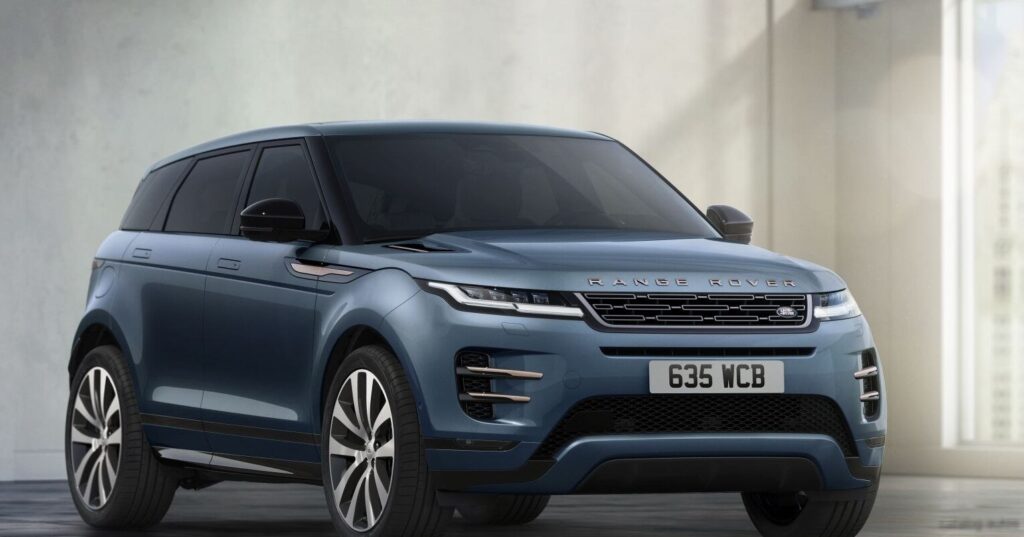
The Land Rover Range Rover Evoque II (facelift 2023) 2.0 P200 represents a mid-range offering within the second generation of the Evoque, launched in June 2023. Positioned as a blend of style, technology, and moderate performance, this variant utilizes a 2.0-liter turbocharged four-cylinder engine with mild hybrid assistance, paired with a nine-speed automatic transmission and all-wheel drive. It builds upon the success of the original Evoque, continuing Land Rover’s tradition of compact luxury SUVs with off-road capability. The facelift brought updated styling, improved interior technology, and refinements to the powertrain for enhanced efficiency and driveability. This model is primarily targeted towards buyers seeking a premium SUV experience with a focus on comfort and everyday usability, rather than outright performance.
Technical Specifications
| Brand | Land Rover |
| Model | Range Rover Evoque |
| Generation | Range Rover Evoque II (facelift 2023) |
| Type (Engine) | 2.0 P200 (200 Hp) Mild Hybrid AWD Automatic |
| Start of production | June, 2023 |
| Powertrain Architecture | MHEV (Mild Hybrid Electric Vehicle) |
| Body type | SUV |
| Seats | 5 |
| Doors | 5 |
| Combined fuel consumption (WLTP) | 8.6-9.3 l/100 km (27.4 – 25.3 US mpg) |
| CO2 emissions (WLTP) | 194-211 g/km |
| Fuel consumption (NEDC) – combined | 7.6 l/100 km (30.9 US mpg) |
| CO2 emissions (NEDC) | 172 g/km |
| Fuel Type | Petrol (Gasoline) |
| Acceleration 0 – 100 km/h | 8.6 sec |
| Acceleration 0 – 62 mph | 8.6 sec |
| Acceleration 0 – 60 mph | 8 sec |
| Maximum speed | 216 km/h (134.22 mph) |
| Emission standard | Euro 6d |
| Weight-to-power ratio | 8.9 kg/Hp, 113 Hp/tonne |
| Weight-to-torque ratio | 5.5 kg/Nm, 180.8 Nm/tonne |
| Gross battery capacity | 0.2 kWh |
| Battery voltage | 48 V |
| Battery technology | Lithium-ion (Li-Ion) |
| Battery location | Under the trunk |
| Electric motor | 1 |
| Electric motor location | Front, Transverse |
| Power | 200 Hp @ 5500 rpm |
| Torque | 320 Nm @ 1200-4000 rpm (236.02 lb.-ft. @ 1200-4000 rpm) |
| Engine layout | Front, Transverse |
| Engine Model/Code | Ingenium |
| Engine displacement | 1997 cm3 (121.86 cu. in.) |
| Number of cylinders | 4 |
| Engine configuration | Inline |
| Cylinder Bore | 83 mm (3.27 in.) |
| Piston Stroke | 92.29 mm (3.63 in.) |
| Compression ratio | 10.5:1 |
| Number of valves per cylinder | 4 |
| Fuel injection system | Direct injection |
| Engine aspiration | Twin-scroll turbo, Intercooler |
| Valvetrain | DOHC |
| Engine systems | Start & Stop System, Particulate filter |
| Kerb Weight | 1770 kg (3902.18 lbs.) |
| Max. weight | 2430 kg (5357.23 lbs.) |
| Max load | 660 kg (1455.05 lbs.) |
| Trunk (boot) space – minimum | 591 l (20.87 cu. ft.) |
| Trunk (boot) space – maximum | 1383 l (48.84 cu. ft.) |
| Fuel tank capacity | 67 l (17.7 US gal | 14.74 UK gal) |
| Max. roof load | 75 kg (165.35 lbs.) |
| Permitted trailer load with brakes (12%) | 1800 kg (3968.32 lbs.) |
| Permitted trailer load without brakes | 750 kg (1653.47 lbs.) |
| Permitted towbar download | 100 kg (220.46 lbs.) |
| Length | 4371 mm (172.09 in.) |
| Width with mirrors folded | 1996 mm (78.58 in.) |
| Width including mirrors | 2100 mm (82.68 in.) |
| Height | 1649 mm (64.92 in.) |
| Wheelbase | 2681 mm (105.55 in.) |
| Front track | 1625 mm (63.98 in.) |
| Rear (Back) track | 1632 mm (64.25 in.) |
| Front overhang | 880 mm (34.65 in.) |
| Rear overhang | 810 mm (31.89 in.) |
| Ride height (ground clearance) | 212 mm (8.35 in.) |
| Drag coefficient (Cd) | 0.33 |
| Minimum turning circle (turning diameter) | 11.6 m (38.06 ft.) |
| Approach angle | 22.2° |
| Departure angle | 30.6° |
| Ramp-over (brakeover) angle | 20.7° |
| Wading depth | 530 mm (20.87 in.) |
| Drivetrain Architecture | ICE and electric motor drive front wheels, rear drive via clutch |
| Drive wheel | All wheel drive (4×4) |
| Number of gears and type of gearbox | 9 gears, automatic transmission |
| Front suspension | Independent, McPherson with coil spring and anti-roll bar |
| Rear suspension | Independent multi-link spring suspension with stabilizer |
| Front brakes | Ventilated discs, 349 mm |
| Rear brakes | Disc, 300 mm |
| Assisting systems | ABS (Anti-lock braking system) |
| Steering type | Steering rack and pinion |
| Power steering | Electric Steering |
| Wheel rims size | 18; 19; 20; 21 |
Powertrain & Engine Architecture
The 2.0 P200 Evoque utilizes Land Rover’s Ingenium engine family, specifically a 2.0-liter turbocharged inline-four cylinder engine. This engine, designated as part of the Ingenium modular architecture, is designed for efficiency and scalability. The ‘P200’ designation indicates a power output of 200 horsepower at 5500 rpm and 320 Nm (236 lb-ft) of torque available from 1200 to 4000 rpm. The mild hybrid system incorporates a 48-volt electrical system and a belt-integrated starter generator (BiSG). This system allows for smoother start-stop operation, regenerative braking to recapture energy, and a small boost in power during acceleration. Fuel is delivered via direct injection, optimizing combustion efficiency. The engine features a twin-scroll turbocharger and intercooler to minimize turbo lag and maximize power output. The nine-speed automatic transmission, sourced from ZF, is a key component of the powertrain. It provides a wide range of gear ratios for both fuel efficiency and responsive acceleration. The transmission is electronically controlled and adapts to driving conditions and driver input.
Driving Characteristics
The 2.0 P200 Evoque offers a comfortable and refined driving experience. While not a performance-oriented variant, the 200 hp engine provides adequate power for everyday driving and highway cruising. Acceleration from 0-60 mph takes approximately 8 seconds. The nine-speed automatic transmission generally shifts smoothly, although some drivers may notice occasional hesitation. The mild hybrid system contributes to a more responsive feel during initial acceleration. Compared to higher-output Evoque models (like the P250 or P300), the P200 feels less eager to accelerate, particularly when fully loaded. However, it excels in fuel economy, offering a noticeable improvement over the more powerful engines. The all-wheel-drive system provides confident traction in various weather conditions, and the Evoque’s Terrain Response system allows drivers to optimize settings for different surfaces.
Equipment & Trim Levels
The 2.0 P200 typically comes well-equipped, reflecting Land Rover’s premium positioning. Standard features generally include leather upholstery, a touchscreen infotainment system with Apple CarPlay and Android Auto compatibility, navigation, automatic climate control, and a suite of driver-assistance systems such as lane departure warning, emergency braking, and front and rear parking sensors. Optional extras often include a panoramic sunroof, upgraded audio systems (Meridian), adaptive cruise control, and premium interior trim options. Trim levels vary by market, but generally, the P200 serves as a solid mid-range option, offering a good balance of features and price.
Chassis & Braking
The Evoque II utilizes a sophisticated chassis design focused on balancing on-road comfort with off-road capability. The front suspension employs McPherson struts with a coil spring and anti-roll bar, while the rear features an independent multi-link setup with a stabilizer bar. This configuration provides a comfortable ride and good handling characteristics. Braking duties are handled by ventilated discs at the front (349mm) and solid discs at the rear (300mm). The braking system is equipped with ABS (Anti-lock Braking System) and electronic brake-force distribution. The steering is electrically assisted, providing a light and precise feel.
Market Reception & Comparison
The Range Rover Evoque II 2.0 P200 has been generally well-received by automotive critics. It’s praised for its stylish design, comfortable interior, and refined driving experience. However, some reviewers note that the 200 hp engine can feel underpowered, especially when compared to competitors offering more powerful base engines. Fuel economy is a strong point, with the mild hybrid system contributing to improved efficiency. Compared to the higher-output Evoque variants, the P200 offers a more affordable entry point into the Range Rover lineup, making it attractive to buyers prioritizing value and fuel efficiency over outright performance. Reliability reports are still emerging for the facelifted model, but the Ingenium engine family has generally proven to be reliable.
Legacy
The 2.0 P200 powertrain, as part of the Evoque II facelift, represents Land Rover’s commitment to improving fuel efficiency and reducing emissions. The mild hybrid technology is a step towards electrification, and the Ingenium engine is expected to remain a mainstay in the Land Rover lineup for years to come. On the used car market, the 2023 Evoque 2.0 P200 is expected to hold its value well due to the brand’s reputation for luxury and reliability. The combination of a comfortable ride, stylish design, and reasonable running costs should make it a popular choice among buyers seeking a compact luxury SUV.