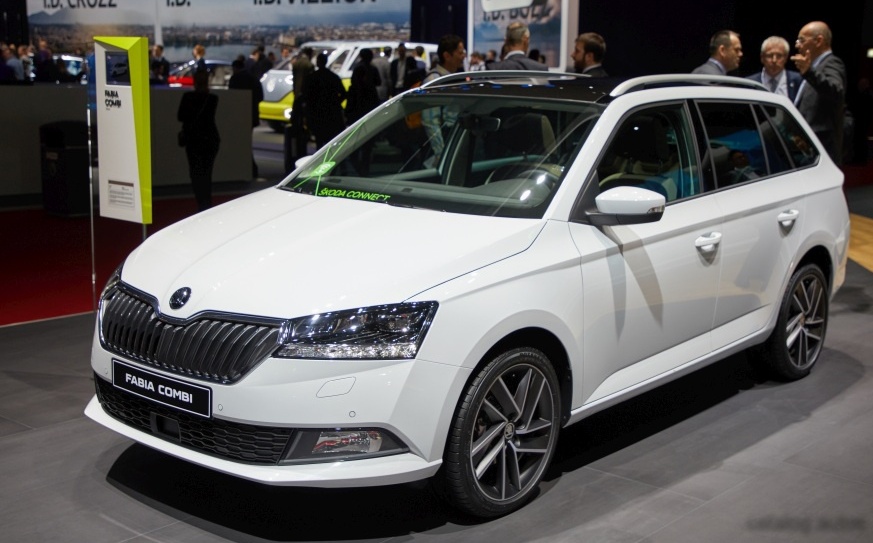
The Skoda Fabia III Combi (facelift, 2018) 1.0 MPI 60 hp represents an entry-level offering within the third generation Fabia Combi range, produced from November 2020 through 2021. Positioned as the most economical and accessible variant, it catered to buyers prioritizing fuel efficiency and practicality over outright performance. This model is part of the broader Fabia III series (model code 5J), which utilized the Volkswagen Group’s A05 (PQ25) platform, shared with vehicles like the Volkswagen Polo and SEAT Ibiza. The facelift introduced in 2018 brought revised styling, updated technology, and refined engine options, including this 1.0-liter MPI variant.
Technical Specifications
| Brand | Skoda |
| Model | Fabia |
| Generation | Fabia III Combi (facelift 2018) |
| Type (Engine) | 1.0 MPI (60 Hp) |
| Start of production | November, 2020 |
| End of production | 2021 |
| Powertrain Architecture | Internal Combustion engine |
| Body type | Station wagon (estate) |
| Seats | 5 |
| Doors | 5 |
| Fuel consumption (urban) | 5.6-5.8 l/100 km (42 – 40.6 US mpg, 50.4 – 48.7 UK mpg, 17.9 – 17.2 km/l) |
| Fuel consumption (extra urban) | 4.2 l/100 km (56 US mpg, 67.3 UK mpg, 23.8 km/l) |
| Fuel consumption (combined) | 4.7-4.8 l/100 km (50 – 49 US mpg, 60.1 – 58.9 UK mpg, 21.3 – 20.8 km/l) |
| CO2 emissions | 108-109 g/km |
| Fuel Type | Petrol (Gasoline) |
| Acceleration 0 – 100 km/h | 16.6 sec |
| Acceleration 0 – 62 mph | 16.6 sec |
| Acceleration 0 – 60 mph | 15.8 sec |
| Maximum speed | 161 km/h (100.04 mph) |
| Emission standard | Euro 6d-Temp |
| Weight-to-power ratio | 17.1 kg/Hp, 58.5 Hp/tonne |
| Weight-to-torque ratio | 10.8 kg/Nm, 92.6 Nm/tonne |
| Power | 60 Hp @ 5000-5500 rpm |
| Power per litre | 60.1 Hp/l |
| Torque | 95 Nm @ 3000-4300 rpm (70.07 lb.-ft. @ 3000-4300 rpm) |
| Engine layout | Front, Transverse |
| Engine Model/Code | EA211 / CHYE |
| Engine displacement | 999 cm3 (60.96 cu. in.) |
| Number of cylinders | 3 |
| Engine configuration | Inline |
| Cylinder Bore | 74.5 mm (2.93 in.) |
| Piston Stroke | 76.4 mm (3.01 in.) |
| Compression ratio | 10.5:1 |
| Fuel injection system | Multi-port manifold injection |
| Engine aspiration | Naturally aspirated engine |
| Valvetrain | DOHC |
| Engine oil capacity | 3.4 l (3.59 US qt | 2.99 UK qt) |
| Kerb Weight | 1026 kg (2261.94 lbs.) |
| Max. weight | 1540 kg (3395.12 lbs.) |
| Max load | 514 kg (1133.18 lbs.) |
| Trunk (boot) space – minimum | 530 l (18.72 cu. ft.) |
| Trunk (boot) space – maximum | 1395 l (49.26 cu. ft.) |
| Fuel tank capacity | 45 l (11.89 US gal | 9.9 UK gal) |
| Max. roof load | 75 kg (165.35 lbs.) |
| Permitted trailer load with brakes (12%) | 800 kg (1763.7 lbs.) |
| Permitted trailer load without brakes | 550 kg (1212.54 lbs.) |
| Permitted towbar download | 50 kg (110.23 lbs.) |
| Length | 4262 mm (167.8 in.) |
| Width | 1732 mm (68.19 in.) |
| Height | 1467 mm (57.76 in.) |
| Wheelbase | 2470 mm (97.24 in.) |
| Front track | 1463 mm (57.6 in.) |
| Rear (Back) track | 1457 mm (57.36 in.) |
| Ride height (ground clearance) | 135 mm (5.31 in.) |
| Drag coefficient (Cd) | 0.330 |
| Minimum turning circle (turning diameter) | 9.8 m (32.15 ft.) |
| Drivetrain Architecture | The Internal combustion engine (ICE) drives the front wheels of the vehicle. |
| Drive wheel | Front wheel drive |
| Number of gears and type of gearbox | 5 gears, manual transmission |
| Front suspension | Independent, type McPherson with coil spring and anti-roll bar |
| Front brakes | Ventilated discs |
| Rear brakes | Drum |
| Assisting systems | ABS (Anti-lock braking system) |
| Steering type | Steering rack and pinion |
| Power steering | Electric Steering |
| Tires size | 215/45 R16 |
| Wheel rims size | 7; 0J x 16 |
INTRODUCTION
The Skoda Fabia III Combi 1.0 MPI 60 hp, introduced in late 2020, served as the entry point to the practical and spacious Fabia Combi estate range. It was designed to appeal to budget-conscious buyers seeking a reliable and fuel-efficient vehicle for everyday use. This variant utilized the EA211 engine family, a mainstay of the Volkswagen Group, and was offered with a five-speed manual transmission. The facelifted Fabia III Combi, launched in 2018, featured updated styling cues, improved safety features, and enhanced infotainment systems, all of which were incorporated into this base-level model.
Powertrain & Engine Architecture
At the heart of the Fabia Combi 1.0 MPI 60 hp lies the EA211 engine, specifically the CHYE code. This is a naturally aspirated, three-cylinder 1.0-liter petrol engine. It employs multi-point fuel injection, delivering fuel directly into the intake ports. The engine features a double overhead camshaft (DOHC) valvetrain, optimizing gas flow for improved efficiency. The 1.0 MPI engine produces 60 horsepower at 5000-5500 rpm and 95 Nm (70.07 lb-ft) of torque between 3000 and 4300 rpm. The engine’s compact size and lightweight construction contribute to the Fabia’s overall efficiency. The five-speed manual transmission provides a relatively simple and robust drivetrain, prioritizing fuel economy over sporty performance. The gear ratios are geared towards maximizing fuel efficiency, with a taller final drive.
Driving Characteristics
The 1.0 MPI 60 hp Fabia Combi is not designed for rapid acceleration. Its 0-62 mph time of 16.6 seconds reflects its focus on economy. In real-world driving, the engine feels adequate for urban and suburban commutes, but struggles when fully loaded or tackling steep inclines. The five-speed gearbox requires frequent shifting to maintain momentum, particularly when overtaking. Compared to higher-output versions of the Fabia, such as the 1.0 TSI or 1.5 TSI, this variant offers significantly less power and torque. However, the lighter engine weight contributes to nimble handling, and the steering is reasonably precise. The relatively soft suspension setup prioritizes ride comfort over sporty handling.
Equipment & Trim Levels
The 1.0 MPI 60 hp Fabia Combi typically came with a basic level of equipment. Standard features generally included steel wheels with hubcaps, manual air conditioning, electric front windows, a basic audio system with Bluetooth connectivity, and ABS brakes. Safety features such as front airbags and stability control were also standard. Interior upholstery was typically cloth, and the dashboard featured a simple, functional design. Optional extras included alloy wheels, parking sensors, a touchscreen infotainment system, and cruise control. The trim level was generally positioned as the base model, with limited customization options available.
Chassis & Braking
The Fabia Combi 1.0 MPI 60 hp utilizes a McPherson strut front suspension with a coil spring and anti-roll bar. The rear suspension employs a torsion beam setup, which is a cost-effective and space-saving solution. The front brakes are ventilated discs, providing adequate stopping power for the vehicle’s weight and performance. However, the rear brakes are drums, which are less effective than disc brakes. The steering is a rack and pinion system with electric power assistance, offering a light and easy steering feel. The relatively narrow 215/45 R16 tires contribute to fuel efficiency but offer limited grip in wet or slippery conditions.
Market Reception & Comparison
The Skoda Fabia Combi 1.0 MPI 60 hp was generally well-received by critics as a practical and affordable estate car. Its fuel economy was a major selling point, with combined fuel consumption figures ranging from 4.7 to 4.8 l/100 km. However, its lack of power was often criticized, particularly when compared to more powerful variants in the Fabia range. The 1.0 TSI engine, for example, offered significantly more performance with only a slight penalty in fuel economy. Compared to rivals like the Dacia Logan MCV, the Fabia offered a more refined interior and a higher level of standard equipment, but at a slightly higher price point. Reliability was generally good, with the EA211 engine proving to be a durable and dependable unit.
Legacy
The 1.0 MPI engine, while not known for its performance, has proven to be a reliable and economical powerplant. In the used car market, the Fabia Combi 1.0 MPI 60 hp represents an affordable and practical option for buyers seeking a spacious and fuel-efficient estate car. Maintenance costs are relatively low, and spare parts are readily available. However, potential buyers should be aware of the engine’s limited power output and the drum brakes on the rear axle. Overall, this variant remains a sensible choice for those prioritizing practicality and economy over outright performance.