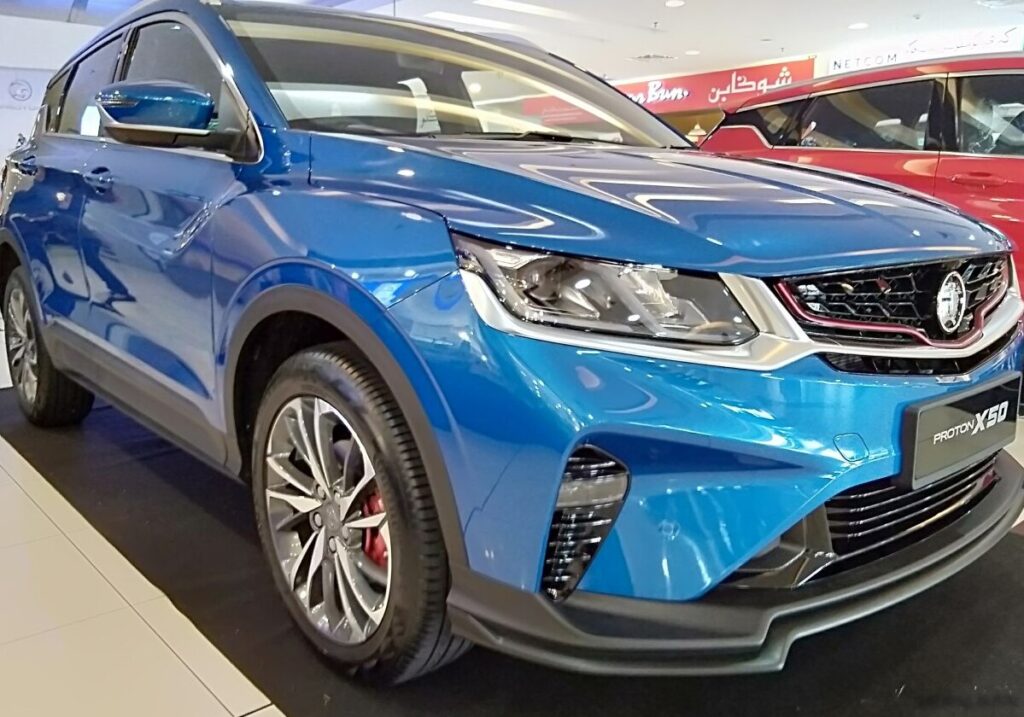
The Proton X50 1.5T GDi, produced from 2020 to 2025, represents a significant step forward for Proton, the Malaysian national car manufacturer. This compact SUV was designed to compete in the rapidly growing subcompact crossover segment, primarily targeting the Southeast Asian market, but with ambitions for broader regional appeal. The X50 is built upon a heavily modified version of the Geely Binyue platform (Geely being Proton’s parent company), and the 1.5T GDi variant, equipped with a 7-speed dual-clutch transmission (DCT), served as a key mid-range offering within the X50 lineup. It positioned itself as a more performance-oriented alternative to the base model, while remaining more accessible than the higher-specification trims.
Technical Specifications
| Brand | Proton |
| Model | X50 |
| Generation | X50 |
| Type (Engine) | 1.5T GDi (177 Hp) DCT |
| Start of production | 2020 |
| End of production | 2025 |
| Powertrain Architecture | Internal Combustion engine |
| Body type | SUV |
| Seats | 5 |
| Doors | 5 |
| Fuel Type | Petrol (Gasoline) |
| Weight-to-power ratio | 7.7 kg/Hp, 129.2 Hp/tonne |
| Weight-to-torque ratio | 5.4 kg/Nm, 186.1 Nm/tonne |
| Power | 177 Hp @ 5500 rpm |
| Power per litre | 119.8 Hp/l |
| Torque | 255 Nm @ 1500-4000 rpm (188.08 lb.-ft. @ 1500-4000 rpm) |
| Engine layout | Front, Transverse |
| Engine Model/Code | JLH-3G15TD |
| Engine displacement | 1477 cm3 (90.13 cu. in.) |
| Number of cylinders | 3 |
| Engine configuration | Inline |
| Cylinder Bore | 82 mm (3.23 in.) |
| Piston Stroke | 93.2 mm (3.67 in.) |
| Compression ratio | 10.5:1 |
| Number of valves per cylinder | 4 |
| Fuel injection system | Direct injection |
| Engine aspiration | Turbocharger, Intercooler |
| Valvetrain | DOHC |
| Engine oil capacity | 5 l (5.28 US qt | 4.4 UK qt) |
| Coolant | 6.83 l (7.22 US qt | 6.01 UK qt) |
| Kerb Weight | 1370 kg (3020.33 lbs.) |
| Length | 4330 mm (170.47 in.) |
| Width | 1800 mm (70.87 in.) |
| Height | 1609 mm (63.35 in.) |
| Wheelbase | 2600 mm (102.36 in.) |
| Minimum turning circle | 10.8 m (35.43 ft.) |
| Drivetrain Architecture | ICE, Front Wheel Drive |
| Number of gears | 7 |
| Gearbox type | Automatic transmission DCT |
| Front suspension | Independent, McPherson with coil spring and anti-roll bar |
| Rear suspension | Torsion |
| Front brakes | Ventilated discs |
| Rear brakes | Disc |
| Assisting systems | ABS (Anti-lock braking system) |
| Steering type | Steering rack and pinion |
| Power steering | Electric |
| Tires size | 215/55 R18 |
Powertrain & Engine Architecture
The heart of the X50 1.5T GDi is the JLH-3G15TD engine, a 1.5-liter turbocharged inline-three cylinder petrol engine. This engine is a product of Geely’s research and development, and represents a modern approach to maximizing efficiency and power from a small displacement. The engine utilizes direct fuel injection, which precisely meters fuel into the combustion chamber, improving combustion efficiency and reducing emissions. A single turbocharger with an intercooler provides forced induction, boosting power output. The engine features a double overhead camshaft (DOHC) valvetrain, optimizing airflow into and out of the cylinders. The 7-speed dual-clutch transmission (DCT) is a crucial component of this powertrain. DCTs offer faster and smoother gear changes compared to traditional automatic transmissions, contributing to improved acceleration and fuel economy. The DCT’s programming is tuned for a balance between performance and efficiency, with quick upshifts during acceleration and smooth downshifts during deceleration.
Driving Characteristics
The X50 1.5T GDi delivers a noticeably more spirited driving experience than the base model X50. The 177 horsepower and 255 Nm (188 lb-ft) of torque provide ample power for everyday driving and overtaking maneuvers. The DCT contributes to responsive acceleration, and the engine’s torque curve provides good pulling power across a wide RPM range. While not a sports SUV, the X50 1.5T GDi offers a level of performance that is competitive within its segment. The DCT’s gear ratios are optimized for both acceleration and fuel efficiency. Compared to a manual transmission, the DCT offers convenience and ease of use, particularly in urban traffic. However, some drivers may prefer the more direct feel of a manual gearbox. The suspension tuning is geared towards comfort, providing a reasonably smooth ride over most road surfaces.
Equipment & Trim Levels
The 1.5T GDi trim of the Proton X50 typically included a higher level of standard equipment compared to the base model. This often included features such as leatherette upholstery, a touchscreen infotainment system with Apple CarPlay and Android Auto compatibility, a reverse camera, and keyless entry. Depending on the specific sub-trim level (e.g., Standard, Premium), additional features such as a panoramic sunroof, automatic headlights and wipers, and a more advanced sound system could be included. Safety features were also enhanced, often including multiple airbags, electronic stability control, and traction control. Optional extras typically included upgraded audio systems, body kits, and paint options.
Chassis & Braking
The X50 utilizes a front-wheel-drive layout. The front suspension employs an independent McPherson strut setup with coil springs and an anti-roll bar, providing a balance of comfort and handling. The rear suspension utilizes a torsion beam setup, which is a cost-effective and space-efficient solution. The braking system consists of ventilated discs at the front and solid discs at the rear. Anti-lock braking system (ABS) is standard, enhancing braking performance and safety. The steering system is a rack and pinion type with electric power steering, providing light and precise steering feel.
Market Reception & Comparison
The Proton X50 1.5T GDi was generally well-received by critics and consumers in the Southeast Asian market. It was praised for its stylish design, comfortable interior, and competitive performance. The DCT transmission was a highlight, offering a more engaging driving experience than traditional automatics. Compared to other subcompact SUVs in the region, such as the Honda HR-V and Mazda CX-3, the X50 offered a compelling value proposition, with a generous level of equipment for its price. Fuel economy was competitive, although not class-leading. Reliability reports have been mixed, with some owners reporting minor issues with the infotainment system and occasional turbocharger concerns.
Legacy
The Proton X50 1.5T GDi played a crucial role in revitalizing the Proton brand and establishing it as a serious contender in the competitive SUV market. The powertrain, while not without its minor quirks, proved to be generally reliable and capable. On the used car market, the X50 1.5T GDi holds its value reasonably well, particularly well-maintained examples with low mileage. The combination of style, performance, and affordability has made it a popular choice among Malaysian car buyers, and it continues to be a common sight on the roads today. The X50’s success paved the way for Proton to further expand its SUV lineup and compete more effectively in the regional automotive landscape.