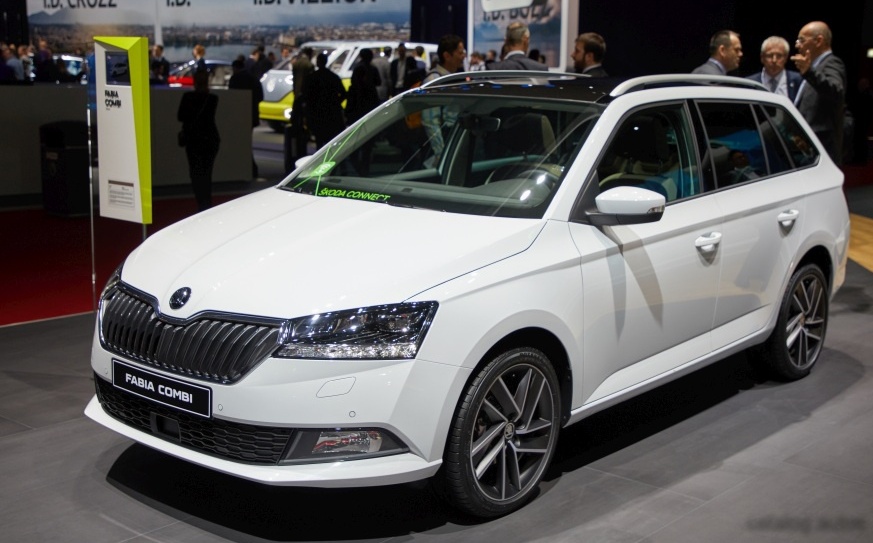
The Skoda Fabia III Combi (facelift, produced from July 2018 to July 2019) 1.0 MPI 75 hp represents an entry-level offering within the third-generation Fabia Combi range. Positioned as a practical and economical choice, this variant catered to buyers prioritizing fuel efficiency and affordability over outright performance. It was a key model in Skoda’s European lineup, offering a spacious estate body style at a competitive price point. The Fabia III, built on the Volkswagen Group’s PQ25 platform (A3/1HX0), aimed to provide a compelling alternative to rivals like the Renault Clio Estate and Opel/Vauxhall Astra Sports Tourer.
| Brand | Skoda |
| Model | Fabia |
| Generation | Fabia III Combi (facelift 2018) |
| Type (Engine) | 1.0 MPI (75 Hp) |
| Start of production | July, 2018 |
| End of production | July, 2019 |
| Powertrain Architecture | Internal Combustion engine |
| Body type | Station wagon (estate) |
| Seats | 5 |
| Doors | 5 |
| Fuel consumption (urban) | 6 l/100 km (39.2 US mpg, 47.1 UK mpg, 16.7 km/l) |
| Fuel consumption (extra urban) | 4.2 l/100 km (56 US mpg, 67.3 UK mpg, 23.8 km/l) |
| Fuel consumption (combined) | 4.9 l/100 km (48 US mpg, 57.6 UK mpg, 20.4 km/l) |
| CO2 emissions | 111 g/km |
| Fuel Type | Petrol (Gasoline) |
| Acceleration 0 – 100 km/h | 14.9 sec |
| Acceleration 0 – 62 mph | 14.9 sec |
| Acceleration 0 – 60 mph | 14.2 sec |
| Maximum speed | 169 km/h (105.01 mph) |
| Emission standard | Euro 6 |
| Weight-to-power ratio | 13.7 kg/Hp, 72.7 Hp/tonne |
| Weight-to-torque ratio | 10.9 kg/Nm, 92.1 Nm/tonne |
| Power | 75 Hp |
| Power per litre | 75.1 Hp/l |
| Torque | 95 Nm @ 3000-4300 rpm (70.07 lb.-ft. @ 3000-4300 rpm) |
| Engine layout | Front, Transverse |
| Engine Model/Code | EA211 / CHYB |
| Engine displacement | 999 cm3 (60.96 cu. in.) |
| Number of cylinders | 3 |
| Engine configuration | Inline |
| Cylinder Bore | 74.5 mm (2.93 in.) |
| Piston Stroke | 76.4 mm (3.01 in.) |
| Compression ratio | 10.5:1 |
| Number of valves per cylinder | 4 |
| Fuel injection system | Multi-port manifold injection |
| Engine aspiration | Naturally aspirated engine |
| Engine oil capacity | 3.4 l (3.59 US qt | 2.99 UK qt) |
| Kerb Weight | 1031 kg (2272.97 lbs.) |
| Max. weight | 1561 kg (3441.42 lbs.) |
| Max load | 530 kg (1168.45 lbs.) |
| Trunk (boot) space – minimum | 530 l (18.72 cu. ft.) |
| Trunk (boot) space – maximum | 1395 l (49.26 cu. ft.) |
| Fuel tank capacity | 45 l (11.89 US gal | 9.9 UK gal) |
| Max. roof load | 75 kg (165.35 lbs.) |
| Permitted trailer load with brakes (12%) | 800 kg (1763.7 lbs.) |
| Permitted trailer load without brakes | 550 kg (1212.54 lbs.) |
| Permitted towbar download | 50 kg (110.23 lbs.) |
| Length | 4262 mm (167.8 in.) |
| Width | 1732 mm (68.19 in.) |
| Height | 1467 mm (57.76 in.) |
| Wheelbase | 2470 mm (97.24 in.) |
| Front track | 1463 mm (57.6 in.) |
| Rear (Back) track | 1457 mm (57.36 in.) |
| Minimum turning circle | 10.4 m (34.12 ft.) |
| Drivetrain Architecture | Front wheel drive |
| Number of gears and type of gearbox | 5 gears, manual transmission |
| Front brakes | Ventilated discs |
| Assisting systems | ABS (Anti-lock braking system) |
| Steering type | Steering rack and pinion |
| Power steering | Electric Steering |
Powertrain & Engine Architecture
The heart of this Fabia variant is the EA211 series 1.0-liter three-cylinder petrol engine, specifically the CHYB code. This engine is a naturally aspirated unit, utilizing multi-point fuel injection. The EA211 family was designed for modularity and efficiency, and the 1.0 MPI represents the base level of this engine range. It features a single overhead camshaft (SOHC) operating four valves per cylinder. The engine’s relatively simple design contributes to its reliability and lower maintenance costs. The 75 hp output is achieved at 5,500 rpm, while peak torque of 95 Nm (70 lb-ft) is delivered between 3,000 and 4,300 rpm. This engine is paired with a five-speed manual transmission, chosen for its cost-effectiveness and simplicity. While an automatic transmission was offered on other Fabia trims, it wasn’t available with this specific engine and power output.
Driving Characteristics
The 1.0 MPI 75 hp Fabia Combi is not a performance-oriented vehicle. Acceleration is modest, taking approximately 14.9 seconds to reach 62 mph (100 km/h). The engine feels strained when pushed hard, particularly when fully loaded or climbing hills. The five-speed gearbox is well-matched to the engine’s characteristics, with relatively short gear ratios aimed at keeping the engine in its optimal torque band. However, this also means higher engine speeds at highway cruising speeds. The focus is on providing adequate power for everyday driving, prioritizing fuel economy and a comfortable ride over sporty handling. Compared to the 1.2 TSI or 1.5 TSI variants, this engine offers significantly less power and torque, resulting in a noticeably slower driving experience. The manual transmission provides a more engaging driving experience than an automatic would, but it lacks the convenience of self-shifting gears.
Equipment & Trim Levels
The 1.0 MPI 75 hp Fabia Combi typically came with a basic level of equipment. Standard features generally included air conditioning, electric front windows, a basic audio system with USB connectivity, and ABS brakes. Safety features such as driver and passenger airbags were also standard. Interior upholstery was typically cloth, with a functional but not luxurious design. Optional extras included alloy wheels, parking sensors, a more advanced infotainment system with touchscreen display, and cruise control. The trim level often dictated the availability of these options. This variant was positioned as the entry point to the Fabia Combi range, making it an attractive option for budget-conscious buyers.
Chassis & Braking
The Fabia Combi’s chassis utilizes a MacPherson strut front suspension and a torsion beam rear suspension. This setup provides a good balance between ride comfort and handling. The torsion beam rear suspension is a cost-effective solution commonly found in vehicles of this class. Braking is handled by ventilated discs on the front wheels and drum brakes on the rear. While adequate for everyday driving, the rear drum brakes are less effective than disc brakes, particularly under heavy braking. The steering is electrically assisted, providing light and easy steering feel. Stabilizer bars are fitted to both the front and rear axles to reduce body roll during cornering.
Market Reception & Comparison
The 1.0 MPI 75 hp Fabia Combi was generally well-received as a practical and affordable estate car. Critics praised its fuel efficiency and spacious interior, but noted its lack of performance. Compared to the more powerful TSI variants, this engine offered significantly lower running costs but a less engaging driving experience. The 1.2 TSI, while more expensive, provided a noticeable improvement in performance and refinement. The 1.6 TDI diesel variant offered even better fuel economy but came with the higher maintenance costs associated with diesel engines. The 1.0 MPI appealed to buyers who prioritized economy and practicality over performance, making it a popular choice for families and those who primarily used the car for commuting.
Legacy
The EA211 1.0 MPI engine has proven to be a relatively reliable unit, with few major issues reported. Its simple design and robust construction contribute to its longevity. In the used car market, the 1.0 MPI Fabia Combi represents a good value proposition, offering a spacious and economical estate car at an affordable price. However, potential buyers should be aware of its limited performance and the potential for higher maintenance costs as the vehicle ages. The engine’s relatively low power output means it is best suited for urban driving and shorter journeys. Overall, the 1.0 MPI 75 hp Fabia Combi remains a practical and economical choice for those seeking a no-frills estate car.