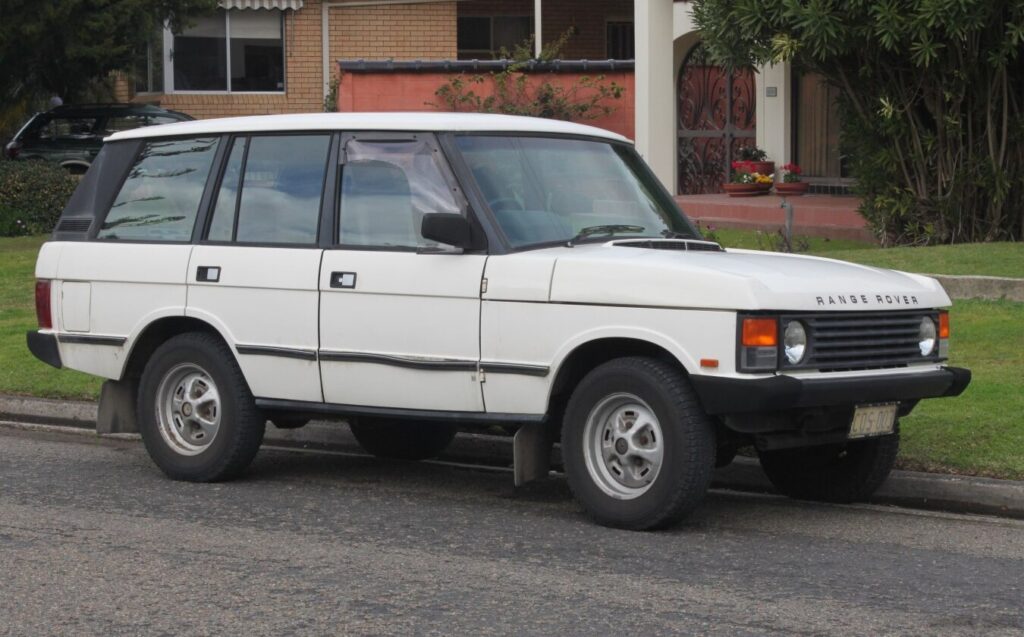
The Land Rover Range Rover I 3.9, produced from 1988 to 1994, represents a significant evolution of the original Range Rover, launched in 1970. This variant, powered by a 3.9-liter Rover V8 engine producing 173 horsepower, occupied a middle ground in the first-generation Range Rover lineup, offering a balance between performance and refinement. It arrived as the original two-door models were being phased out and the four-door body style became standard, solidifying the Range Rover’s position as a luxury SUV. The 3.9-liter model aimed to provide a more accessible entry point into Range Rover ownership than the more powerful, and expensive, 4.6-liter V8.
Technical Specifications
| Brand | Land Rover |
| Model | Range Rover |
| Generation | Range Rover I |
| Type (Engine) | 3.9 (173 Hp) |
| Start of Production | 1988 |
| End of Production | 1994 |
| Powertrain Architecture | Internal Combustion Engine |
| Body Type | SUV |
| Fuel Type | Petrol (Gasoline) |
| Power | 173 Hp |
| Engine Aspiration | Naturally Aspirated |
Powertrain & Engine Architecture
The heart of the Range Rover I 3.9 is the Rover 3.9-liter V8 engine, internally designated as the 14PBT. This engine is a descendant of the Buick-derived Rover V8, which had been in production since the 1960s. The 3.9-liter displacement was achieved through an increase in bore size compared to earlier versions. It features a cast iron block and aluminum cylinder heads, employing a single overhead camshaft (SOHC) design with two valves per cylinder. Fuel delivery is managed by a Bosch Jetronic fuel injection system, a significant upgrade over the carburetors used in earlier Range Rovers. This system improved fuel efficiency and reduced emissions, while also enhancing driveability. The engine produces 173 horsepower at 4,750 rpm and 230 lb-ft of torque at 3,100 rpm. The engine is mated to a four-speed automatic transmission (Chrysler TorqueFlite 727), known for its robustness and reliability. While not particularly sophisticated, this transmission provided smooth shifts and adequate performance for the vehicle’s intended purpose.
Driving Characteristics
The Range Rover I 3.9 offers a comfortable and capable driving experience, though it’s not a performance-oriented vehicle. The 173 horsepower provides adequate power for on-road driving and moderate off-road excursions. Acceleration from 0 to 60 mph takes around 10.5 seconds, which was respectable for an SUV of its size and weight in the late 1980s and early 1990s. The automatic transmission contributes to a relaxed driving style, with smooth gear changes. However, it lacks the responsiveness of a manual transmission, and the limited number of gears can result in the engine feeling strained at higher speeds. The Range Rover’s permanent four-wheel drive system, coupled with its sophisticated suspension, provides excellent traction and stability on a variety of surfaces. The suspension, featuring coil springs and long-travel dampers, delivers a comfortable ride, even on rough terrain. Compared to the 4.6-liter V8 models, the 3.9-liter version feels noticeably less powerful, particularly when fully loaded or tackling steep inclines. However, the 3.9-liter engine is generally considered more fuel-efficient and slightly more reliable than its larger counterpart.
Equipment & Trim Levels
The Range Rover I 3.9 was typically equipped with a generous level of standard features, reflecting its luxury positioning. Standard equipment included leather upholstery, power windows, central locking, and a sunroof. Air conditioning was also a common feature. Interior trim levels varied, with options for different wood veneers and leather colors. The dashboard layout is relatively simple and functional, with clearly labeled controls. Optional extras included a premium sound system, heated seats, and a rear wash/wipe system. The 3.9-liter model often served as a base for customers who then added options to personalize their vehicle. It was positioned as a more attainable luxury SUV, allowing buyers to experience the Range Rover brand without the higher price tag of the top-of-the-line 4.6-liter models.
Chassis & Braking
The Range Rover I 3.9 utilizes a robust body-on-frame construction, providing excellent strength and durability. The chassis is designed to withstand both on-road and off-road stresses. The suspension system consists of coil springs, long-travel dampers, and anti-roll bars. Front suspension is independent, while the rear suspension is a live axle configuration. Braking is provided by disc brakes on all four wheels, although some earlier models may have featured rear drum brakes. The braking system is hydraulically assisted and offers adequate stopping power for the vehicle’s weight. Steering is power-assisted, providing a relatively light and easy driving experience. The Range Rover’s ground clearance and approach/departure angles are excellent, making it a capable off-road vehicle.
Market Reception & Comparison
The Range Rover I 3.9 was generally well-received by critics and buyers alike. It was praised for its luxurious interior, comfortable ride, and off-road capability. The 3.9-liter engine was considered a good compromise between performance and fuel economy. Compared to the 4.6-liter V8 models, the 3.9-liter version offered a more affordable entry point into Range Rover ownership. However, some critics noted that the 3.9-liter engine lacked the outright power of its larger counterpart. In terms of fuel economy, the 3.9-liter engine typically achieved around 14-16 mpg in mixed driving conditions, which was relatively poor by modern standards but acceptable for a vehicle of its size and capabilities at the time. Compared to other luxury SUVs of the era, such as the Jeep Grand Cherokee, the Range Rover I 3.9 offered a more refined and sophisticated driving experience, but at a higher price point.
Legacy
The Range Rover I 3.9 holds a significant place in automotive history as a pioneering luxury SUV. The 3.9-liter V8 engine, while not the most powerful option, proved to be relatively reliable and is still regarded as a durable powerplant. Today, well-maintained examples of the Range Rover I 3.9 are sought after by collectors and enthusiasts. The vehicle’s classic styling, luxurious interior, and off-road capability continue to appeal to a wide range of buyers. However, potential owners should be aware of the challenges associated with owning a classic vehicle, including the availability of spare parts and the potential for costly repairs. Rust is a common issue, particularly in vehicles that have spent time in harsh climates. Despite these challenges, the Range Rover I 3.9 remains a desirable and iconic vehicle, representing a golden age of British automotive engineering.