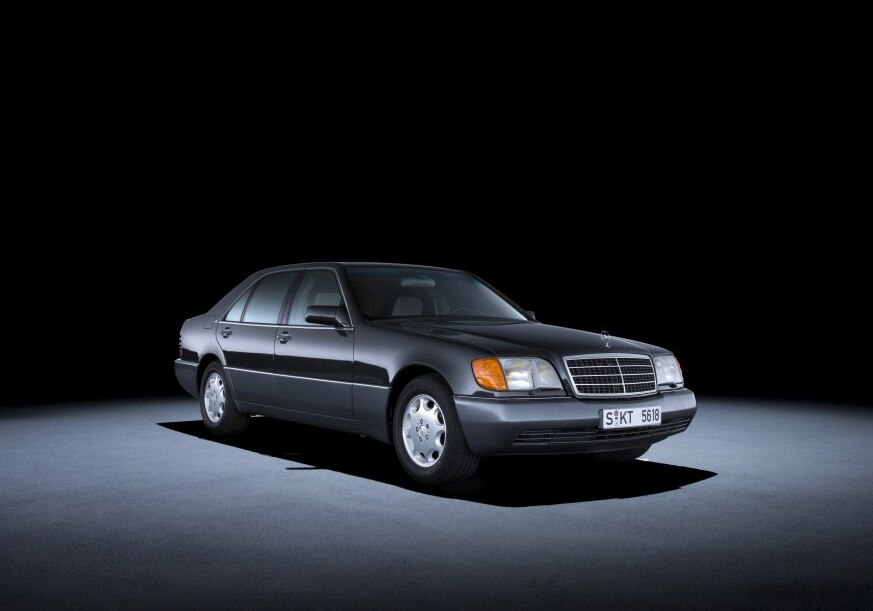
The Mercedes-Benz S 320 (V140 long wheelbase) represented a significant step forward in luxury and technology when it was introduced in 1993 and remained in production through 1994. Part of the W140 generation S-Class, known for its robust construction and advanced features, the S 320 occupied a middle ground in the lineup, offering a balance between performance and economy. It served as a key model for Mercedes-Benz in the crucial North American and European markets, appealing to buyers seeking a prestigious sedan with a comfortable driving experience. This variant was positioned as a more accessible entry point into the flagship S-Class range, slotting below the more powerful S 420 and S 500 models.
Technical Specifications
| Brand | Mercedes-Benz |
| Model | S-class |
| Generation | S-class Long (V140) |
| Type | S 320 (231 Hp) Automatic 5-speed |
| Start of production | 1993 |
| End of production | 1994 |
| Powertrain Architecture | Internal Combustion engine |
| Body type | Sedan |
| Seats | 5 |
| Doors | 4 |
| Fuel consumption (urban) | 14.9 l/100 km (15.8 US mpg / 19 UK mpg) |
| Fuel consumption (extra urban) | 8.8 l/100 km (26.7 US mpg / 32.1 UK mpg) |
| Fuel consumption (combined) | 11.5 l/100 km (20.5 US mpg / 24.6 UK mpg) |
| Fuel Type | Petrol (Gasoline) |
| Acceleration 0 – 100 km/h | 8.9 sec |
| Acceleration 0 – 62 mph | 8.9 sec |
| Acceleration 0 – 60 mph | 8.5 sec |
| Maximum speed | 225 km/h (139.81 mph) |
| Weight-to-power ratio | 8.2 kg/Hp |
| Weight-to-torque ratio | 6 kg/Nm |
| Power | 231 Hp @ 5600 rpm |
| Power per litre | 72.2 Hp/l |
| Torque | 315 Nm @ 3750 rpm (232.33 lb.-ft. @ 3750 rpm) |
| Engine layout | Front, Longitudinal |
| Engine Model/Code | M 104 E 32 |
| Engine displacement | 3199 cm3 (195.21 cu. in.) |
| Number of cylinders | 6 |
| Engine configuration | Inline |
| Cylinder Bore | 89.9 mm (3.54 in.) |
| Piston Stroke | 84 mm (3.31 in.) |
| Compression ratio | 10:1 |
| Number of valves per cylinder | 4 |
| Fuel injection system | Multi-port manifold injection |
| Engine aspiration | Naturally aspirated engine |
| Valvetrain | DOHC |
| Engine oil capacity | 7.5 l (7.93 US qt | 6.6 UK qt) |
| Coolant | 14.5 l (15.32 US qt | 12.76 UK qt) |
| Kerb Weight | 1900 kg (4188.78 lbs.) |
| Max. weight | 2560 kg (5643.83 lbs.) |
| Max load | 660 kg (1455.05 lbs.) |
| Trunk (boot) space – minimum | 525 l (18.54 cu. ft.) |
| Fuel tank capacity | 100 l (26.42 US gal | 22 UK gal) |
| Length | 5213 mm (205.24 in.) |
| Width | 1886 mm (74.25 in.) |
| Height | 1485 mm (58.46 in.) |
| Wheelbase | 3140 mm (123.62 in.) |
| Front track | 1606 mm (63.23 in.) |
| Rear (Back) track | 1579 mm (62.17 in.) |
| Minimum turning circle | 12.51 m (41.04 ft.) |
| Drivetrain Architecture | Rear wheel drive |
| Number of gears | 5 |
| Gearbox type | Automatic transmission |
| Front suspension | Double wishbone |
| Rear suspension | Independent multi-link spring suspension with stabilizer |
| Front brakes | Ventilated discs |
| Rear brakes | Disc |
| Assisting systems | ABS (Anti-lock braking system), Hydraulic Steering |
| Tires size | 235/60 R16 |
| Wheel rims size | 16 |
Powertrain & Engine Architecture
The S 320 was powered by the M104 E 32 engine, a 3.2-liter inline-6 cylinder powerplant. This engine was a significant departure from the V8 engines traditionally found in the S-Class, representing Mercedes-Benz’s effort to offer a more fuel-efficient option without sacrificing substantial performance. The M104 featured a cast iron block with aluminum cylinder heads, dual overhead camshafts (DOHC), and four valves per cylinder. Fuel delivery was handled by a Bosch multi-port fuel injection system, contributing to smooth operation and relatively good fuel economy for its class. The engine produced 231 horsepower at 5600 rpm and 315 Nm (232 lb-ft) of torque at 3750 rpm. Paired with a 5-speed automatic transmission, the powertrain delivered power to the rear wheels. This transmission was electronically controlled, offering smooth shifts and adaptive shifting characteristics.
Driving Characteristics
The S 320 Automatic offered a comfortable and refined driving experience, prioritizing smoothness and quietness over outright sportiness. While the 0-60 mph time of around 8.5 seconds wasn’t particularly quick by modern standards, it was adequate for comfortable highway cruising and passing maneuvers. The automatic transmission, while smooth, could feel somewhat hesitant at times, particularly during quick downshifts. Compared to the more powerful S 420 and S 500 models, the S 320 felt less eager to accelerate, but it offered a more relaxed and fuel-efficient driving experience. The gear ratios were tuned for comfort and efficiency, rather than maximizing performance. The long wheelbase of the S-Class contributed to a stable and comfortable ride, even on uneven surfaces.
Equipment & Trim Levels
The S 320 came standard with a comprehensive list of features befitting a luxury sedan of its era. These included leather upholstery, power-adjustable front seats with memory function, automatic climate control, a premium sound system, and power windows and locks. Wood trim adorned the interior, adding to the sense of luxury. Optional extras included a sunroof, upgraded sound systems, rear seat entertainment, and various driver assistance features. The S 320’s trim level was generally considered mid-range within the W140 lineup, offering a good balance of features and price.
Chassis & Braking
The S 320 featured a robust chassis with double wishbone suspension at the front and an independent multi-link spring suspension with a stabilizer bar at the rear. This suspension setup provided a comfortable ride and good handling characteristics. Brakes consisted of ventilated discs at the front and solid discs at the rear. Anti-lock braking system (ABS) was standard, enhancing safety and control during hard braking. The steering was hydraulic power-assisted, providing a light and responsive feel. The S 320 rode on 16-inch alloy wheels with 235/60 R16 tires.
Market Reception & Comparison
The S 320 was generally well-received by critics, who praised its comfortable ride, refined interior, and relatively fuel-efficient engine. However, some reviewers noted that the engine lacked the punch of the V8 models. Compared to the S 420, the S 320 offered better fuel economy but less performance. Compared to the S 500, the difference in performance was even more pronounced. The S 320 appealed to buyers who prioritized comfort and fuel efficiency over outright speed and acceleration. Its price point made it a more accessible entry point into the S-Class range.
Legacy
The M104 engine, found in the S 320, is known for its durability and reliability. With proper maintenance, these engines can last for many years and accumulate high mileage. The W140 S-Class, as a whole, is regarded as a well-built and over-engineered vehicle. Today, the S 320 is a sought-after classic car, appreciated by enthusiasts for its build quality, comfortable ride, and relatively simple mechanicals compared to later S-Class models. Parts availability is generally good, although some specific components may be becoming increasingly difficult to find. The S 320 represents a high point in Mercedes-Benz engineering and remains a desirable luxury sedan for those seeking a classic driving experience.