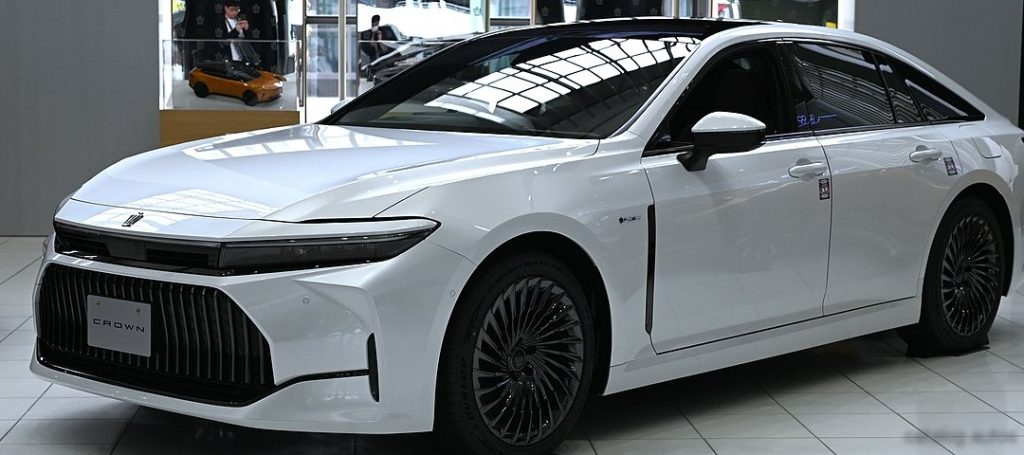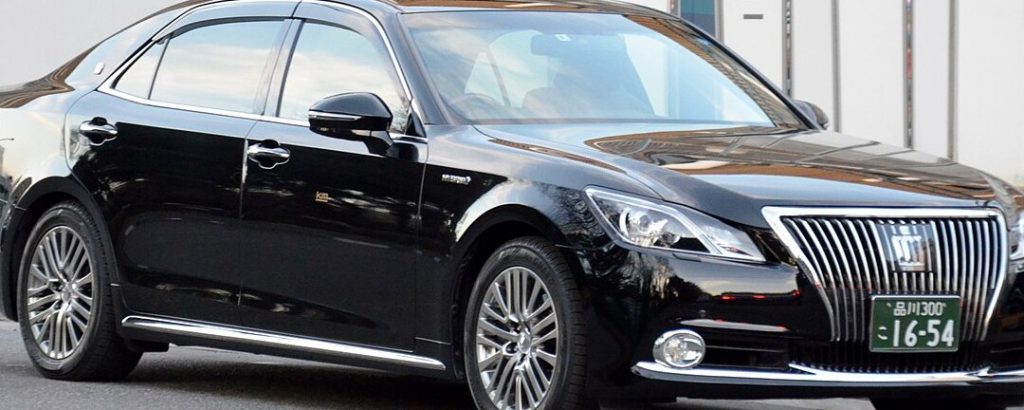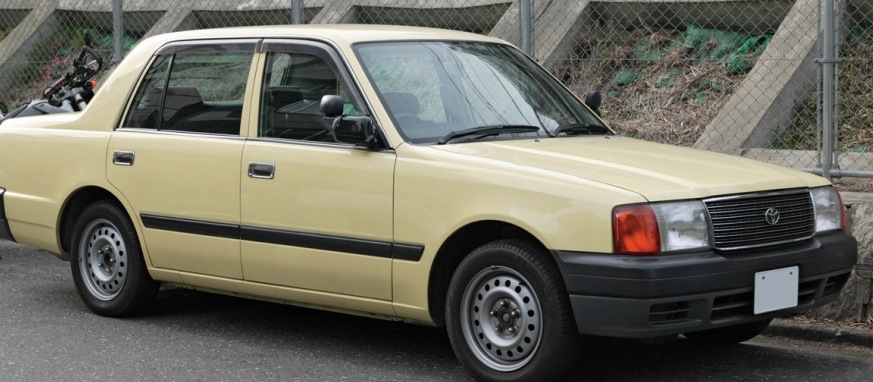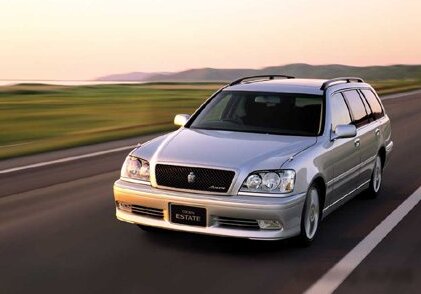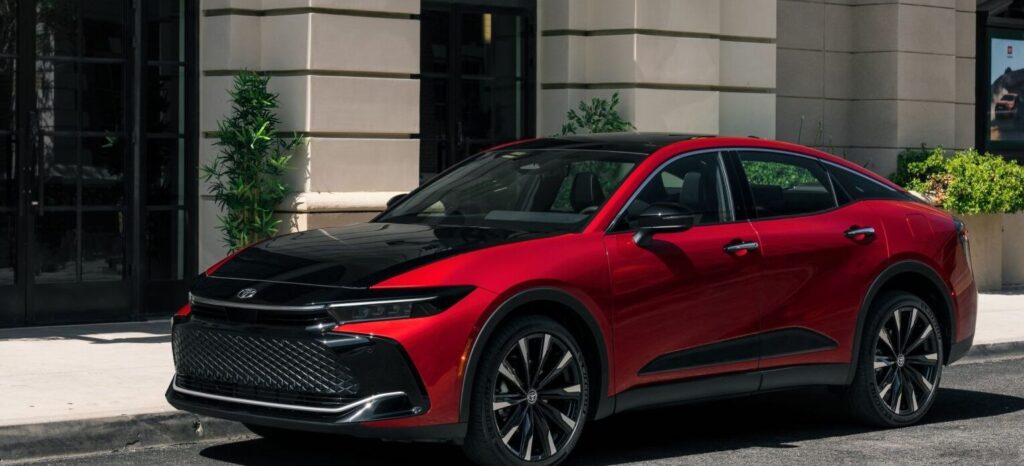
The Toyota Crown XVI (S235) 2.5 D-4S Hybrid E-Four e-CVT, launched in July 2022, represents a significant evolution of Toyota’s flagship sedan, reimagined as a crossover. This variant occupies a mid-to-upper position within the S235 Crown lineup, offering a blend of fuel efficiency, performance, and all-wheel-drive capability. It’s a key model in Toyota’s strategy to revitalize the Crown nameplate for a modern audience, particularly in markets where traditional sedans are losing ground to SUVs and crossovers. The S235 generation marked a departure from the Crown’s traditional sedan body style, embracing a more contemporary crossover form factor, aiming to broaden its appeal.
Technical Specifications
| Brand | Toyota |
| Model | Crown |
| Generation | Crown XVI (S235) |
| Type (Engine) | 2.5 D-4S (234 Hp) Hybrid E-Four e-CVT |
| Start of production | July, 2022 |
| Powertrain Architecture | FHEV (Full Hybrid Electric Vehicle) |
| Body type | Crossover |
| Seats | 5 |
| Doors | 4 |
| Fuel consumption (economy) – urban (WLTC) | 4.7 l/100 km (50 US mpg, 60.1 UK mpg, 21.3 km/l) |
| Fuel consumption (economy) – extra urban (WLTC) | 4.5 l/100 km (52.3 US mpg, 62.8 UK mpg, 22.2 km/l) |
| Fuel consumption (economy) – combined (WLTC) | 4.5 l/100 km (52.3 US mpg, 62.8 UK mpg, 22.2 km/l) |
| CO2 emissions (WLTC) | 104 g/km |
| Fuel Type | Petrol (Gasoline) |
| Weight-to-power ratio | 7.4 kg/Hp, 134.5 Hp/tonne |
| Weight-to-torque ratio | 7.9 kg/Nm, 127 Nm/tonne |
| Battery technology | Nickel-metal hydride (NiMH) |
| Battery location | Below the floor, under the rear seats |
| Electric motor power (1) | 120 Hp |
| Electric motor Torque (1) | 202 Nm (148.99 lb.-ft.) |
| Electric motor model/code (1) | 3NM |
| Electric motor location (1) | Integrated into the transmission |
| Electric motor power (2) | 54 Hp |
| Electric motor Torque (2) | 121 Nm (89.25 lb.-ft.) |
| Electric motor model/code (2) | 4NM |
| Electric motor location (2) | Rear axle, Transverse |
| System power | 234 Hp |
| Power | 186 Hp @ 6000 rpm |
| Torque | 221 Nm @ 3600-5200 rpm (163 lb.-ft. @ 3600-5200 rpm) |
| Engine layout | Front, Transverse |
| Engine Model/Code | A25A-FXS |
| Engine displacement | 2487 cm3 (151.77 cu. in.) |
| Number of cylinders | 4 |
| Engine configuration | Inline |
| Cylinder Bore | 87.5 mm (3.44 in.) |
| Piston Stroke | 103.4 mm (4.07 in.) |
| Number of valves per cylinder | 4 |
| Fuel injection system | Direct injection and Multi-port manifold injection |
| Engine aspiration | Naturally aspirated engine |
| Valvetrain | VVT-iE |
| Engine oil capacity | 4.3 l (4.54 US qt | 3.78 UK qt) |
| Coolant | 6 l (6.34 US qt | 5.28 UK qt) |
| Kerb Weight | 1740-1790 kg (3836.04 – 3946.27 lbs.) |
| Trunk (boot) space – minimum | 450 l (15.89 cu. ft.) |
| Fuel tank capacity | 55 l (14.53 US gal | 12.1 UK gal) |
| Length | 4930 mm (194.09 in.) |
| Width | 1840 mm (72.44 in.) |
| Height | 1540 mm (60.63 in.) |
| Wheelbase | 2850 mm (112.2 in.) |
| Front track | 1600-1605 mm (62.99 – 63.19 in.) |
| Rear (Back) track | 1605-1615 mm (63.19 – 63.58 in.) |
| Front overhang | 1020 mm (40.16 in.) |
| Rear overhang | 1060 mm (41.73 in.) |
| Ride height (ground clearance) | 145 mm (5.71 in.) |
| Minimum turning circle (turning diameter) | 10.8 m (35.43 ft.) |
| Drivetrain Architecture | An Internal combustion engine (ICE) drives the front wheels, one electric motor drives the front wheels, one electric motor drives the rear wheels. There is an ability for running in full electric or mixed mode. |
| Drive wheel | All wheel drive (4×4) |
| Number of gears and type of gearbox | automatic transmission e-CVT |
| Front suspension | Independent type McPherson |
| Rear suspension | Independent multi-link suspension |
| Front brakes | Ventilated discs |
| Rear brakes | Ventilated discs |
| Assisting systems | ABS (Anti-lock braking system) |
| Steering type | Steering rack and pinion |
| Power steering | Electric Steering |
| Tires size | 225/60 R18; 225/55 R19; 225/45 R21 |
| Wheel rims size | 7J x 18; 7J x 19; 7.5J x 21 |
Powertrain & Engine Architecture
The heart of the Crown XVI 2.5 D-4S Hybrid E-Four is Toyota’s A25A-FXS 2.5-liter inline-four engine. This engine utilizes Toyota’s D-4S direct and port fuel injection system, optimizing combustion efficiency and power delivery. The engine produces 186 horsepower at 6000 rpm and 221 Nm (163 lb-ft) of torque between 3600 and 5200 rpm. It’s paired with Toyota’s fourth-generation hybrid system, featuring a nickel-metal hydride (NiMH) battery pack positioned under the rear seats. The system incorporates two electric motors: a primary motor integrated with the e-CVT and a rear motor providing on-demand all-wheel drive. The front motor delivers 120 hp and 202 Nm of torque, while the rear motor contributes 54 hp and 121 Nm of torque. The combined system output is 234 horsepower. The e-CVT (electronically controlled continuously variable transmission) seamlessly manages power flow between the engine and electric motors, prioritizing fuel efficiency and smooth acceleration.
Driving Characteristics
The 2.5 D-4S Hybrid E-Four offers a refined and comfortable driving experience. The e-CVT provides seamless acceleration, and the electric motors contribute to instant torque, particularly at lower speeds. While not a performance-oriented variant, the combined 234 hp provides adequate power for everyday driving and highway merging. The E-Four all-wheel-drive system enhances traction and stability, especially in inclement weather. Compared to potential future higher-output turbocharged versions, this variant prioritizes fuel economy and smoothness over outright speed. The gear ratios are optimized for efficiency, resulting in a slightly less responsive feel than a traditional automatic transmission, but the overall driving experience is pleasant and predictable.
Equipment & Trim Levels
The Crown XVI 2.5 D-4S Hybrid E-Four typically comes well-equipped with standard features including Toyota Safety Sense 3.0, which encompasses a suite of advanced driver-assistance systems such as pre-collision system with pedestrian detection, lane departure alert with steering assist, and dynamic radar cruise control. Interior features generally include premium cloth or synthetic leather upholstery, a 12.3-inch touchscreen infotainment system with wireless Apple CarPlay and Android Auto compatibility, and a comprehensive climate control system. Optional extras often include a panoramic sunroof, premium audio system, and upgraded leather upholstery.
Chassis & Braking
The Crown XVI utilizes a front independent McPherson strut suspension and a rear independent multi-link suspension, providing a comfortable ride and stable handling. Ventilated disc brakes are standard on all four wheels, offering ample stopping power. The E-Four system’s rear electric motor contributes to enhanced stability during braking and cornering. Stabilizer bars are fitted to both the front and rear axles to minimize body roll. The suspension tuning is geared towards comfort, prioritizing a smooth ride over sporty handling.
Market Reception & Comparison
The Crown XVI 2.5 D-4S Hybrid E-Four has been generally well-received by critics for its fuel efficiency, comfortable ride, and advanced technology. It offers a compelling alternative to traditional luxury sedans and SUVs. Compared to other trims in the Crown lineup, this variant strikes a balance between performance and economy. While the base 2.4L turbocharged engine offers more power, the hybrid delivers superior fuel economy. Reliability is expected to be high, consistent with Toyota’s reputation, although long-term data is still emerging for this new generation.
Legacy
The Toyota Crown XVI 2.5 D-4S Hybrid E-Four represents a pivotal moment in the Crown’s history, marking its transition to a crossover body style and embracing hybrid technology. The powertrain, while not the most powerful in the lineup, is expected to be durable and reliable, benefiting from Toyota’s extensive experience with hybrid systems. In the used car market, this variant is likely to appeal to buyers seeking a fuel-efficient, comfortable, and technologically advanced crossover with the prestige of the Crown nameplate. Its long-term value will depend on maintenance records and overall condition, but it’s poised to become a desirable option for those seeking a refined and practical vehicle.