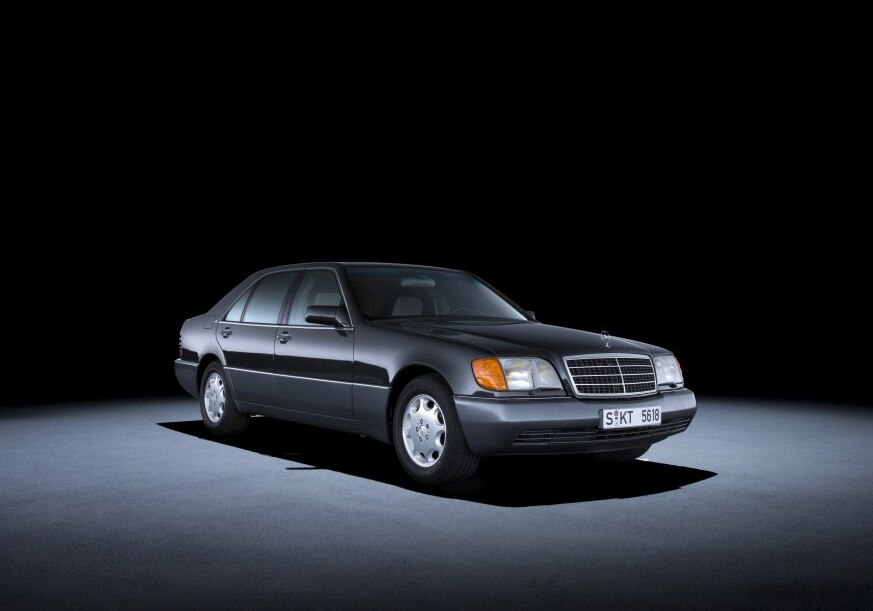
The Mercedes-Benz S-Class Long (V140) S 500 V8 Automatic, produced from 1993 to 1994, represented the pinnacle of luxury and engineering for the German automaker. Part of the W140 generation – the successor to the W126 – the S 500 occupied a premium position within the long-wheelbase variant of the S-Class. The “Long” designation signified an extended wheelbase, offering significantly increased rear passenger legroom, catering to a market that valued chauffeur-driven comfort. This model was primarily aimed at affluent buyers in Europe, North America, and Asia who desired a spacious, technologically advanced, and powerfully equipped luxury sedan. It served as a statement of success and a showcase for Mercedes-Benz’s innovation.
Technical Specifications
| Brand | Mercedes-Benz |
| Model | S-class |
| Generation | S-class Long (V140) |
| Type (Engine) | S 500 V8 (320 Hp) Automatic |
| Start of production | 1993 |
| End of production | 1994 |
| Powertrain Architecture | Internal Combustion engine |
| Body type | Sedan |
| Seats | 5 |
| Doors | 4 |
| Fuel consumption (economy) – urban | 17.2 l/100 km (13.7 US mpg, 16.4 UK mpg, 5.8 km/l) |
| Fuel consumption (economy) – extra urban | 10 l/100 km (23.5 US mpg, 28.2 UK mpg, 10 km/l) |
| Fuel consumption (economy) – combined | 13 l/100 km (18.1 US mpg, 21.7 UK mpg, 7.7 km/l) |
| Fuel Type | Petrol (Gasoline) |
| Acceleration 0 – 100 km/h | 7.3 sec |
| Acceleration 0 – 62 mph | 7.3 sec |
| Acceleration 0 – 60 mph | 6.9 sec |
| Maximum speed | 250 km/h (155.34 mph) |
| Weight-to-power ratio | 6.3 kg/Hp, 159.2 Hp/tonne |
| Weight-to-torque ratio | 4.3 kg/Nm, 233.8 Nm/tonne |
| Power | 320 Hp @ 5600 rpm |
| Power per litre | 64.3 Hp/l |
| Torque | 470 Nm @ 3900 rpm (346.65 lb.-ft. @ 3900 rpm) |
| Engine layout | Front, Longitudinal |
| Engine Model/Code | M 119 E 50 |
| Engine displacement | 4973 cm3 (303.47 cu. in.) |
| Number of cylinders | 8 |
| Engine configuration | V-engine |
| Cylinder Bore | 96.5 mm (3.8 in.) |
| Piston Stroke | 85 mm (3.35 in.) |
| Compression ratio | 10:1 |
| Number of valves per cylinder | 4 |
| Fuel injection system | Multi-port manifold injection |
| Engine aspiration | Naturally aspirated engine |
| Valvetrain | DOHC |
| Engine oil capacity | 8 l (8.45 US qt | 7.04 UK qt) |
| Coolant | 16.5 l (17.44 US qt | 14.52 UK qt) |
| Kerb Weight | 2010 kg (4431.29 lbs.) |
| Max. weight | 2660 kg (5864.3 lbs.) |
| Max load | 650 kg (1433 lbs.) |
| Trunk (boot) space – minimum | 525 l (18.54 cu. ft.) |
| Fuel tank capacity | 100 l (26.42 US gal | 22 UK gal) |
| Length | 5213 mm (205.24 in.) |
| Width | 1886 mm (74.25 in.) |
| Height | 1485 mm (58.46 in.) |
| Wheelbase | 3140 mm (123.62 in.) |
| Front track | 1606 mm (63.23 in.) |
| Rear (Back) track | 1579 mm (62.17 in.) |
| Drivetrain Architecture | The Internal combustion engine (ICE) drives the rear wheels of the vehicle. |
| Drive wheel | Rear wheel drive |
| Number of gears and type of gearbox | 4 gears, automatic transmission |
| Front suspension | Double wishbone |
| Rear suspension | Independent multi-link spring suspension with stabilizer |
| Front brakes | Ventilated discs |
| Rear brakes | Ventilated discs |
| Assisting systems | ABS (Anti-lock braking system), Hydraulic Steering |
| Tires size | 235/60 R16 |
| Wheel rims size | 16 |
Powertrain & Engine Architecture
The S 500 V8 was powered by the M119 E 50 engine, a 4.973-liter (303.47 cubic inches) naturally aspirated V8. This engine was a significant advancement in Mercedes-Benz’s engine technology, featuring all-aluminum construction, a dual overhead camshaft (DOHC) valvetrain with four valves per cylinder, and a Bosch Motronic fuel injection system. The M119 was known for its smooth power delivery and relatively high specific output for its time. The engine produced 320 horsepower at 5600 rpm and 470 Nm (346.65 lb-ft) of torque at 3900 rpm. The engine’s longitudinal mounting and rear-wheel-drive configuration were standard for the S-Class. Paired with the M119 was a four-speed automatic transmission, designed for smooth and refined gear changes, prioritizing comfort over outright performance. This transmission was electronically controlled, offering adaptive shift patterns based on driving conditions.
Driving Characteristics
The S 500 V8 Automatic offered a driving experience focused on effortless cruising and luxurious comfort. While not a sports sedan, the 320 hp engine provided ample power for confident acceleration and highway passing. The 0-60 mph sprint took approximately 6.9 seconds, and the car was electronically limited to a top speed of 250 km/h (155 mph). The automatic transmission, while smooth, wasn’t particularly quick to downshift, and the gear ratios were optimized for fuel efficiency and relaxed driving rather than aggressive performance. Compared to the later S 500 models with the updated M119 engine or the more fuel-efficient six-cylinder variants, the V8 offered a more substantial power reserve but at the cost of increased fuel consumption.
Equipment & Trim Levels
The S 500 V8 Automatic came standard with a comprehensive list of luxury features. Leather upholstery was standard, along with power-adjustable front seats with memory function. Wood trim adorned the interior, and features like automatic climate control, a premium sound system, and power windows and locks were all included. The long-wheelbase configuration provided generous rear legroom, and rear passengers benefited from individual climate controls and reading lights. Optional extras included a sunroof, upgraded sound systems, and various interior trim options. The S 500 represented the highest trim level available, offering the most luxurious appointments and advanced features.
Chassis & Braking
The V140 S-Class featured a sophisticated chassis designed for ride comfort and handling stability. The front suspension utilized a double wishbone design, while the rear employed an independent multi-link setup with a stabilizer bar. This configuration minimized body roll and provided a smooth ride over various road surfaces. Braking duties were handled by ventilated disc brakes on all four wheels, coupled with an Anti-lock Braking System (ABS) for enhanced safety. The hydraulic power steering provided light and precise steering feel. The suspension was tuned to prioritize comfort, resulting in a slightly softer ride compared to sportier sedans.
Market Reception & Comparison
The S 500 V8 Automatic was generally well-received by automotive critics, who praised its luxurious interior, smooth ride, and powerful engine. However, its fuel consumption was often cited as a drawback. Compared to the six-cylinder S-Class models, the S 500 offered significantly more performance but at a higher price and with lower fuel economy. The V8 also required more frequent and potentially more expensive maintenance. Despite these drawbacks, the S 500 remained a popular choice among buyers who prioritized luxury and performance.
Legacy
The M119 engine, while superseded by later designs, is considered a robust and reliable powerplant when properly maintained. The V140 S-Class, in general, is known for its build quality and durability. Today, well-maintained S 500 V8 models are sought after by collectors and enthusiasts. While parts availability can be a concern, the M119 engine’s relatively simple design makes it easier to repair than some of the more complex engines that followed. The S 500 V8 Automatic remains a symbol of Mercedes-Benz’s engineering prowess and a testament to the enduring appeal of classic luxury sedans.