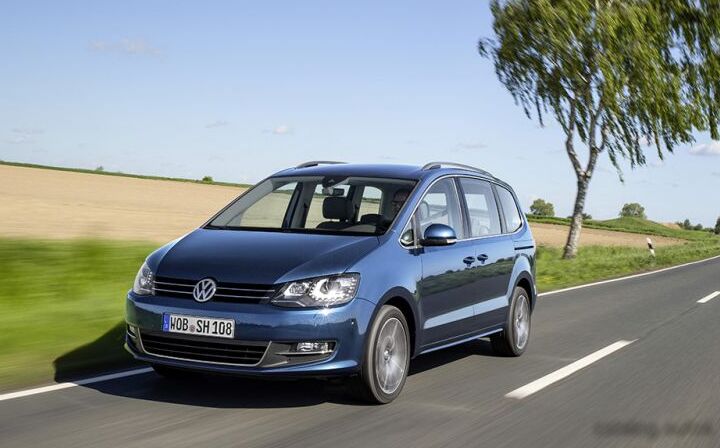
The Volkswagen Sharan II, particularly the facelifted version introduced in 2015, represented a significant evolution of Volkswagen’s minivan offering. The 2.0 TDI SCR variant with 150 horsepower and a dual-clutch gearbox (DSG) was produced from 2018 to 2020. This version occupied a middle ground in the Sharan lineup, offering a balance between fuel efficiency, performance, and practicality for families. It was primarily marketed in Europe, where the minivan segment remained strong, and aimed to provide a comfortable and versatile vehicle for long journeys and everyday use.
Technical Specifications
| Brand | Volkswagen |
| Model | Sharan |
| Generation | Sharan II (facelift 2015) |
| Type (Engine) | 2.0 TDI SCR (150 Hp) DSG |
| Start of production | 2018 |
| End of production | 2020 |
| Powertrain Architecture | Internal Combustion engine |
| Body type | Minivan, MPV |
| Seats | 5-7 |
| Doors | 5 |
| Fuel consumption (urban) | 6.2-6.3 l/100 km (37.9 – 37.3 US mpg) |
| Fuel consumption (extra urban) | 4.7-5.0 l/100 km (50 – 47 US mpg) |
| Fuel consumption (combined) | 5.2-5.4 l/100 km (45.2 – 43.6 US mpg) |
| CO2 emissions | 137-143 g/km |
| Fuel Type | Diesel |
| Acceleration 0 – 100 km/h | 10.3 sec |
| Acceleration 0 – 62 mph | 10.3 sec |
| Acceleration 0 – 60 mph | 9.8 sec |
| Maximum speed | 198 km/h (123.03 mph) |
| Emission standard | Euro 6d-TEMP |
| Weight-to-power ratio | 12 kg/Hp |
| Weight-to-torque ratio | 5.3 kg/Nm |
| Power | 150 Hp |
| Torque | 340 Nm @ 1750-3000 rpm (250.77 lb.-ft. @ 1750-3000 rpm) |
| Engine layout | Front, Transverse |
| Engine Model/Code | CUVC, DFLA, DLTA |
| Engine displacement | 1968 cm3 (120.09 cu. in.) |
| Number of cylinders | 4 |
| Engine configuration | Inline |
| Number of valves per cylinder | 4 |
| Fuel injection system | Diesel Commonrail |
| Engine aspiration | Turbocharger, Intercooler |
| Engine oil capacity | 4.7 l (4.97 US qt | 4.14 UK qt) |
| Coolant capacity | 8 l (8.45 US qt | 7.04 UK qt) |
| Kerb Weight | 1805 kg (3979.34 lbs.) |
| Max. weight | 2540 kg (5599.74 lbs.) |
| Max load | 735 kg (1620.4 lbs.) |
| Trunk (boot) space – minimum | 955 l (33.73 cu. ft.) |
| Trunk (boot) space – maximum | 2430 l (85.81 cu. ft.) |
| Fuel tank capacity | 70 l (18.49 US gal | 15.4 UK gal) |
| AdBlue tank capacity | 17 l (4.49 US gal | 3.74 UK gal) |
| Max. roof load | 100 kg (220.46 lbs.) |
| Permitted trailer load with brakes (8%) | 2400 kg (5291.09 lbs.) |
| Permitted trailer load with brakes (12%) | 2200 kg (4850.17 lbs.) |
| Permitted trailer load without brakes | 750 kg (1653.47 lbs.) |
| Permitted towbar download | 100 kg (220.46 lbs.) |
| Length | 4854 mm (191.1 in.) |
| Width | 1904 mm (74.96 in.) |
| Width including mirrors | 2081 mm (81.93 in.) |
| Height | 1746 mm (68.74 in.) |
| Wheelbase | 2920 mm (114.96 in.) |
| Front track | 1559-1571 mm (61.38 – 61.85 in.) |
| Rear track | 1605-1617 mm (63.19 – 63.66 in.) |
| Ride height (ground clearance) | 152 mm (5.98 in.) |
| Minimum turning circle | 11.9 m (39.04 ft.) |
| Drivetrain | Front wheel drive |
| Number of gears | 6 |
| Gearbox type | Automatic transmission DSG |
| Front brakes | Ventilated discs |
| Rear brakes | Disc |
| Tires size | 205/60 R16 H; 225/50 R17 H; 225/45 R18 H |
| Wheel rims size | 6.5J x 16; 7J x 17; 7.5J x 18 |
INTRODUCTION
The Volkswagen Sharan II, launched in 2010 and receiving a significant facelift in 2015, was a collaborative effort with Ford, sharing a platform with the Ford Galaxy and S-Max. The 2.0 TDI SCR 150 hp DSG variant, introduced in 2018, was a key offering in the Sharan range. It aimed to provide a practical and efficient solution for families needing space and versatility. Built on the PQ46 platform (also known as the A6 platform in some contexts), the Sharan II offered a more refined driving experience and improved interior quality compared to its predecessor. This particular engine and transmission combination was positioned as a sweet spot, offering adequate performance for most driving situations while prioritizing fuel economy.
Powertrain & Engine Architecture
The heart of this Sharan variant is the 2.0-liter four-cylinder diesel engine, specifically utilizing the common rail direct injection system. Engine codes for this generation included CUVC, DFLA, and DLTA, depending on the specific market and emissions regulations. The engine features a turbocharger with an intercooler to boost power and efficiency. The SCR (Selective Catalytic Reduction) system, a key component of the Euro 6 emissions standards, uses AdBlue (Diesel Exhaust Fluid) to reduce nitrogen oxide (NOx) emissions. The engine produces 150 horsepower and 340 Nm (250.77 lb-ft) of torque between 1750 and 3000 rpm. This torque band provides good responsiveness for everyday driving. The engine is paired with a 6-speed DSG (Direct-Shift Gearbox), a dual-clutch transmission known for its quick and smooth gear changes. The DSG contributes to both fuel efficiency and a more engaging driving experience compared to a traditional automatic transmission.
Driving Characteristics
The 150 hp 2.0 TDI with the DSG transmission delivers a competent, if not exhilarating, driving experience. Acceleration from 0-60 mph takes around 9.8 seconds, and top speed is 198 km/h (123 mph). The DSG transmission is well-matched to the engine’s torque curve, providing brisk acceleration in most situations. Compared to the more powerful 2.0 TDI BiTurbo variants, this version feels less urgent, but it offers a smoother and more relaxed driving experience. The DSG transmission’s gear ratios are optimized for both fuel efficiency and responsiveness. In typical driving conditions, the transmission shifts smoothly and efficiently, contributing to the Sharan’s respectable fuel economy figures. Compared to manual transmission versions, the DSG offers convenience and ease of use, particularly in urban traffic.
Equipment & Trim Levels
The Sharan II, in its 2.0 TDI SCR 150 hp DSG guise, typically came well-equipped, although specific features varied depending on the market and optional packages selected. Standard equipment generally included air conditioning, electric windows, central locking, a touchscreen infotainment system, and alloy wheels. Higher trim levels added features such as leather upholstery, a panoramic sunroof, parking sensors, and advanced safety systems like adaptive cruise control and lane assist. Interior upholstery was typically cloth on base models, with leather options available. The dashboard layout was functional and modern, with a focus on ergonomics and ease of use. Optional extras included a navigation system, a premium sound system, and rear-seat entertainment systems.
Chassis & Braking
The Sharan II utilizes a MacPherson strut front suspension and a multi-link rear suspension, providing a comfortable and controlled ride. The suspension is tuned to prioritize comfort, making it well-suited for long journeys. Braking duties are handled by ventilated discs at the front and solid discs at the rear. ABS (Anti-lock Braking System) is standard, providing enhanced braking performance and stability. The Sharan’s weight (approximately 1805 kg / 3979 lbs) is relatively high for its class, but the braking system is adequate for most driving situations. Stabilizer bars are fitted to both the front and rear axles to reduce body roll during cornering.
Market Reception & Comparison
The Volkswagen Sharan II, including the 2.0 TDI SCR 150 hp DSG variant, was generally well-received by automotive critics. It was praised for its spacious interior, comfortable ride, and practical features. The 150 hp engine was considered adequate for most drivers, offering a good balance between performance and fuel economy. Compared to the more powerful TDI variants, this version was seen as a more sensible choice for those prioritizing efficiency and affordability. Fuel economy figures of 5.2-5.4 l/100 km (45.2 – 43.6 US mpg) were competitive in its class. Reliability was generally good, although some owners reported issues with the DSG transmission, a common concern with these units.
Legacy
The Volkswagen Sharan II, particularly the 2.0 TDI SCR 150 hp DSG model, remains a popular choice in the used car market. Its reputation for practicality, reliability, and fuel efficiency continues to attract buyers. The DSG transmission, while potentially requiring maintenance, offers a smooth and efficient driving experience. The SCR system, while adding complexity, helps to reduce emissions and meet modern environmental standards. While newer MPVs have emerged, the Sharan II remains a well-regarded and capable vehicle, offering a compelling combination of space, comfort, and practicality for families.