Technical Specifications
| Brand | Seat |
| Model | Alhambra |
| Generation | Alhambra II (7N, facelift 2015) |
| Type (Engine) | 2.0 TDI (184 Hp) |
| Start of production | May, 2015 |
| End of production | 2018 |
| Powertrain Architecture | Internal Combustion engine |
| Body type | Minivan, MPV |
| Seats | 5 |
| Doors | 5 |
| Fuel consumption (combined) | 5.3 l/100 km (44.4 US mpg, 53.3 UK mpg, 18.9 km/l) |
| CO2 emissions | 138 g/km |
| Fuel Type | Diesel |
| Acceleration 0 – 100 km/h | 8.9 sec |
| Acceleration 0 – 62 mph | 8.9 sec |
| Acceleration 0 – 60 mph | 8.5 sec |
| Maximum speed | 215 km/h (133.59 mph) |
| Emission standard | Euro 6 |
| Weight-to-power ratio | 9.4 kg/Hp, 106.7 Hp/tonne |
| Weight-to-torque ratio | 4.5 kg/Nm, 220.3 Nm/tonne |
| Power | 184 Hp @ 3500-4000 rpm |
| Power per litre | 93.5 Hp/l |
| Torque | 380 Nm @ 1750-3000 rpm (280.27 lb.-ft. @ 1750-3000 rpm) |
| Engine layout | Front, Transverse |
| Engine Model/Code | CUWA, DFMA |
| Engine displacement | 1968 cm3 (120.09 cu. in.) |
| Number of cylinders | 4 |
| Engine configuration | Inline |
| Cylinder Bore | 81 mm (3.19 in.) |
| Piston Stroke | 95.5 mm (3.76 in.) |
| Compression ratio | 16.2:1 |
| Number of valves per cylinder | 4 |
| Fuel injection system | Diesel Commonrail |
| Engine aspiration | Turbocharger, Intercooler |
| Engine oil capacity | 4.6 l (4.86 US qt | 4.05 UK qt) |
| Coolant | 8 l (8.45 US qt | 7.04 UK qt) |
| Kerb Weight | 1725 kg (3802.97 lbs.) |
| Max. weight | 2400 kg (5291.09 lbs.) |
| Max load | 675 kg (1488.12 lbs.) |
| Trunk (boot) space – minimum | 955 l (33.73 cu. ft.) |
| Trunk (boot) space – maximum | 2430 l (85.81 cu. ft.) |
| Fuel tank capacity | 70 l (18.49 US gal | 15.4 UK gal) |
| Length | 4854 mm (191.1 in.) |
| Width | 1904 mm (74.96 in.) |
| Height | 1720 mm (67.72 in.) |
| Wheelbase | 2919 mm (114.92 in.) |
| Front track | 1557-1569 mm (61.3 – 61.77 in.) |
| Rear (Back) track | 1605-1617 mm (63.19 – 63.66 in.) |
| Minimum turning circle | 11.9 m (39.04 ft.) |
| Drivetrain Architecture | Front wheel drive |
| Number of gears and type of gearbox | 6 gears, manual transmission |
| Front suspension | Independent type McPherson |
| Rear suspension | Independent coil spring |
| Front brakes | Ventilated discs |
| Rear brakes | Disc |
| Assisting systems | ABS (Anti-lock braking system) |
| Steering type | Steering rack and pinion |
| Power steering | Electric Steering |
| Tires size | 205/60 R16; 215/60 R16; 225/50 R17; 225/45 R18 |
| Wheel rims size | 16; 17; 18 |
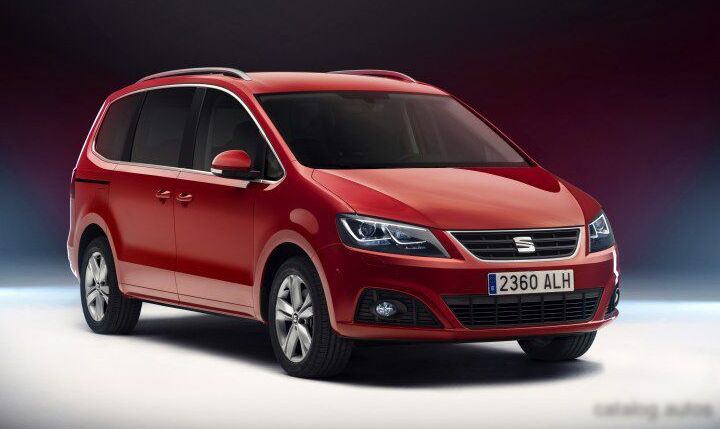
The Seat Alhambra II (7N), particularly the facelifted version introduced in May 2015, represents Seat’s entry into the large MPV (Multi-Purpose Vehicle) segment. Built in collaboration with Volkswagen – sharing a platform and many components with the VW Sharan – the Alhambra aimed to provide a spacious and practical vehicle for families. Production of this generation, including the 2.0 TDI 184 horsepower variant, continued until 2018. This specific engine and power output positioned the Alhambra as a mid-to-upper range offering within the lineup, appealing to buyers needing both performance and fuel efficiency in a large people carrier. The 7N series benefitted from significant improvements over the original Alhambra, focusing on interior refinement, safety features, and a more modern driving experience.
Powertrain & Engine Architecture
The 2.0 TDI engine in the 2015-2018 Seat Alhambra utilizes the common rail direct injection system, a hallmark of modern diesel engines. Engine codes CUWA and DFMA were commonly found in this application. This system delivers fuel directly into the combustion chamber at extremely high pressure, promoting efficient combustion and reducing emissions. The engine features a turbocharger with an intercooler, which forces more air into the cylinders, boosting power output. The 184 horsepower output is achieved through careful calibration of the engine management system and the turbocharger. The engine also incorporates four valves per cylinder, enhancing breathing and contributing to improved performance. The Alhambra used a 6-speed manual transmission as standard, providing a good balance between fuel economy and driver control. While an automatic transmission was available on other Alhambra trims, the 184 hp version was primarily offered with the manual gearbox in many markets.
Driving Characteristics
The 184 hp 2.0 TDI engine provides a noticeable step up in performance compared to lower-powered versions of the Alhambra. While not a sports car, the engine delivers ample torque – 380 Nm (280 lb-ft) – from low engine speeds, making it easy to accelerate even when fully loaded with passengers and luggage. The manual transmission allows for precise control, and the gear ratios are well-suited for both highway cruising and urban driving. Compared to the 140 hp engine, the 184 hp version feels significantly more relaxed on long journeys and offers quicker overtaking capabilities. The 6-speed gearbox helps to keep engine speeds reasonable at highway speeds, contributing to improved fuel economy and reduced noise levels. The Alhambra’s weight does impact acceleration, with a 0-60 mph time of around 8.5 seconds, but the focus is more on usability and comfort than outright speed.
Equipment & Trim Levels
The 2.0 TDI 184 hp Alhambra typically came with a generous level of standard equipment. This included features like air conditioning, electric windows and mirrors, a multi-function steering wheel, and an integrated audio system. Higher trim levels added features such as alloy wheels, parking sensors, a touchscreen infotainment system with navigation, and leather upholstery. Safety features were also comprehensive, including ABS, ESP (Electronic Stability Program), and multiple airbags. Optional extras included a panoramic sunroof, advanced parking assistance systems, and upgraded audio systems. The interior design was functional and modern, with a focus on practicality and durability. The Alhambra’s flexible seating configuration allowed for a variety of seating arrangements, maximizing space for passengers and cargo.
Chassis & Braking
The Alhambra II utilizes an independent suspension system on both the front and rear axles, providing a comfortable ride quality. The front suspension employs McPherson struts, while the rear features a multi-link setup. This configuration helps to absorb bumps and irregularities in the road surface, minimizing body roll and maintaining stability. The braking system consists of ventilated discs on the front wheels and solid discs on the rear. ABS (Anti-lock Braking System) is standard, providing enhanced braking performance in emergency situations. The steering is rack and pinion, offering precise and responsive handling. Stabilizer bars are fitted to both the front and rear axles to further reduce body roll and improve handling.
Market Reception & Comparison
The Seat Alhambra II, particularly the 2.0 TDI 184 hp variant, was generally well-received by automotive critics. It was praised for its spacious interior, comfortable ride, and fuel efficiency. The 184 hp engine was considered a good compromise between performance and economy, offering enough power for most driving situations without sacrificing fuel consumption. Compared to the lower-powered 140 hp engine, the 184 hp version was seen as a more refined and capable option. However, some critics noted that the Alhambra’s styling was somewhat conservative compared to some of its rivals. In terms of reliability, the Alhambra generally proved to be a dependable vehicle, although, like any car, it was not without its potential issues. Common issues included problems with the turbocharger and the diesel particulate filter.
Legacy
The Seat Alhambra II, including the 2.0 TDI 184 hp model, has established a reputation as a practical and reliable MPV. On the used car market, these models represent good value for money, offering a lot of space and features for a relatively affordable price. The 2.0 TDI engine is known for its durability, although regular maintenance is essential to ensure long-term reliability. The Alhambra’s spacious interior and flexible seating configuration continue to appeal to families, making it a popular choice in the used car market. While no longer in production, the Alhambra remains a well-regarded MPV, offering a compelling combination of practicality, comfort, and fuel efficiency.