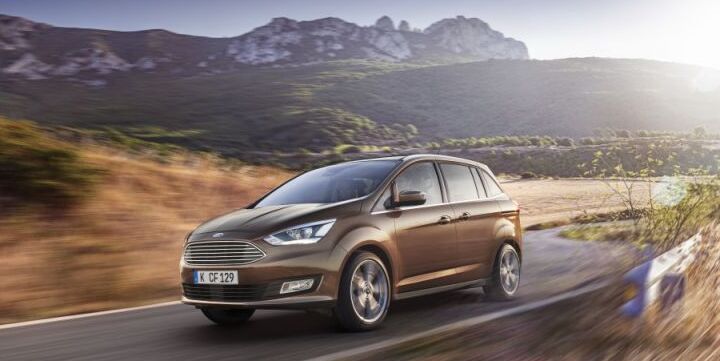
The Ford Grand C-MAX 2.0 TDCi (150 hp) S&S, produced from April 2015 to June 2019, represents a significant iteration of Ford’s compact multi-purpose vehicle (MPV) offering. Positioned as a mid-range option within the Grand C-MAX lineup, this variant aimed to balance fuel efficiency, practicality, and a reasonable level of performance for family transport. It falls within the second generation of the C-MAX, specifically the facelifted model (often referred to as the Mk2), built on the Ford C-platform. The “S&S” designation indicates the inclusion of Ford’s Auto-Start-Stop technology, designed to improve fuel economy in urban driving conditions.
Technical Specifications
| Brand | Ford |
| Model | C-MAX |
| Generation | Grand C-MAX (facelift 2015) |
| Type (Engine) | 2.0 TDCi (150 Hp) S&S |
| Start of production | April, 2015 |
| End of production | June, 2019 |
| Powertrain Architecture | Internal Combustion engine |
| Body type | MPV |
| Seats | 5 |
| Doors | 5 |
| Fuel consumption (urban) | 5.2 l/100 km (45.2 US mpg, 54.3 UK mpg, 19.2 km/l) |
| Fuel consumption (extra urban) | 4.2 l/100 km (56 US mpg, 67.3 UK mpg, 23.8 km/l) |
| Fuel consumption (combined) | 4.6 l/100 km (51.1 US mpg, 61.4 UK mpg, 21.7 km/l) |
| CO2 emissions | 119 g/km |
| Fuel Type | Diesel |
| Acceleration 0 – 100 km/h | 9.8 sec |
| Acceleration 0 – 62 mph | 9.8 sec |
| Acceleration 0 – 60 mph | 9.3 sec |
| Maximum speed | 202 km/h (125.52 mph) |
| Emission standard | Euro 6 |
| Weight-to-power ratio | 10 kg/Hp, 99.9 Hp/tonne |
| Weight-to-torque ratio | 3.8 kg/Nm, 266.3 Nm/tonne |
| Power | 150 Hp @ 3500 rpm |
| Power per litre | 75.1 Hp/l |
| Torque | 400 Nm @ 2000-2500 rpm (295.02 lb.-ft. @ 2000-2500 rpm) |
| Engine layout | Front, Transverse |
| Engine Model/Code | T7DB, T7DC, T7DD |
| Engine displacement | 1997 cm3 (121.86 cu. in.) |
| Number of cylinders | 4 |
| Engine configuration | Inline |
| Cylinder Bore | 85 mm (3.35 in.) |
| Piston Stroke | 88 mm (3.46 in.) |
| Compression ratio | 16:1 |
| Number of valves per cylinder | 4 |
| Fuel injection system | Diesel Commonrail |
| Engine aspiration | Turbocharger, Intercooler |
| Valvetrain | DOHC |
| Engine oil capacity | 5.65 l (5.97 US qt | 4.97 UK qt) |
| Coolant capacity | 8 l (8.45 US qt | 7.04 UK qt) |
| Kerb Weight | 1502 kg (3311.34 lbs.) |
| Max. weight | 2300 kg (5070.63 lbs.) |
| Max load | 798 kg (1759.29 lbs.) |
| Trunk (boot) space – minimum | 520 l (18.36 cu. ft.) |
| Trunk (boot) space – maximum | 1787 l (63.11 cu. ft.) |
| Fuel tank capacity | 60 l (15.85 US gal | 13.2 UK gal) |
| Max. roof load | 75 kg (165.35 lbs.) |
| Permitted trailer load with brakes (12%) | 1800 kg (3968.32 lbs.) |
| Permitted trailer load without brakes | 750 kg (1653.47 lbs.) |
| Permitted towbar download | 90 kg (198.42 lbs.) |
| Length | 4519 mm (177.91 in.) |
| Width | 1828 mm (71.97 in.) |
| Width with mirrors folded | 1858 mm (73.15 in.) |
| Width including mirrors | 2067 mm (81.38 in.) |
| Height | 1642 mm (64.65 in.) |
| Wheelbase | 2788 mm (109.76 in.) |
| Front track | 1543 mm (60.75 in.) |
| Rear track | 1554 mm (61.18 in.) |
| Minimum turning circle | 11.6 m (38.06 ft.) |
| Drivetrain | Front wheel drive |
| Number of gears | 6 |
| Gearbox type | Manual transmission |
| Front suspension | Independent, McPherson with coil spring and anti-roll bar |
| Rear suspension | Independent multi-link spring suspension with stabilizer |
| Front brakes | Ventilated discs, 300×25 mm |
| Rear brakes | Disc, 280×11 mm |
| Assisting systems | ABS (Anti-lock braking system) |
| Steering type | Steering rack and pinion |
| Power steering | Electric |
| Tires size | 205/55 R16; 215/55 R16; 215/50 R17; 235/40 R18 |
| Wheel rims size | 6.5J x 16; 7J x 16; 7J x 17; 8J x 18 |
INTRODUCTION
The Ford Grand C-MAX 2.0 TDCi (150 hp) S&S, launched in 2015 following a facelift of the original model, offered a practical and relatively efficient option in the European MPV segment. The Grand C-MAX, distinguished by its seven-seat configuration, catered to families needing extra space and versatility. This particular variant, powered by the 2.0-liter turbodiesel engine, aimed to provide a balance between performance and fuel economy, making it a popular choice for those covering significant distances. The facelift brought updated styling, improved interior materials, and enhanced technology compared to the pre-2015 models.
Powertrain & Engine Architecture
At the heart of this Grand C-MAX variant lies Ford’s 2.0-liter TDCi diesel engine, specifically utilizing the T7DB, T7DC, or T7DD engine code depending on the specific market and production date. This engine is a four-cylinder, inline configuration, featuring a common-rail direct fuel injection system. The system operates at very high pressures to atomize the fuel for efficient combustion. The engine also incorporates a turbocharger with an intercooler to increase power output and improve torque. The double overhead camshaft (DOHC) valvetrain, with four valves per cylinder, further enhances breathing and contributes to the engine’s performance. The Auto-Start-Stop system, denoted by the “S&S” badge, automatically shuts off the engine when the vehicle is stationary (e.g., at traffic lights) and restarts it when the driver depresses the clutch or selects ‘Drive’, reducing fuel consumption and emissions. The engine produces 150 horsepower at 3500 rpm and a substantial 400 Nm (295 lb-ft) of torque between 2000 and 2500 rpm. This torque output is a key characteristic of modern turbodiesel engines, providing strong pulling power for everyday driving and when carrying a full load.
Driving Characteristics
The 2.0 TDCi engine, paired with a six-speed manual transmission, delivers a respectable driving experience. While not overtly sporty, the engine provides ample power for overtaking and maintaining comfortable cruising speeds. The 9.8-second 0-62 mph acceleration time is adequate for most drivers, and the engine feels responsive thanks to the readily available torque. Compared to the lower-powered 1.6-liter TDCi variants, the 2.0-liter offers noticeably more punch, especially when fully loaded. The six-speed gearbox is well-matched to the engine’s characteristics, providing smooth shifts and allowing the driver to keep the engine in its optimal torque band. The manual transmission also gives the driver more control over gear selection compared to the optional automatic transmission available on other C-MAX trims. The suspension setup, tuned for comfort, provides a reasonably compliant ride, although it can feel slightly firm on rougher road surfaces.
Equipment & Trim Levels
The 2.0 TDCi (150 hp) S&S typically came equipped as a mid-range trim level, offering a good balance of features. Standard equipment generally included air conditioning, a basic audio system with USB connectivity, alloy wheels, and electric front and rear windows. Higher trim levels, such as Titanium, added features like automatic climate control, a more advanced infotainment system with touchscreen display, rear parking sensors, and upgraded interior trim. Optional extras included navigation, panoramic sunroof, and leather upholstery. Interior upholstery was typically cloth, with options for partial leather trim on higher-spec models. The dashboard layout was functional and user-friendly, with logically arranged controls.
Chassis & Braking
The Grand C-MAX features an independent suspension setup on both the front and rear axles. The front utilizes a McPherson strut design, while the rear employs a multi-link system. This configuration provides a good balance between ride comfort and handling. The front brakes are ventilated discs, providing strong stopping power, while the rear brakes are solid discs. Anti-lock Braking System (ABS) is standard, enhancing safety during emergency braking situations. The steering is electrically assisted, providing a light and precise feel. Stabilizer bars are fitted to both the front and rear axles to reduce body roll during cornering.
Market Reception & Comparison
The Ford Grand C-MAX 2.0 TDCi (150 hp) S&S was generally well-received by automotive critics. It was praised for its spacious interior, practical design, and fuel-efficient engine. However, some reviewers noted that the interior plastics could feel a little low-rent in certain areas. Compared to the 1.6-liter TDCi variants, the 2.0-liter offered significantly better performance, making it a more suitable choice for those who frequently carry passengers or luggage. The 2.0 TDCi also offered better fuel economy than the petrol-powered options. Against competitors like the Volkswagen Touran and Citroën C4 Picasso, the Grand C-MAX offered a competitive package in terms of price, space, and features.
Legacy
The 2.0 TDCi engine, in various iterations, has proven to be a relatively reliable powertrain. However, like all diesel engines, it’s important to ensure regular maintenance, including oil changes and filter replacements. Potential issues to watch out for include diesel particulate filter (DPF) clogging, particularly on vehicles used primarily for short journeys. The Grand C-MAX 2.0 TDCi (150 hp) S&S remains a popular choice in the used car market, offering a practical and affordable option for families. Its combination of space, fuel efficiency, and reasonable performance continues to appeal to buyers looking for a versatile MPV.