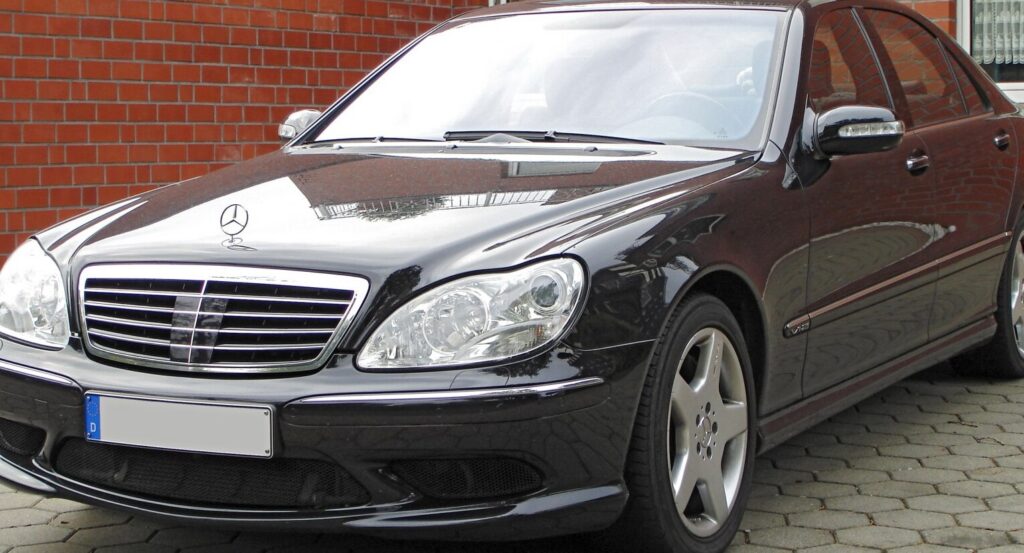
The Mercedes-Benz S-Class Long (V220), specifically the facelifted version produced from 2002 to 2003, represented the pinnacle of German luxury and engineering. The S 500 V8 variant, equipped with the 5G-TRONIC automatic transmission, was a key model within the range, offering a blend of performance and comfort aimed at discerning buyers. This long-wheelbase version, designated internally as the V220, catered to markets – including the United States – where rear passenger space was highly valued. It sat towards the upper end of the S-Class lineup, positioned below the even more exclusive S 600 models but above the S 430 and S 320.
Technical Specifications
| Brand | Mercedes-Benz |
| Model | S-class |
| Generation | S-class Long (V220, facelift 2002) |
| Type (Engine) | S 500 V8 (306 Hp) 5G-TRONIC |
| Start of production | August, 2002 |
| End of production | August, 2003 |
| Powertrain Architecture | Internal Combustion engine |
| Body type | Sedan |
| Seats | 5 |
| Doors | 4 |
| Fuel consumption (economy) – urban (NEDC) | 18 l/100 km (13.1 US mpg, 15.7 UK mpg, 5.6 km/l) |
| Fuel consumption (economy) – extra urban (NEDC) | 8.7 l/100 km (27 US mpg, 32.5 UK mpg, 11.5 km/l) |
| Fuel consumption (economy) – combined (NEDC) | 11.9 l/100 km (19.8 US mpg, 23.7 UK mpg, 8.4 km/l) |
| CO2 emissions (NEDC) | 285 g/km |
| Fuel Type | Petrol (Gasoline) |
| Acceleration 0 – 100 km/h | 6.5 sec |
| Acceleration 0 – 62 mph | 6.5 sec |
| Acceleration 0 – 60 mph | 6.2 sec |
| Maximum speed | 250 km/h (155.34 mph), Electronically limited |
| Emission standard | Euro 4 |
| Weight-to-power ratio | 5.9 kg/Hp, 168.1 Hp/tonne |
| Weight-to-torque ratio | 4 kg/Nm, 252.7 Nm/tonne |
| Power | 306 Hp @ 5600 rpm |
| Power per litre | 61.6 Hp/l |
| Torque | 460 Nm @ 2700-4250 rpm (339.28 lb.-ft. @ 2700-4250 rpm) |
| Maximum engine speed | 6400 rpm |
| Engine layout | Front, Longitudinal |
| Engine Model/Code | M 113.960 |
| Engine displacement | 4966 cm3 (303.04 cu. in.) |
| Number of cylinders | 8 |
| Engine configuration | V-engine |
| Cylinder Bore | 97 mm (3.82 in.) |
| Piston Stroke | 84 mm (3.31 in.) |
| Compression ratio | 10:1 |
| Number of valves per cylinder | 3 |
| Fuel injection system | Multi-port manifold injection |
| Engine aspiration | Naturally aspirated engine |
| Valvetrain | SOHC |
| Engine oil capacity | 8 l (8.45 US qt | 7.04 UK qt) |
| Kerb Weight | 1820 kg (4012.41 lbs.) |
| Max. weight | 2420 kg (5335.19 lbs.) |
| Max load | 600 kg (1322.77 lbs.) |
| Trunk (boot) space – minimum | 500 l (17.66 cu. ft.) |
| Fuel tank capacity | 88 l (23.25 US gal | 19.36 UK gal) |
| Length | 5163 mm (203.27 in.) |
| Width | 1855 mm (73.03 in.) |
| Width including mirrors | 2092 mm (82.36 in.) |
| Height | 1444 mm (56.85 in.) |
| Wheelbase | 3085 mm (121.46 in.) |
| Front track | 1574 mm (61.97 in.) |
| Rear (Back) track | 1574 mm (61.97 in.) |
| Front overhang | 872 mm (34.33 in.) |
| Rear overhang | 1206 mm (47.48 in.) |
| Minimum turning circle | 12.1 m (39.7 ft.) |
| Drivetrain Architecture | Rear wheel drive |
| Drive wheel | Rear wheel drive |
| Number of gears and type of gearbox | 5 gears, automatic transmission G-TRONIC |
| Front suspension | Independent multi-link suspension, Transverse stabilizer, Air suspension |
| Rear suspension | Independent multi-link suspension, Air suspension, Transverse stabilizer |
| Front brakes | Ventilated discs |
| Rear brakes | Ventilated discs |
| Assisting systems | ABS (Anti-lock braking system) |
| Steering type | Steering rack and pinion |
| Power steering | Hydraulic Steering |
| Tires size | 225/60 R17 |
| Wheel rims size | 7.5J x 16 |
INTRODUCTION
The S 500 V8 with the 5G-TRONIC transmission, produced from 2002-2003, was a significant iteration of the W220 S-Class. The W220, launched in 1998, aimed to re-establish Mercedes-Benz as the leader in luxury sedans, and the facelifted version addressed some of the initial criticisms regarding its styling and electronic complexity. The “Long” wheelbase variant added approximately 120mm (4.7 inches) to the standard S-Class, providing substantially more rear legroom. This model was particularly popular in markets like the United States, China, and other regions where chauffeur-driven travel was common. The S 500 V8 represented a sweet spot in the lineup, offering strong performance without the outright expense of the flagship S 600.
Powertrain & Engine Architecture
At the heart of the S 500 V8 lay the M113.960 engine, a 4.966-liter naturally aspirated V8. This engine was a three-valve-per-cylinder design, utilizing a single overhead camshaft (SOHC) configuration. It featured multi-port fuel injection and a compression ratio of 10:1. The M113 engine family was known for its smoothness and reliability. The 5G-TRONIC transmission, a five-speed automatic, was a crucial component of the driving experience. This transmission was electronically controlled and offered a smooth, refined shift quality. It featured adaptive shift programs that adjusted to the driver’s style and road conditions. The transmission’s gear ratios were tuned for a balance of acceleration and fuel efficiency, prioritizing comfort over outright sportiness.
Driving Characteristics
The S 500 V8, despite its size and weight, delivered surprisingly brisk performance. The 306 horsepower and 339 lb-ft of torque allowed for a 0-60 mph time of around 6.2 seconds. While not a sports car, the engine provided ample power for effortless highway cruising and confident overtaking. The 5G-TRONIC transmission contributed to a relaxed driving experience, with smooth gear changes and a lack of harshness. Compared to the S 320, the S 500 offered a noticeable increase in power and acceleration. The S 600, with its V12 engine, provided even greater performance, but at a significant price premium. The automatic transmission, while refined, didn’t offer the same level of driver engagement as the available manual transmissions in other S-Class models.
Equipment & Trim Levels
The S 500 V8 came standard with a comprehensive list of luxury features. These included leather upholstery, wood trim, power-adjustable heated and ventilated front seats, a premium sound system, automatic climate control, and a sunroof. The long-wheelbase model also featured power-adjustable rear seats with massage functions. Optional extras included a rear entertainment system, parking assist, and upgraded leather options. The interior design emphasized elegance and comfort, with a focus on high-quality materials and meticulous craftsmanship.
Chassis & Braking
The S-Class V220 featured an independent multi-link suspension at all four corners, enhanced by Mercedes’ Airmatic air suspension system. This system provided a remarkably smooth and comfortable ride, automatically adjusting the suspension damping to suit road conditions. The S 500 V8 was equipped with ventilated disc brakes on all four wheels, coupled with an Anti-lock Braking System (ABS) for enhanced safety. The suspension was tuned for comfort, prioritizing ride quality over sharp handling. Stabilizer bars were fitted front and rear to reduce body roll during cornering.
Market Reception & Comparison
The S 500 V8 was generally well-received by automotive critics. It was praised for its luxurious interior, comfortable ride, and strong performance. However, some reviewers noted that the car’s size and weight could make it feel cumbersome in tight spaces. Fuel economy, at around 19.8 US mpg combined, was considered average for a vehicle in this class. Compared to the S 430, the S 500 offered a more powerful engine and a more refined driving experience. The S 600, while offering superior performance, was significantly more expensive and less fuel-efficient.
Legacy
The M113 engine family, including the one found in the S 500 V8, has proven to be remarkably durable and reliable. With proper maintenance, these engines can easily exceed 200,000 miles. The 5G-TRONIC transmission is also generally reliable, although some units may require servicing over time. Today, the W220 S-Class, including the S 500 V8, represents a compelling value on the used car market. It offers a level of luxury and refinement that is difficult to find in more modern vehicles at a similar price point. However, potential buyers should be aware of the potential for age-related maintenance issues, such as air suspension problems and electronic component failures. The S 500 V8 remains a testament to Mercedes-Benz’s engineering prowess and its commitment to building luxurious, long-lasting automobiles.