
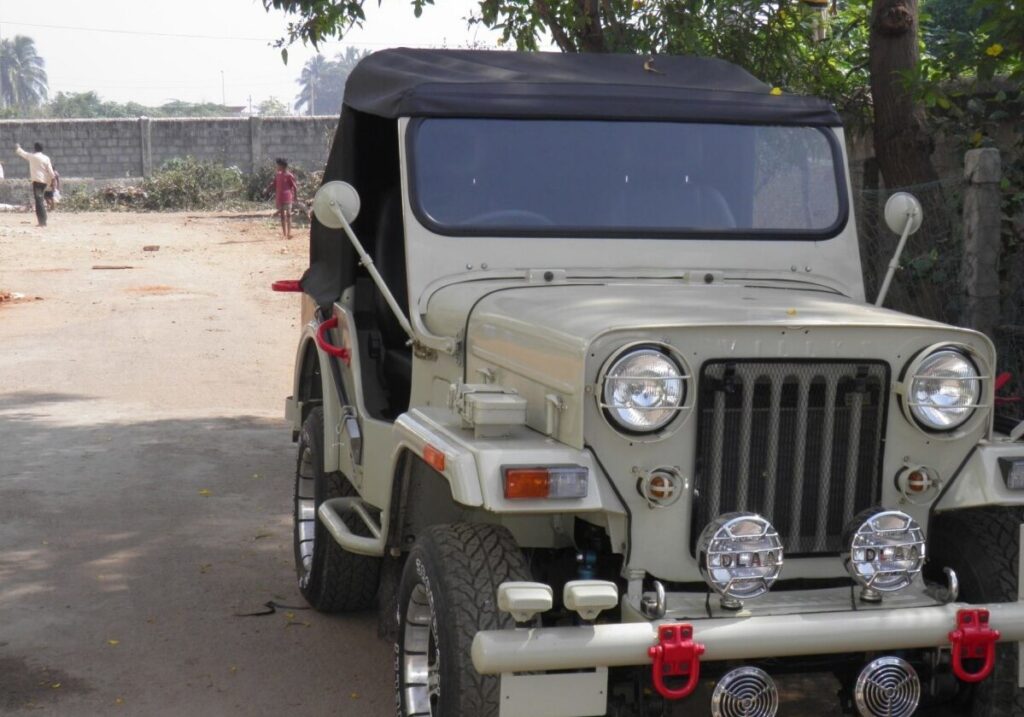
The Mahindra CJ 3 2.1D, produced between 1988 and 1992, represents a significant iteration of the iconic CJ (Civilian Jeep) series in the Indian automotive landscape. This variant, powered by a 2.1-liter diesel engine producing 63 horsepower, served as a workhorse vehicle primarily aimed at rural markets and utility applications. It built upon the foundation laid by earlier CJ models, offering increased diesel power and a robust, simple design suited to challenging terrains and demanding tasks. The CJ 3 2.1D occupied a crucial position in Mahindra’s lineup, providing an affordable and durable off-road vehicle for farmers, foresters, and other users requiring a dependable transportation solution.
Technical Specifications
| Brand | Mahindra |
| Model | CJ 3 |
| Generation | CJ 3 |
| Type (Engine) | 2.1 D (63 Hp) |
| Start of Production | 1988 |
| End of Production | 1992 |
| Powertrain Architecture | Internal Combustion Engine |
| Body Type | Off-road Vehicle |
| Fuel Type | Diesel |
| Power | 63 Hp |
| Engine Aspiration | Naturally Aspirated |
Powertrain & Engine Architecture
The heart of the CJ 3 2.1D is its 2.1-liter, naturally aspirated diesel engine. This engine, while relatively simple in design, was known for its durability and ability to produce usable torque at low engine speeds – a critical characteristic for off-road applications. The engine utilizes a direct injection diesel system, common for the era, which contributes to its fuel efficiency, though at the expense of some refinement. Details regarding the specific injection pump used are often variant-dependent within the 2.1D range, but generally, it was a mechanically governed rotary pump. The engine features a cast iron block and head, contributing to its robustness. The valvetrain consists of a single overhead camshaft operating two valves per cylinder. Unlike many modern diesel engines, turbocharging or intercooling were not employed in this variant, prioritizing simplicity and cost-effectiveness over peak power output. The engine is mated to a four-speed manual transmission, selected for its durability and straightforward operation. The transmission sends power to a part-time four-wheel-drive system, allowing the driver to engage four-wheel drive when needed for increased traction in off-road conditions.
Driving Characteristics
The driving experience of the CJ 3 2.1D is defined by its utilitarian nature. With only 63 horsepower, acceleration is modest, and the vehicle is not designed for high-speed driving. However, the engine’s torque characteristics provide sufficient power for navigating rough terrain and hauling moderate loads. The four-speed manual transmission requires deliberate shifting, and the gear ratios are optimized for low-speed crawling rather than rapid acceleration. The part-time four-wheel-drive system, when engaged, provides excellent traction on loose surfaces, but is not intended for use on paved roads. Steering is typically non-power-assisted, requiring considerable effort, especially at low speeds. The suspension, consisting of leaf springs front and rear, provides a firm ride, prioritizing load-carrying capacity and durability over comfort. Compared to potential gasoline-powered CJ variants (though less common in this generation), the 2.1D offers significantly improved fuel economy and a more robust powertrain, albeit with reduced overall performance.
Equipment & Trim Levels
The Mahindra CJ 3 2.1D was intentionally kept basic in terms of equipment and trim. It was designed as a functional vehicle, not a luxury one. Standard features typically included a basic dashboard with minimal instrumentation (speedometer, fuel gauge, and potentially an ammeter), simple bench seats upholstered in vinyl, and a folding windshield. Doors were often equipped with basic latches and minimal weather sealing. Optional extras were limited, but could include a hardtop, a winch, and potentially a basic radio. The interior was generally spartan, with a focus on durability and ease of cleaning. There wasn’t a significant range of trim levels; the CJ 3 2.1D was largely standardized, with variations primarily stemming from optional accessories added by the dealer or owner.
Chassis & Braking
The CJ 3 2.1D utilizes a robust ladder frame chassis, providing a solid foundation for off-road use. The suspension system consists of leaf springs at both the front and rear, with solid axles providing ample articulation for navigating uneven terrain. Braking is typically accomplished via drum brakes on all four wheels, which were standard for vehicles of this type and price point during the production period. Power steering was not typically offered on this variant, requiring manual effort for steering. The tires are typically heavy-duty, multi-ply tires designed for off-road use, prioritizing durability and traction over ride comfort. The vehicle’s relatively high ground clearance further enhances its off-road capability.
Market Reception & Comparison
The Mahindra CJ 3 2.1D was well-received in its target market – rural India. Its affordability, durability, and off-road capability made it an ideal vehicle for farmers, foresters, and other users requiring a dependable workhorse. Critics generally praised its robustness and simplicity, but noted its lack of refinement and limited performance. Compared to other vehicles in its class, such as the Tata Sumo (which offered more passenger capacity and a slightly more refined experience), the CJ 3 2.1D excelled in pure off-road capability and simplicity of maintenance. Fuel economy was a significant advantage over gasoline-powered alternatives. The 2.1D engine, while not powerful, proved to be remarkably reliable and relatively inexpensive to repair, making it a popular choice for those prioritizing practicality over performance.
Legacy
The Mahindra CJ 3 2.1D holds a significant place in Indian automotive history. It represents a pivotal moment in Mahindra’s development as a leading manufacturer of off-road vehicles. The 2.1-liter diesel engine, while superseded by more modern designs, proved to be exceptionally durable, and many examples remain in service today. In the used car market, well-maintained CJ 3 2.1Ds are sought after by enthusiasts and collectors, particularly those interested in preserving a piece of Indian automotive heritage. The vehicle’s simple design and readily available parts make it relatively easy to maintain and repair, contributing to its enduring popularity. The CJ 3 2.1D laid the groundwork for subsequent Mahindra off-road vehicles, establishing a reputation for robustness and reliability that continues to this day. While not a technologically advanced vehicle by modern standards, its enduring legacy is a testament to its practical design and unwavering dependability.

