
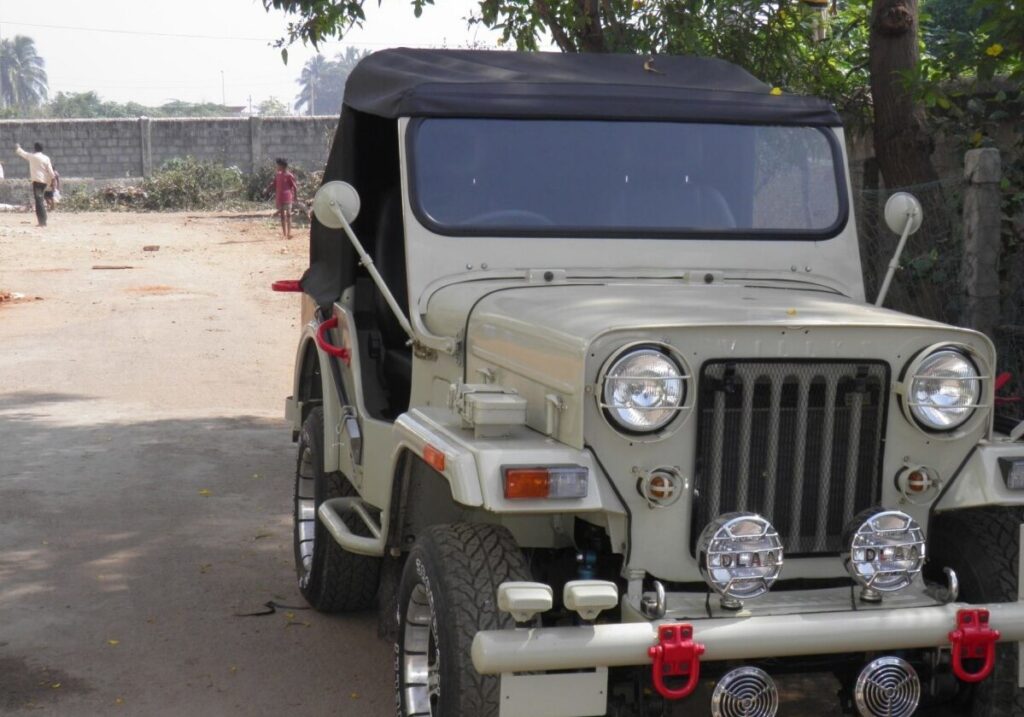
The Mahindra CJ 3 2.2, produced between 1988 and 1992, represents a significant iteration of the iconic CJ (Civilian Jeep) series manufactured by Mahindra & Mahindra Limited in India. This variant, powered by a 2.2-liter gasoline engine producing 72 horsepower, served as a workhorse vehicle primarily for agricultural, utility, and limited recreational purposes within the Indian market. It was a direct descendant of the original Willys Jeep design, adapted and refined over decades by Mahindra, and played a crucial role in the motorization of rural India. The CJ 3 2.2 occupied a position as a relatively affordable and robust off-road vehicle, bridging the gap between earlier, less powerful CJ models and later, more sophisticated offerings.
Technical Specifications
| Brand | Mahindra |
| Model | CJ 3 |
| Generation | CJ 3 |
| Type (Engine) | 2.2 (72 Hp) |
| Start of Production | 1988 |
| End of Production | 1992 |
| Powertrain Architecture | Internal Combustion Engine |
| Body Type | Off-road Vehicle |
| Fuel Type | Petrol (Gasoline) |
| Power | 72 Hp |
| Engine Aspiration | Naturally Aspirated |
Powertrain & Engine Architecture
The heart of the CJ 3 2.2 is its 2.2-liter, four-cylinder gasoline engine. While specific engine codes aren’t widely documented for this period of Mahindra production, the engine is based on Mahindra’s long-running gasoline engine family, derived from the Willys inline-four. It’s a naturally aspirated engine, meaning it doesn’t employ a turbocharger or supercharger to force air into the cylinders. Fuel delivery is managed by a carburetor, a common feature for vehicles of this era and market segment. The engine utilizes a relatively simple overhead valve (OHV) valvetrain, with two valves per cylinder. The 72 horsepower output is achieved at a relatively low engine speed, prioritizing torque for off-road capability rather than outright speed. The engine is coupled to a four-speed manual transmission, which was the standard configuration for the CJ 3 2.2. Automatic transmissions were not offered on this model. The drivetrain is a traditional part-time four-wheel drive system, with a transfer case allowing the driver to switch between two-wheel drive (rear-wheel drive) and four-wheel drive modes as needed.
Driving Characteristics
The driving experience of the CJ 3 2.2 is characterized by its ruggedness and simplicity. With only 72 horsepower, acceleration is modest, and the vehicle is not designed for high-speed driving. However, the engine produces a respectable amount of low-end torque, making it capable of tackling steep inclines and rough terrain. The four-speed manual transmission requires deliberate shifting, and the gear ratios are optimized for off-road performance. The part-time four-wheel drive system provides excellent traction in challenging conditions, but it’s crucial to engage four-wheel drive only on loose surfaces to avoid drivetrain damage. Steering is typically non-power assisted, requiring considerable effort, especially at low speeds. The suspension, consisting of leaf springs front and rear, provides a firm ride, prioritizing durability over comfort. Compared to potential future iterations with diesel engines, the 2.2 gasoline variant offered less torque but a slightly more responsive feel at higher RPMs. It was less fuel-efficient than the diesel options, a significant consideration for many Indian buyers.
Equipment & Trim Levels
The Mahindra CJ 3 2.2 was a utilitarian vehicle, and as such, it was equipped with minimal creature comforts. Standard features typically included basic steel wheels, a simple dashboard with essential gauges (speedometer, fuel gauge, and temperature gauge), and bench seating upholstered in vinyl. Doors were often equipped with simple latches and wind-up windows. A basic windshield wiper system was standard, but features like heaters, radios, or more elaborate interior trim were generally not included. The CJ 3 2.2 was offered in a limited number of colors, typically consisting of basic shades of green, blue, and red. Optional extras were scarce, but some buyers might have added aftermarket accessories such as a roll cage, a winch, or upgraded tires. The trim level was largely uniform across all CJ 3 2.2 models, with variations primarily stemming from individual owner modifications.
Chassis & Braking
The chassis of the CJ 3 2.2 is a body-on-frame construction, utilizing a ladder frame design for maximum strength and durability. The suspension system consists of leaf springs at both the front and rear, providing a robust and simple solution for off-road use. The front axle is a solid axle, while the rear axle is also a solid axle, contributing to the vehicle’s off-road capability. Braking is accomplished via drum brakes on all four wheels. The braking system is mechanically operated, lacking power assistance. Steering is a recirculating ball system, known for its simplicity and durability, but requiring significant driver effort. The relatively simple chassis and braking systems were chosen for their reliability and ease of maintenance, crucial considerations in the Indian market.
Market Reception & Comparison
The Mahindra CJ 3 2.2 was well-received in the Indian market as a dependable and affordable off-road vehicle. It was particularly popular among farmers, landowners, and those requiring a rugged vehicle for work in rural areas. Critics at the time praised its simplicity, durability, and off-road capability. However, the gasoline engine was often criticized for its relatively low fuel economy compared to the diesel-powered CJ models. The 2.2 gasoline variant was positioned as an entry-level option within the CJ lineup, appealing to buyers who prioritized affordability over fuel efficiency or outright performance. Compared to the later CJ 500 Diesel, the 2.2 offered less torque and fuel economy but a slightly more responsive engine. The CJ 3 2.2 competed with other locally manufactured utility vehicles, but its Willys Jeep heritage and Mahindra’s reputation for reliability gave it a competitive edge.
Legacy
The Mahindra CJ 3 2.2 holds a significant place in the history of the Indian automotive industry. It represents a crucial step in the evolution of the CJ series and helped establish Mahindra & Mahindra as a leading manufacturer of utility vehicles. While the 2.2 gasoline engine is no longer in production, the CJ 3 2.2 remains a popular vehicle among enthusiasts and collectors in India. Its simple mechanical design and readily available parts make it relatively easy to maintain and repair. In the used car market today, well-maintained examples of the CJ 3 2.2 can fetch reasonable prices, particularly among those seeking a classic off-road vehicle with a rich heritage. The powertrain, while not known for exceptional longevity compared to later diesel iterations, is generally considered reliable if properly maintained, and parts availability remains good within India. The CJ 3 2.2 serves as a reminder of a simpler era in automotive history, when ruggedness and practicality were prioritized over luxury and sophistication.

