
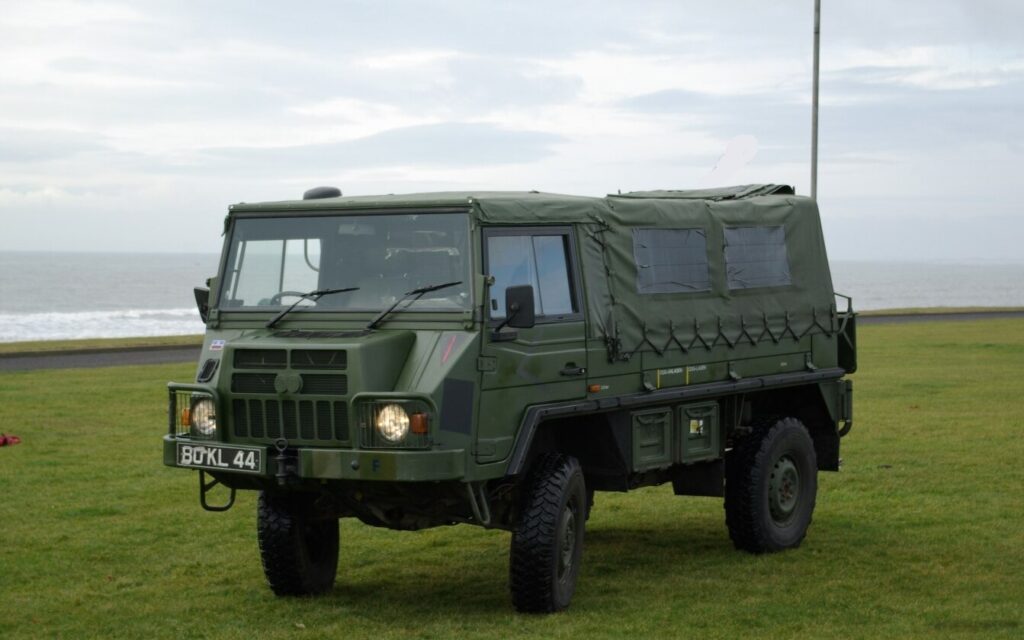
The Puch Pinzgauer 2.4 TD, produced from 1971 to 2000, represents a significant iteration of the Austrian-built, all-terrain vehicle renowned for its robust construction and exceptional off-road capability. This 2.4-liter turbocharged diesel variant, delivering 115 horsepower, occupied a crucial role within the Pinzgauer lineup, offering a balance of power, fuel efficiency, and durability that appealed to a diverse range of operators, from military personnel to civilian adventurers. The Pinzgauer, originally designed to meet the demanding requirements of the Austrian Armed Forces, quickly gained a reputation for its ability to traverse challenging terrain, a characteristic that defined its long production run and enduring legacy.
Technical Specifications
| Brand | PUCH |
| Model | Pinzgauer |
| Generation | Pinzgauer |
| Type (Engine) | 2.4 TD (115 Hp) |
| Start of Production | 1971 |
| End of Production | 2000 |
| Powertrain Architecture | Internal Combustion Engine |
| Body Type | Off-Road Vehicle |
| Fuel Type | Diesel |
| Power | 115 Hp |
| Engine Aspiration | Turbocharger |
Powertrain & Engine Architecture
The heart of the Pinzgauer 2.4 TD is a 2.4-liter, four-cylinder diesel engine. While the exact engine code varied depending on the production year and specific market, it generally falls within the Steyr Diesel/Mercedes-Benz OM616 family. This engine is a naturally aspirated, indirect injection diesel, known for its longevity and relatively simple mechanical design. The addition of a turbocharger significantly boosted power output to 115 horsepower, a substantial increase over the naturally aspirated versions. The turbocharger improved torque delivery, particularly at lower engine speeds, enhancing the vehicle’s ability to climb steep inclines and navigate difficult obstacles.
The engine features a robust cast iron block and head, contributing to its durability. Fuel injection is handled by a mechanical Bosch inline pump, a system favored for its reliability and ease of maintenance. The engine’s valvetrain utilizes a single overhead camshaft, operating two valves per cylinder. The transmission is typically a five-speed manual, although some civilian models were equipped with an optional four-speed automatic. The automatic transmission, while offering convenience, was generally considered less robust than the manual and slightly less efficient in demanding off-road conditions. The Pinzgauer’s drivetrain is characterized by permanent all-wheel drive, with a two-speed transfer case providing selectable high and low ranges for enhanced off-road performance.
Driving Characteristics
The Pinzgauer 2.4 TD, even with the turbocharger, isn’t about blistering speed. Its strength lies in its immense torque and tenacious traction. The 115 horsepower provides adequate power for maintaining highway speeds, but the vehicle truly shines when tackling challenging terrain. The turbocharger helps mitigate some of the diesel engine’s inherent lag, providing a more responsive feel than naturally aspirated versions. The five-speed manual transmission allows the driver to precisely control engine speed and torque delivery, maximizing performance in off-road situations. The automatic transmission, while convenient, can feel sluggish and may hunt for gears on steep inclines.
The Pinzgauer’s high ground clearance and exceptional approach, departure, and breakover angles enable it to navigate obstacles that would stop most other vehicles. The permanent all-wheel drive system, coupled with the two-speed transfer case, ensures maximum traction in even the most challenging conditions. The vehicle’s relatively short wheelbase contributes to its maneuverability in tight spaces. However, the Pinzgauer’s tall and narrow profile can make it susceptible to rollovers on steep side slopes, requiring careful driving and weight distribution.
Equipment & Trim Levels
The Pinzgauer was never intended to be a luxury vehicle. Its design prioritized functionality and durability over comfort and refinement. As such, the 2.4 TD variant typically featured a spartan interior. Standard equipment included basic steel wheels, vinyl or cloth seats, and a simple dashboard with essential gauges. Civilian models often received upgrades such as more comfortable seating, a radio, and optional winches. Military versions were typically equipped with specialized features such as mounting points for weapons, radio equipment, and cargo securing systems.
Trim levels were minimal. The primary differentiation between models was based on body style (e.g., open-top, closed-top, ambulance) and intended use (military vs. civilian). Optional extras included a hardtop, a canvas cover, auxiliary lighting, and a variety of storage solutions. The Pinzgauer’s interior was designed to be easily cleaned and maintained, reflecting its utilitarian purpose.
Chassis & Braking
The Pinzgauer’s chassis is a ladder frame construction, renowned for its strength and rigidity. The suspension system utilizes leaf springs and solid axles, providing exceptional articulation and off-road capability. The front and rear axles are equipped with heavy-duty differentials, ensuring reliable power delivery to all four wheels. Braking systems varied depending on the production year and model. Earlier models typically featured drum brakes on all four wheels, while later models received front disc brakes for improved stopping power. Power steering was not standard on all models, and many Pinzgauers require significant steering effort, particularly at low speeds.
The vehicle’s robust construction and high ground clearance contribute to its ability to withstand harsh conditions. However, the leaf spring suspension can provide a somewhat harsh ride on paved roads. The Pinzgauer’s relatively narrow track width can also make it feel less stable on high-speed corners.
Market Reception & Comparison
The Pinzgauer 2.4 TD received generally positive reviews from those who valued its off-road capability and durability. Critics praised its robust construction, exceptional traction, and ability to traverse challenging terrain. However, the vehicle was often criticized for its spartan interior, harsh ride, and relatively slow speed. Compared to other off-road vehicles of the era, such as the Land Rover Defender and the Jeep Wrangler, the Pinzgauer offered a unique combination of ruggedness, reliability, and simplicity. The 2.4 TD variant was often seen as a good compromise between the underpowered naturally aspirated versions and the more expensive and complex high-performance models.
Fuel economy was reasonable for a vehicle of its size and capability, typically ranging from 18 to 22 miles per gallon. Reliability was generally excellent, thanks to the engine’s simple mechanical design and robust construction. However, maintenance could be time-consuming and expensive, requiring specialized knowledge and tools.
Legacy
The Puch Pinzgauer 2.4 TD has earned a devoted following among off-road enthusiasts and collectors. Its robust construction, exceptional capability, and unique styling have made it a sought-after vehicle in the used car market. The 2.4 TD variant is particularly valued for its balance of power, fuel efficiency, and reliability. While parts availability can be a challenge, a growing network of suppliers and enthusiasts is helping to keep these vehicles on the road. The Pinzgauer’s legacy as a rugged and capable all-terrain vehicle remains secure, and it continues to be appreciated for its ability to conquer even the most challenging terrain.
