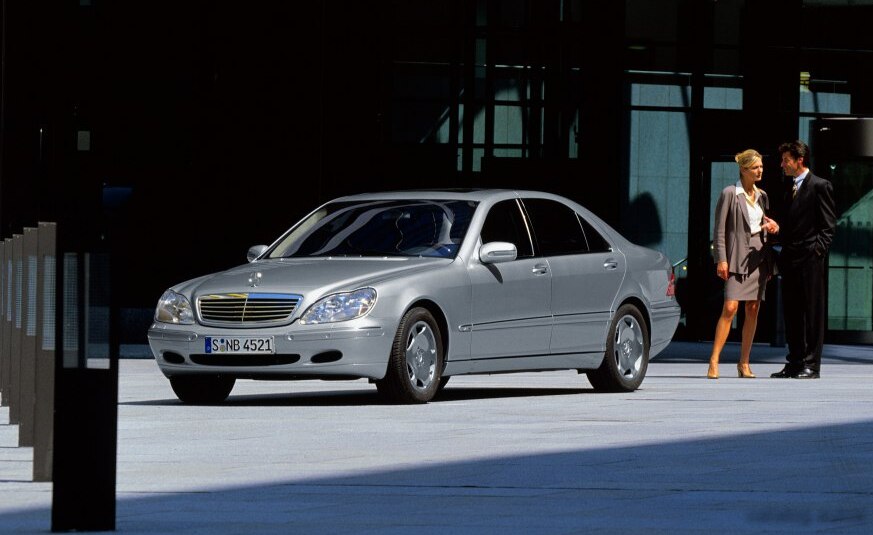
The Mercedes-Benz S-Class Long (V220) S 430, produced from 1998 to 2002, represented a significant evolution in luxury sedan design and technology. As part of the W220 series, the S 430 occupied a crucial position in the lineup, offering a compelling blend of performance, comfort, and advanced features. The “Long” designation indicated an extended wheelbase, providing enhanced rear passenger space – a particularly important feature in markets like Europe and Asia where chauffeur-driven luxury was highly valued. In the United States, the S 430 was positioned as a premium offering, bridging the gap between the standard S 320 and the flagship S 500 models.
Technical Specifications
| Brand | Mercedes-Benz |
| Model | S-class |
| Generation | S-class Long (V220) |
| Type (Engine) | S 430 V8 (279 Hp) 5G-TRONIC |
| Start of production | 1998 |
| End of production | 2002 |
| Powertrain Architecture | Internal Combustion engine |
| Body type | Sedan |
| Seats | 5 |
| Doors | 4 |
| Fuel consumption (urban) | 17.7 l/100 km (13.3 US mpg, 16 UK mpg, 5.6 km/l) |
| Fuel consumption (extra urban) | 9.2 l/100 km (25.6 US mpg, 30.7 UK mpg, 10.9 km/l) |
| Fuel consumption (combined) | 12.3 l/100 km (19.1 US mpg, 23 UK mpg, 8.1 km/l) |
| CO2 emissions | 294 g/km |
| Fuel Type | Petrol (Gasoline) |
| Acceleration 0 – 100 km/h | 7.3 sec |
| Acceleration 0 – 62 mph | 7.3 sec |
| Acceleration 0 – 60 mph | 6.9 sec |
| Maximum speed | 250 km/h (155.34 mph) |
| Weight-to-power ratio | 6.5 kg/Hp, 155 Hp/tonne |
| Weight-to-torque ratio | 4.5 kg/Nm, 222.2 Nm/tonne |
| Power | 279 Hp @ 5750 rpm |
| Power per litre | 65.4 Hp/l |
| Torque | 400 Nm @ 3000-4400 rpm (295.02 lb.-ft. @ 3000-4400 rpm) |
| Engine layout | Front, Longitudinal |
| Engine Model/Code | M 113 E 43/113.941 |
| Engine displacement | 4266 cm3 (260.33 cu. in.) |
| Number of cylinders | 8 |
| Engine configuration | V-engine |
| Cylinder Bore | 89.9 mm (3.54 in.) |
| Piston Stroke | 84 mm (3.31 in.) |
| Compression ratio | 10:1 |
| Number of valves per cylinder | 3 |
| Fuel injection system | Multi-port manifold injection |
| Engine aspiration | Naturally aspirated engine |
| Engine oil capacity | 8 l (8.45 US qt | 7.04 UK qt) |
| Coolant | 11.5 l (12.15 US qt | 10.12 UK qt) |
| Kerb Weight | 1800 kg (3968.32 lbs.) |
| Max. weight | 2400 kg (5291.09 lbs.) |
| Max load | 600 kg (1322.77 lbs.) |
| Trunk (boot) space – minimum | 500 l (17.66 cu. ft.) |
| Fuel tank capacity | 88 l (23.25 US gal | 19.36 UK gal) |
| Length | 5158 mm (203.07 in.) |
| Width | 1855 mm (73.03 in.) |
| Width including mirrors | 2092 mm (82.36 in.) |
| Height | 1444 mm (56.85 in.) |
| Wheelbase | 3085 mm (121.46 in.) |
| Front track | 1574 mm (61.97 in.) |
| Rear (Back) track | 1574 mm (61.97 in.) |
| Front overhang | 867 mm (34.13 in.) |
| Rear overhang | 1206 mm (47.48 in.) |
| Drag coefficient (Cd) | 0.27 |
| Minimum turning circle (turning diameter) | 12.1 m (39.7 ft.) |
| Drivetrain Architecture | Rear wheel drive |
| Drive wheel | Rear wheel drive |
| Number of gears and type of gearbox | 5 gears, automatic transmission G-TRONIC |
| Front brakes | Ventilated discs |
| Rear brakes | Disc |
| Assisting systems | ABS (Anti-lock braking system) |
| Steering type | Steering rack and pinion |
| Power steering | Hydraulic Steering |
| Tires size | 225/60 R16 |
| Wheel rims size | 7.5J x 16 |
INTRODUCTION
The S 430 was powered by Mercedes-Benz’s M113 E 43 engine, a 4.3-liter naturally aspirated V8. This engine was a cornerstone of the W220 S-Class range, known for its smooth power delivery and relative reliability. The 5G-TRONIC automatic transmission, a five-speed unit, was standard, designed to provide seamless gear changes and enhance the overall driving experience. The V220 chassis, signifying the long-wheelbase variant, added approximately 120mm (4.7 inches) to the standard S-Class wheelbase, prioritizing rear passenger comfort. This model year (1998-2002) was a pivotal period for Mercedes-Benz, introducing numerous technological advancements that would become hallmarks of the S-Class.
Powertrain & Engine Architecture
The M113 E 43 engine is a 90-degree V8 featuring all-aluminum construction, a significant departure from previous Mercedes-Benz engines. It utilized a SOHC (single overhead camshaft) per bank valvetrain with three valves per cylinder (two intake, one exhaust). Fuel delivery was handled by a multi-port fuel injection system, precisely metering fuel into each cylinder. The engine’s design emphasized low-end torque and smooth operation, rather than outright peak horsepower. The 5G-TRONIC transmission, developed in-house by Mercedes-Benz, was a sophisticated automatic gearbox for its time. It featured a torque converter lock-up clutch to improve fuel efficiency at cruising speeds and offered selectable shift modes for more spirited driving. The transmission was known for its smoothness and reliability, although some units experienced issues with the conductor plate over time.
Driving Characteristics
The S 430, with its 279 horsepower and 295 lb-ft of torque, offered brisk acceleration – 0 to 60 mph in around 6.9 seconds. While not a sports car, the engine provided ample power for effortless highway cruising and confident overtaking. The 5G-TRONIC transmission contributed to a relaxed driving experience, with smooth and almost imperceptible gear changes. Compared to the S 320 (with its smaller V6 engine), the S 430 offered a noticeable performance upgrade. However, it lacked the outright punch of the S 500, which featured a larger 5.0-liter V8. The longer wheelbase of the S 430 did slightly impact handling agility, making it feel less nimble than the standard-wheelbase S-Class, but this was a trade-off accepted for the increased rear passenger space.
Equipment & Trim Levels
The S 430 came standard with a comprehensive list of luxury features, including leather upholstery, wood trim, automatic climate control, power-adjustable seats with memory function, and a premium sound system. Optional extras were plentiful, including a sunroof, navigation system, rear seat entertainment, massaging seats, and various driver-assistance systems. Trim levels were relatively simple, with most customization occurring through the selection of individual options. The interior design emphasized elegance and sophistication, with a focus on high-quality materials and meticulous craftsmanship.
Chassis & Braking
The S 430 utilized a fully independent suspension system, with multi-link setups at both the front and rear. This provided a comfortable ride and good handling characteristics. The standard brakes consisted of ventilated discs at the front and solid discs at the rear, equipped with ABS (Anti-lock Braking System). The suspension was tuned to prioritize ride comfort, but it also offered a reasonable level of control in corners. The long wheelbase and relatively heavy curb weight (approximately 3,968 lbs) contributed to a stable and planted feel on the road.
Market Reception & Comparison
The S 430 was generally well-received by automotive critics, who praised its smooth engine, comfortable ride, and luxurious interior. However, some reviewers noted that the car lacked the sporty character of its European rivals. Fuel economy was a common criticism, with the S 430 averaging around 19 mpg in combined driving. Compared to the S 320, the S 430 offered a significant performance boost, but at a higher price point. The S 500 provided even more power, but also came with a substantial price premium. Reliability was generally good, although some owners reported issues with the electronic systems and the 5G-TRONIC transmission.
Legacy
Today, the W220 S-Class, including the S 430, is considered a classic example of early 21st-century luxury. While not without its quirks, the M113 engine has proven to be remarkably durable, and well-maintained examples can still provide years of reliable service. The 5G-TRONIC transmission, while requiring occasional maintenance, is generally considered robust. The S 430 represents a sweet spot in the W220 lineup, offering a good balance of performance, comfort, and value in the used car market. Its advanced features and luxurious appointments continue to appeal to enthusiasts and collectors alike, solidifying its place as a significant milestone in Mercedes-Benz history.