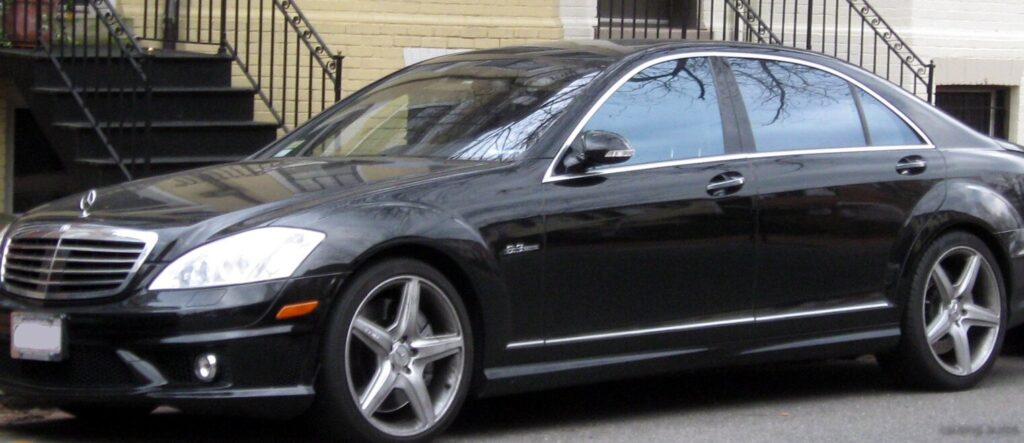
The Mercedes-Benz S-Class Long (V221) AMG S 63, produced from 2006 to 2009, represented the pinnacle of performance and luxury within the V221 S-Class generation. Positioned as the flagship variant, the S 63 combined the extended wheelbase of the “Long” body style with the potent, hand-built AMG 6.2-liter V8 engine and the sophisticated 7G-TRONIC seven-speed automatic transmission. This model catered to buyers seeking uncompromising power, a spacious interior, and the prestige associated with the Mercedes-Benz brand. It was primarily marketed towards affluent customers in North America, Europe, and Asia who desired a high-performance luxury sedan.
Technical Specifications
| Brand | Mercedes-Benz |
| Model | S-class |
| Generation | S-class Long (V221) |
| Type | AMG S 63 (525 Hp) 7G-TRONIC |
| Start of production | 2006 |
| End of production | 2009 |
| Powertrain Architecture | Internal Combustion engine |
| Body type | Sedan |
| Seats | 4 |
| Doors | 4 |
| Fuel consumption (urban) | 23.2 l/100 km (10.1 US mpg, 12.2 UK mpg, 4.3 km/l) |
| Fuel consumption (extra urban) | 10.2 l/100 km (23.1 US mpg, 27.7 UK mpg, 9.8 km/l) |
| Fuel consumption (combined) | 14.9 l/100 km (15.8 US mpg, 19 UK mpg, 6.7 km/l) |
| CO2 emissions | 355 g/km |
| Fuel Type | Petrol (Gasoline) |
| Acceleration 0 – 100 km/h | 4.6 sec |
| Acceleration 0 – 62 mph | 4.6 sec |
| Acceleration 0 – 60 mph | 4.4 sec |
| Maximum speed | 250 km/h (155.34 mph) |
| Weight-to-power ratio | 3.9 kg/Hp, 257.4 Hp/tonne |
| Weight-to-torque ratio | 3.2 kg/Nm, 308.8 Nm/tonne |
| Power | 525 Hp @ 6800 rpm |
| Power per litre | 84.6 Hp/l |
| Torque | 630 Nm @ 5200 rpm (464.66 lb.-ft. @ 5200 rpm) |
| Engine layout | Front, Longitudinal |
| Engine Model/Code | M 156.984 |
| Engine displacement | 6208 cm3 (378.84 cu. in.) |
| Number of cylinders | 8 |
| Engine configuration | V-engine |
| Cylinder Bore | 102.2 mm (4.02 in.) |
| Piston Stroke | 94.6 mm (3.72 in.) |
| Compression ratio | 11.3:1 |
| Number of valves per cylinder | 4 |
| Fuel injection system | Multi-port manifold injection |
| Engine aspiration | Naturally aspirated engine |
| Engine oil capacity | 9.4 l (9.93 US qt | 8.27 UK qt) |
| Kerb Weight | 2040 kg (4497.43 lbs.) |
| Max. weight | 2615 kg (5765.09 lbs.) |
| Max load | 575 kg (1267.66 lbs.) |
| Trunk (boot) space – maximum | 560 l (19.78 cu. ft.) |
| Fuel tank capacity | 90 l (23.78 US gal | 19.8 UK gal) |
| Length | 5209 mm (205.08 in.) |
| Width | 1872 mm (73.7 in.) |
| Width including mirrors | 2115 mm (83.27 in.) |
| Height | 1473 mm (57.99 in.) |
| Wheelbase | 3165 mm (124.61 in.) |
| Front track | 1604 mm (63.15 in.) |
| Rear (Back) track | 1606 mm (63.23 in.) |
| Front overhang | 871 mm (34.29 in.) |
| Rear overhang | 1173 mm (46.18 in.) |
| Minimum turning circle | 12.2 m (40.03 ft.) |
| Drivetrain Architecture | Rear wheel drive |
| Number of gears and type of gearbox | 7 gears, automatic transmission G-TRONIC |
| Front suspension | Air suspension |
| Rear suspension | Air suspension |
| Front brakes | Ventilated discs |
| Rear brakes | Ventilated discs |
| Assisting systems | ABS (Anti-lock braking system) |
| Tires size | 255/40 R19; 275/40 R19 |
| Wheel rims size | 19 |
Powertrain & Engine Architecture
The heart of the S 63 was the M156.984 6.2-liter naturally aspirated V8 engine. This engine, entirely hand-assembled at the AMG facility in Affalterbach, Germany, was a significant departure from the forced-induction trends of the time. It featured a lightweight aluminum block with silicon-aluminum alloy cylinder liners, a forged crankshaft, and forged pistons. The engine utilized a three-valve per cylinder design (two intake, one exhaust) and a multi-port fuel injection system. The 7G-TRONIC seven-speed automatic transmission, while a standard feature on the S-Class, was specifically tuned by AMG for the S 63 to provide quicker shifts and more responsive performance. The transmission offered a manual shift mode, allowing drivers greater control over gear selection.
Driving Characteristics
The S 63 delivered a distinctly different driving experience compared to other S-Class variants. The 525 horsepower and 464 lb-ft of torque provided exhilarating acceleration, with 0-60 mph times consistently in the low 4-second range. The naturally aspirated engine offered a linear power delivery, building smoothly to its peak output. The 7G-TRONIC transmission, while refined, wasn’t as quick as some dual-clutch transmissions available in competing models. However, it provided a comfortable and smooth driving experience, perfectly suited for long-distance cruising. The air suspension, standard on the S 63, offered a compliant ride while maintaining excellent body control. Compared to the S 550, the S 63 offered significantly more performance, while the S 320 CDI prioritized fuel efficiency.
Equipment & Trim Levels
The S 63 came standard with a comprehensive list of luxury features, including leather upholstery, wood trim, a premium sound system, and a sunroof. The extended wheelbase provided ample rear legroom, enhancing passenger comfort. Optional extras included massaging seats, a rear entertainment system, and advanced driver-assistance systems like Distronic Plus adaptive cruise control. The interior design was characterized by a sophisticated and elegant aesthetic, reflecting the S-Class’s position as a flagship luxury sedan. Exterior styling cues included AMG-specific body styling, including unique front and rear bumpers, side skirts, and quad exhaust outlets.
Chassis & Braking
The S 63 featured an air suspension system with AMG-tuned adaptive damping. This system automatically adjusted the suspension settings based on road conditions and driving style, providing a balance between comfort and handling. The braking system consisted of ventilated discs on all four wheels, with larger rotors and upgraded calipers compared to other S-Class models. Anti-lock brakes (ABS) and electronic stability control (ESP) were standard features, enhancing safety and control. The S 63’s chassis was designed to handle the increased power and torque of the AMG engine, providing a stable and confident driving experience.
Market Reception & Comparison
The S 63 was generally well-received by automotive critics, who praised its powerful engine, luxurious interior, and refined driving experience. However, some critics noted its relatively high fuel consumption and the lack of a more advanced transmission. Compared to rivals like the BMW 760i and the Porsche Panamera, the S 63 offered a unique combination of performance, luxury, and prestige. Its fuel economy was significantly lower than the more efficient S 320 CDI, but it offered a substantial performance advantage. Reliability was generally good, although the complexity of the engine and transmission required regular maintenance.
Legacy
The V221 S 63 remains a desirable vehicle in the used car market, particularly among enthusiasts who appreciate its naturally aspirated engine and luxurious appointments. The M156 engine is considered by many to be one of AMG’s finest creations, known for its reliability and distinctive sound. While maintenance costs can be higher than those of more mainstream luxury sedans, the S 63 continues to offer a unique and rewarding driving experience. Its combination of performance, luxury, and exclusivity has cemented its place as a modern classic.