
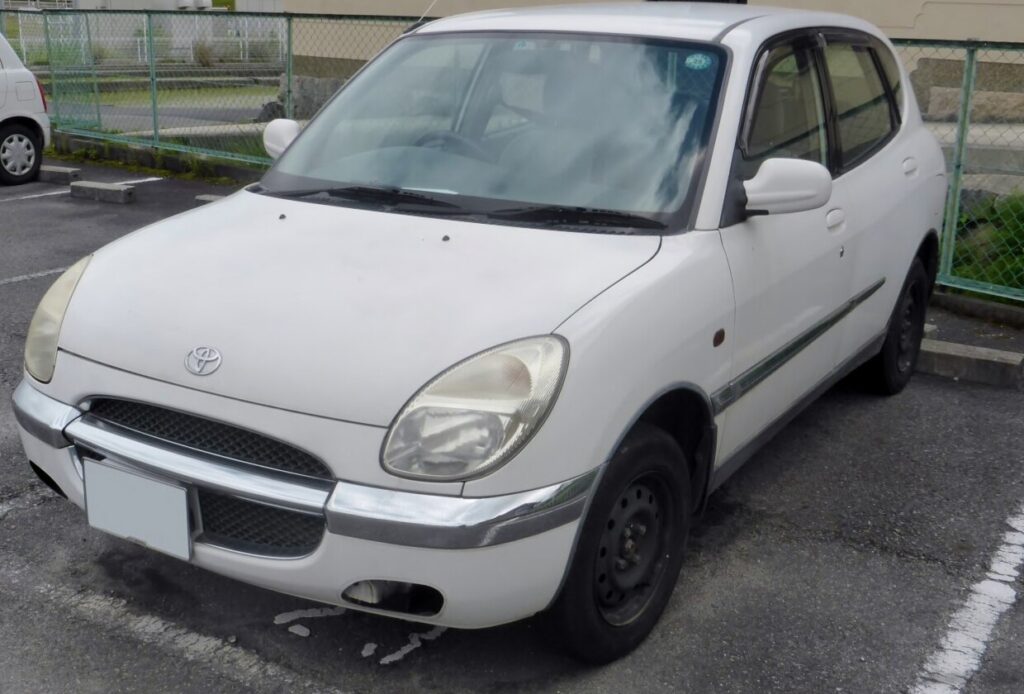
The Toyota Duet, known as the Daihatsu Charade in some markets, is a supermini car produced by Toyota from 2000 to 2004. The M10 series, representing the second generation of the Duet, was a collaborative effort between Toyota and Daihatsu, leveraging Daihatsu’s expertise in small car engineering. This generation aimed to provide an affordable and practical city car, particularly appealing to first-time buyers and those seeking economical transportation. The 1.3 i 16V variant, producing 110 horsepower, represented a mid-range offering within the Duet lineup, positioned above the base models and below any potential limited editions. It was primarily sold in Europe and Japan, offering a balance between performance and fuel efficiency.
Technical Specifications
| Brand | Toyota |
| Model | Duet |
| Generation | Duet (M10) |
| Type (Engine) | 1.3 i 16V (110 Hp) |
| Start of production | 2000 |
| End of production | June, 2004 |
| Powertrain Architecture | Internal Combustion engine |
| Body type | Hatchback |
| Seats | 5 |
| Doors | 5 |
| Fuel consumption (urban) | 5.1 l/100 km (46.1 US mpg, 55.4 UK mpg, 19.6 km/l) |
| Fuel Type | Petrol (Gasoline) |
| Weight-to-power ratio | 7.7 kg/Hp, 129.4 Hp/tonne |
| Weight-to-torque ratio | 6.7 kg/Nm, 148.2 Nm/tonne |
| Power | 110 Hp @ 7000 rpm |
| Power per litre | 84.8 Hp/l |
| Torque | 126 Nm @ 4400 rpm (92.93 lb.-ft. @ 4400 rpm) |
| Engine layout | Front, Longitudinal |
| Engine Model/Code | K3-VE |
| Engine displacement | 1297 cm3 (79.15 cu. in.) |
| Number of cylinders | 4 |
| Engine configuration | Inline |
| Cylinder Bore | 72 mm (2.83 in.) |
| Piston Stroke | 79.7 mm (3.14 in.) |
| Compression ratio | 11:1 |
| Number of valves per cylinder | 4 |
| Fuel injection system | Multi-port manifold injection |
| Engine aspiration | Naturally aspirated engine |
| Valvetrain | DOHC |
| Engine oil capacity | 3.6 l (3.8 US qt | 3.17 UK qt) |
| Coolant | 3.6 l (3.8 US qt | 3.17 UK qt) |
| Kerb Weight | 850 kg (1873.93 lbs.) |
| Max. weight | 1125 kg (2480.2 lbs.) |
| Max load | 275 kg (606.27 lbs.) |
| Fuel tank capacity | 40 l (10.57 US gal | 8.8 UK gal) |
| Length | 3660 mm (144.09 in.) |
| Width | 1600 mm (62.99 in.) |
| Height | 1450 mm (57.09 in.) |
| Wheelbase | 2370 mm (93.31 in.) |
| Front track | 1380 mm (54.33 in.) |
| Rear track | 1365 mm (53.74 in.) |
| Minimum turning circle | 8.6 m (28.22 ft.) |
| Drivetrain Architecture | Front wheel drive |
| Number of gears and type of gearbox | 5 gears, manual transmission |
| Front suspension | Spring Strut |
| Rear suspension | Torsion |
| Front brakes | Disc |
| Rear brakes | Drum |
| Assisting systems | ABS (Anti-lock braking system) |
| Steering type | Steering rack and pinion |
| Power steering | Hydraulic Steering |
| Tires size | 165/65 R14 |
Powertrain & Engine Architecture
The heart of the Duet 1.3 i 16V is the K3-VE engine, a 1.3-liter inline-four cylinder gasoline engine. This engine utilizes a double overhead camshaft (DOHC) valvetrain with four valves per cylinder, contributing to its relatively high output for its displacement. The engine employs multi-port fuel injection, a common technology at the time, delivering fuel directly into the intake ports for efficient combustion. The 16-valve configuration and DOHC design allowed for improved breathing and higher revving capabilities compared to simpler engine designs. The engine is longitudinally mounted in the front of the vehicle, driving the front wheels. The 5-speed manual transmission was the standard offering for this variant, providing a balance between fuel economy and driver control. The transmission’s gear ratios were tuned for city driving, with a relatively short final drive to provide adequate acceleration from low speeds.
Driving Characteristics
The 110 horsepower output of the 1.3 i 16V Duet provided adequate performance for urban and suburban driving. While not a particularly sporty vehicle, it offered sufficient power for overtaking and merging onto highways. Compared to the lower-powered base models, the 1.3 i 16V felt noticeably more responsive. However, it didn’t possess the punch of larger-engined competitors. The 5-speed manual transmission allowed drivers to keep the engine in its optimal power band, maximizing acceleration. The gear ratios were spaced to provide reasonable fuel economy during cruising, but required frequent shifting in stop-and-go traffic. The Duet’s lightweight construction helped to offset the modest power output, resulting in a reasonably nimble driving experience.
Equipment & Trim Levels
The 1.3 i 16V Duet typically came equipped with basic amenities such as power steering, central locking, and electric front windows. Air conditioning was often an optional extra. Interior upholstery was typically cloth, with a simple and functional dashboard layout. Higher trim levels might have included features like alloy wheels, a CD player, and upgraded interior trim. Safety features were relatively basic for the time, typically including ABS brakes and driver and passenger airbags. The Duet was designed as an affordable car, so luxury features were generally limited.
Chassis & Braking
The Duet’s chassis featured a MacPherson strut front suspension and a torsion beam rear suspension. This setup provided a comfortable ride quality, suitable for city driving. The front brakes were disc brakes, offering better stopping power than drum brakes, while the rear brakes were drum brakes to keep costs down. The ABS system helped to prevent wheel lockup during hard braking, improving stability and control. The Duet’s relatively lightweight construction contributed to its nimble handling characteristics. The steering was hydraulic power-assisted, making it easy to maneuver in tight spaces.
Market Reception & Comparison
The Toyota Duet 1.3 i 16V was generally well-received as an affordable and practical city car. Critics praised its fuel efficiency and ease of driving. However, some reviewers noted its lack of refinement and relatively basic interior. Compared to other superminis of the time, such as the Ford Fiesta or Volkswagen Polo, the Duet offered a more budget-friendly option. Its fuel economy was competitive, and its reliability was generally good, typical of Toyota products. The 1.3 i 16V offered a good balance between performance and economy, making it a popular choice for those seeking a practical and affordable car.
Legacy
The Toyota Duet, while not a groundbreaking vehicle, served as a reliable and economical city car for many owners. The K3-VE engine proved to be relatively durable, and with proper maintenance, could provide many years of service. Today, the Duet is a relatively uncommon sight on the roads, but it remains a popular choice among those seeking a cheap and cheerful runabout. Its simple mechanicals make it relatively easy to maintain and repair. The Duet’s legacy lies in its affordability and practicality, providing a valuable transportation solution for a wide range of drivers.
