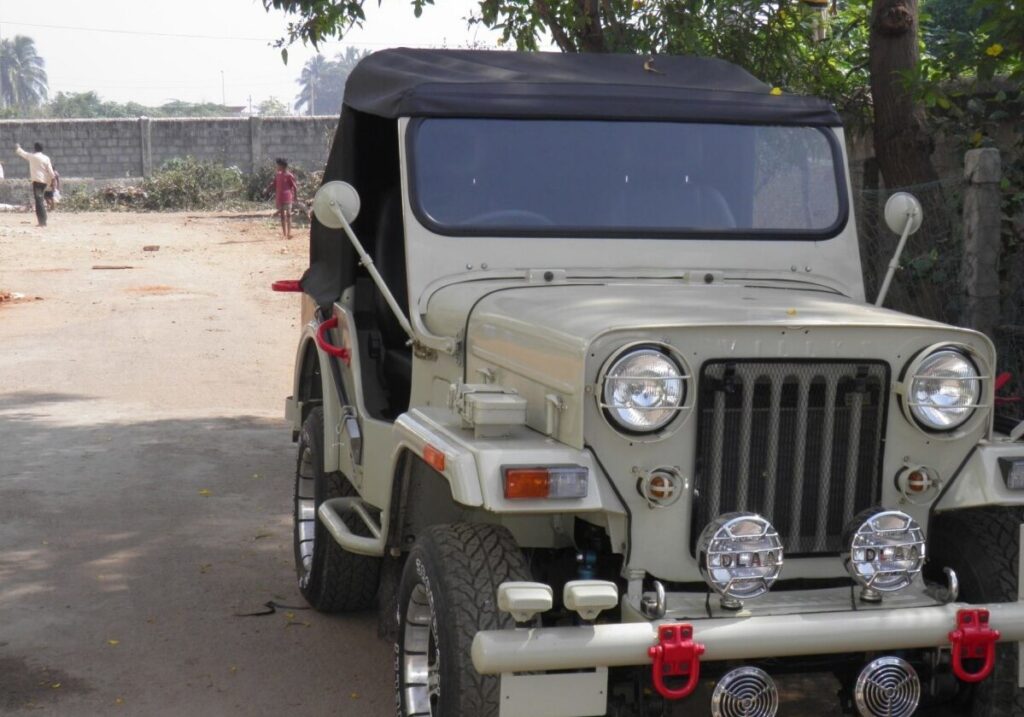
The Mahindra CJ 3 Wagon 2.3 D, produced between 1988 and 1992, represents a significant iteration of the iconic CJ (Civilian Jeep) series adapted for the Indian market. This particular variant, powered by a 2.3-liter diesel engine producing 38 horsepower, served as a workhorse vehicle, primarily aimed at rural customers and utility applications. It built upon the foundation of the original Willys Jeep design, heavily localized and modified by Mahindra & Mahindra to suit the specific needs and economic conditions of India. The CJ 3 Wagon, and specifically this diesel-powered version, occupied a crucial position in Mahindra’s lineup as an affordable and robust off-road vehicle, bridging the gap between basic transportation and more specialized agricultural or commercial needs.
Technical Specifications
| Brand | Mahindra |
| Model | CJ 3 Wagon |
| Generation | CJ 3 Wagon |
| Type (Engine) | 2.3 D (38 Hp) |
| Start of Production | 1988 |
| End of Production | 1992 |
| Powertrain Architecture | Internal Combustion Engine |
| Body Type | Off-Road Vehicle |
| Fuel Type | Diesel |
| Power | 38 Hp |
| Engine Aspiration | Naturally Aspirated |
Powertrain & Engine Architecture
The heart of the CJ 3 Wagon 2.3 D is a 2.3-liter, naturally aspirated diesel engine. This engine, while relatively simple in design, was chosen for its durability, fuel efficiency, and ability to operate reliably in harsh conditions with minimal maintenance. It’s a direct-injection diesel, meaning fuel is injected directly into the combustion chamber rather than pre-combustion chambers common in some older diesel designs. This direct injection contributes to improved efficiency and reduced emissions, although by modern standards, emissions were still significant. The engine utilizes a mechanical fuel injection pump, a robust system that doesn’t rely on complex electronics. The engine’s valvetrain consists of a single overhead camshaft operating two valves per cylinder. The 38 horsepower output is achieved at a relatively low engine speed, prioritizing torque over peak power. The transmission is a typically rugged four-speed manual gearbox, selected for its simplicity and ability to handle the demands of off-road driving. The drivetrain is a part-time four-wheel drive system, with selectable 2H (two-wheel drive high range), 4H (four-wheel drive high range), and 4L (four-wheel drive low range) settings. The low range gearing is crucial for tackling steep inclines and navigating challenging terrain.
Driving Characteristics
The driving experience of the CJ 3 Wagon 2.3 D is defined by its utilitarian nature. With only 38 horsepower, acceleration is deliberately slow, and the vehicle is not designed for high-speed travel. However, the engine produces a respectable amount of low-end torque, making it capable of hauling loads and climbing hills, albeit at a measured pace. The four-speed manual transmission requires deliberate shifting, and the gear ratios are optimized for pulling power rather than speed. The part-time four-wheel drive system provides excellent traction in off-road conditions, but switching between 2H and 4H requires stopping the vehicle. The suspension is basic, consisting of leaf springs front and rear, providing a firm ride that can be uncomfortable on paved roads but offers good articulation when off-roading. Steering is also manual, requiring considerable effort, especially at low speeds. Compared to potential gasoline-powered versions (which were also available), the 2.3 D offered significantly better fuel economy, a crucial factor for its target market. It lacked the responsiveness of a gasoline engine but compensated with superior durability and lower running costs.
Equipment & Trim Levels
The CJ 3 Wagon 2.3 D was intentionally spartan in terms of equipment. It was designed as a functional vehicle, not a luxury one. Standard features typically included basic steel wheels, a simple dashboard with minimal instrumentation (speedometer, fuel gauge, and temperature gauge), and bench seats upholstered in vinyl. Doors featured basic latches and wind-up windows. A canvas or hardtop roof was often optional, providing protection from the elements. Heating was typically not standard, and air conditioning was unavailable. The focus was on providing a durable and reliable vehicle at the lowest possible cost. Trim levels were minimal; variations primarily consisted of optional accessories such as a winch, tow hitch, or upgraded tires. The interior was designed for ease of cleaning and maintenance, reflecting its intended use in demanding environments.
Chassis & Braking
The chassis of the CJ 3 Wagon is a body-on-frame construction, utilizing a ladder frame design for strength and durability. This construction method allows for significant torsional flex, enhancing off-road capability. The suspension, as mentioned previously, consists of leaf springs front and rear, with solid axles. The rear brakes are typically drum brakes, while the front brakes could be either drum or disc brakes depending on the specific year and market. Steering is a recirculating ball type, providing a direct but somewhat heavy feel. The vehicle’s relatively short wheelbase and high ground clearance contribute to its excellent off-road performance. Stabilizer bars were not typically fitted, prioritizing suspension articulation over on-road handling. The tires were typically bias-ply tires, chosen for their durability and affordability, although radial tires were sometimes available as an upgrade.
Market Reception & Comparison
The Mahindra CJ 3 Wagon 2.3 D was well-received in the Indian market, particularly in rural areas. Its affordability, durability, and off-road capability made it a popular choice for farmers, landowners, and small businesses. Critics praised its robustness and low running costs but noted its lack of refinement and limited on-road performance. Compared to other vehicles in its class, such as the Tata Sumo or the Maruti Gypsy, the CJ 3 Wagon offered a more rugged and utilitarian experience. The Sumo was larger and more comfortable, while the Gypsy was faster and more agile but also more expensive. The 2.3 D diesel engine provided significantly better fuel economy than the gasoline engines offered in competing models. Reliability was generally very good, although maintenance requirements were higher than more modern vehicles.
Legacy
The Mahindra CJ 3 Wagon, and particularly the 2.3 D variant, holds a significant place in Indian automotive history. It represents a period of indigenous automotive development and adaptation. While production ceased in 1992, many examples remain in use today, testament to their durability and simplicity. The CJ 3 Wagon laid the groundwork for Mahindra’s continued success in the SUV and off-road vehicle market. In the used car market, these vehicles are sought after by enthusiasts and collectors who appreciate their classic design and rugged character. Parts availability can be a challenge, but the simplicity of the design makes them relatively easy to repair and maintain. The 2.3 D engine, while not particularly powerful, is known for its longevity and ability to withstand years of hard use. The CJ 3 Wagon 2.3 D remains a symbol of a bygone era, representing a time when vehicles were built to last and designed for practicality rather than luxury.