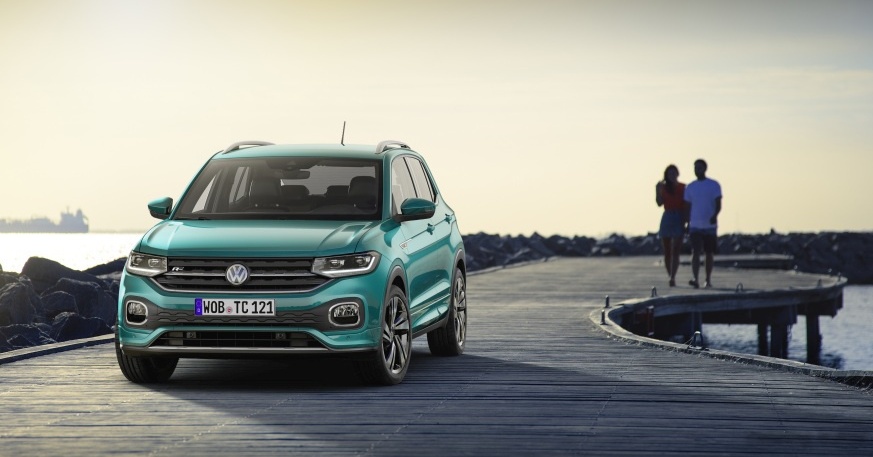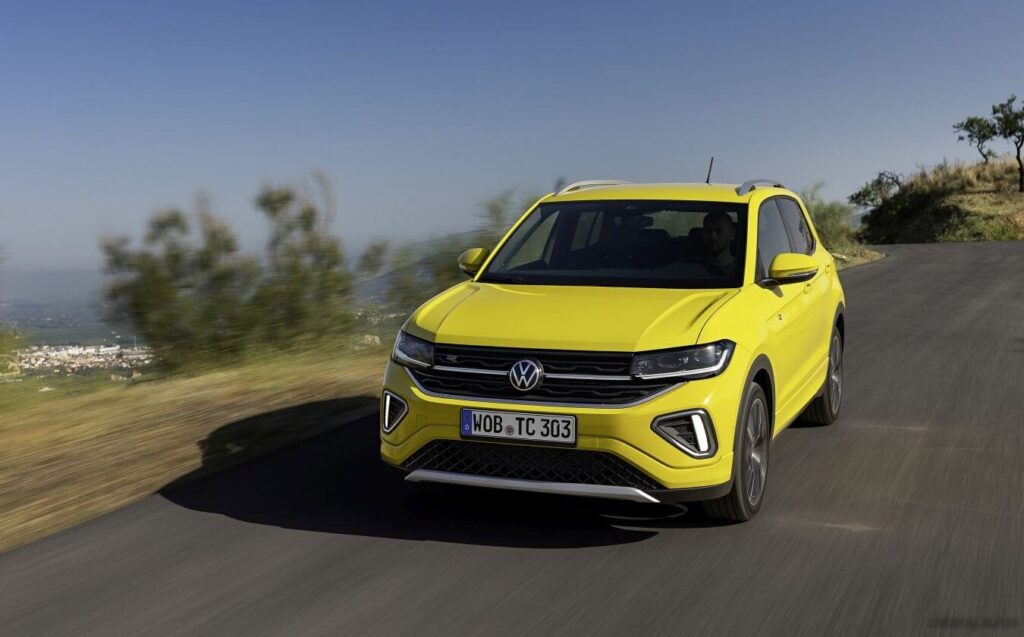
The Volkswagen T-Cross, a subcompact crossover SUV, was introduced in 2019 as a global model, designed to slot beneath the Tiguan in Volkswagen’s lineup. The facelifted version, launched in 2023, brought updated styling, enhanced technology, and refinements to the powertrain options. This article focuses on the 1.0 TSI (95 hp) variant, a key entry point into the T-Cross range, particularly in European and South American markets. Production of this variant began in 2023 and continues as a significant offering within the T-Cross family, built on the MQB A0 platform.
Technical Specifications
| Brand | Volkswagen |
| Model | T-Cross |
| Generation | T-Cross (facelift 2023) |
| Type (Engine) | 1.0 TSI (95 Hp) |
| Start of production | 2023 |
| Powertrain Architecture | Internal Combustion engine |
| Body type | SUV |
| Seats | 5 |
| Doors | 5 |
| Fuel consumption at Low speed (WLTP) | 6.9 l/100 km (34.1 US mpg, 40.9 UK mpg, 14.5 km/l) |
| Fuel consumption at Medium speed (WLTP) | 5.4 l/100 km (43.6 US mpg, 52.3 UK mpg, 18.5 km/l) |
| Fuel consumption at high speed (WLTP) | 4.9 l/100 km (48 US mpg, 57.6 UK mpg, 20.4 km/l) |
| Fuel consumption at very high speed (WLTP) | 5.9 l/100 km (39.9 US mpg, 47.9 UK mpg, 16.9 km/l) |
| Combined fuel consumption (WLTP) | 5.6 l/100 km (42 US mpg, 50.4 UK mpg, 17.9 km/l) |
| CO2 emissions (WLTP) | 127 g/km |
| Fuel Type | Petrol (Gasoline) |
| Acceleration 0 – 100 km/h | 11.2 sec |
| Acceleration 0 – 62 mph | 11.2 sec |
| Acceleration 0 – 60 mph | 10.6 sec |
| Maximum speed | 180 km/h (111.85 mph) |
| Emission standard | Euro 6 EA |
| Weight-to-power ratio | 13.2 kg/Hp, 75.8 Hp/tonne |
| Weight-to-torque ratio | 7.2 kg/Nm, 139.6 Nm/tonne |
| Power | 95 Hp |
| Power per litre | 95.1 Hp/l |
| Torque | 175 Nm @ 1600-3000 rpm (129.07 lb.-ft. @ 1600-3000 rpm) |
| Engine layout | Front, Transverse |
| Engine Model/Code | EA211 evo 2 / DUSB |
| Engine displacement | 999 cm3 (60.96 cu. in.) |
| Number of cylinders | 3 |
| Engine configuration | Inline |
| Cylinder Bore | 74.5 mm (2.93 in.) |
| Piston Stroke | 76.4 mm (3.01 in.) |
| Number of valves per cylinder | 4 |
| Fuel injection system | Direct injection |
| Engine aspiration | Turbocharger, Intercooler |
| Valvetrain | DOHC |
| Engine oil capacity | 4 l (4.23 US qt | 3.52 UK qt) |
| Kerb Weight | 1254 kg (2764.6 lbs.) |
| Max. weight | 1730 kg (3814 lbs.) |
| Max load | 476 kg (1049.4 lbs.) |
| Trunk (boot) space – minimum | 455 l (16.07 cu. ft.) |
| Trunk (boot) space – maximum | 1281 l (45.24 cu. ft.) |
| Fuel tank capacity | 40 l (10.57 US gal | 8.8 UK gal) |
| Max. roof load | 75 kg (165.35 lbs.) |
| Permitted trailer load with brakes (8%) | 1100 kg (2425.08 lbs.) |
| Permitted trailer load with brakes (12%) | 1000 kg (2204.62 lbs.) |
| Permitted trailer load without brakes | 620 kg (1366.87 lbs.) |
| Permitted towbar download | 75 kg (165.35 lbs.) |
| Length | 4127 mm (162.48 in.) |
| Width | 1760 mm (69.29 in.) |
| Width including mirrors | 1993 mm (78.46 in.) |
| Height | 1573 mm (61.93 in.) |
| Wheelbase | 2551 mm (100.43 in.) |
| Front track | 1528-1536 mm (60.16 – 60.47 in.) |
| Rear (Back) track | 1509-1516 mm (59.41 – 59.69 in.) |
| Minimum turning circle (turning diameter) | 10.7 m (35.1 ft.) |
| Front suspension | Independent, type McPherson with coil spring and anti-roll bar |
| Rear suspension | Coil spring, Torsion |
| Front brakes | Ventilated discs |
| Rear brakes | Drum |
| Drive wheel | Front wheel drive |
| Number of gears and type of gearbox | 5 gears, manual transmission |
INTRODUCTION
The 2023 Volkswagen T-Cross 1.0 TSI (95 hp) represents an accessible entry point into the compact SUV market. Positioned as the base engine option in many regions, it’s designed for buyers prioritizing fuel efficiency and affordability. The facelift brought a more modern aesthetic, updated infotainment, and improved safety features to the T-Cross, enhancing its appeal. Built on the MQB A0 platform, shared with models like the Volkswagen Polo and SEAT Ibiza, the T-Cross aims to provide a practical and versatile package in a relatively small footprint. This variant is particularly popular in Europe and South America, where smaller, more economical vehicles are in high demand.
Powertrain & Engine Architecture
At the heart of the T-Cross 1.0 TSI is the EA211 evo 2 engine, a three-cylinder, 1.0-liter turbocharged gasoline engine. This engine, designated with the code DUSB, utilizes direct fuel injection and a single scroll turbocharger with intercooling. The engine produces 95 horsepower and 175 Nm (129 lb-ft) of torque between 1600 and 3000 rpm. The engine features a DOHC (Dual Overhead Camshaft) valvetrain with four valves per cylinder. The 2023 model incorporates a particulate filter to reduce emissions, meeting Euro 6 EA standards. The engine is typically paired with a five-speed manual transmission, although a seven-speed dual-clutch transmission (DSG) was also offered as an option in some markets. The engine’s compact size and lightweight construction contribute to the T-Cross’s overall efficiency.
Driving Characteristics
The 1.0 TSI 95 hp engine delivers adequate performance for everyday driving, but it’s not designed for spirited acceleration. The 0-100 km/h (0-62 mph) sprint takes around 11.2 seconds. The engine feels most comfortable in the mid-range, providing sufficient torque for overtaking maneuvers. The five-speed manual transmission is well-matched to the engine’s characteristics, offering smooth gear changes. Compared to higher-output versions of the T-Cross (like the 1.5 TSI), this variant feels noticeably less powerful, particularly when fully loaded or climbing hills. However, the lighter engine weight contributes to nimble handling and a comfortable ride. The gear ratios are optimized for fuel efficiency, prioritizing economy over outright performance.
Equipment & Trim Levels
The base T-Cross 1.0 TSI typically comes equipped with a reasonable level of standard features. These generally include air conditioning, a touchscreen infotainment system with Bluetooth connectivity, alloy wheels, and a suite of safety features such as ABS, ESC (Electronic Stability Control), and multiple airbags. Higher trim levels add features like automatic climate control, a larger touchscreen display, parking sensors, a rearview camera, and advanced driver-assistance systems (ADAS) such as lane-keeping assist and adaptive cruise control. Interior upholstery is typically cloth, with options for upgraded materials on higher trims. Optional extras include a panoramic sunroof, LED headlights, and a premium sound system.
Chassis & Braking
The T-Cross utilizes a McPherson strut front suspension and a torsion beam rear suspension. This setup provides a good balance between ride comfort and handling. The front brakes are ventilated discs, while the rear brakes are drums, a cost-saving measure common in entry-level trims. The steering is electric power-assisted, offering light and precise control. The T-Cross’s relatively compact size and lightweight construction contribute to its agile handling. Stabilizer bars are fitted to both the front and rear axles to reduce body roll during cornering. The suspension is tuned for comfort, absorbing bumps and imperfections in the road surface effectively.
Market Reception & Comparison
The T-Cross 1.0 TSI has been well-received in markets where fuel efficiency and affordability are key considerations. Critics have praised its practicality, comfortable ride, and modern features. However, some reviewers have noted that the 95 hp engine can feel underpowered, especially when carrying passengers or luggage. Compared to other subcompact SUVs in its class, such as the Renault Captur and Peugeot 2008, the T-Cross offers a competitive level of equipment and a well-built interior. Its fuel economy is generally comparable to its rivals, with the combined WLTP figure of 5.6 l/100 km (42 US mpg) being respectable for a gasoline-powered SUV. Reliability has been generally good, with few reported issues specific to the 1.0 TSI engine.
Legacy
The Volkswagen T-Cross 1.0 TSI (95 hp) has established itself as a popular choice in the subcompact SUV segment. The EA211 engine family is known for its reliability and efficiency, and the T-Cross benefits from Volkswagen’s reputation for build quality and engineering. On the used car market, these models are generally sought after for their affordability and low running costs. While not the most powerful or dynamically engaging SUV in its class, the T-Cross 1.0 TSI offers a practical and well-rounded package that appeals to a wide range of buyers. Its continued presence in Volkswagen’s lineup demonstrates its enduring popularity and relevance in the evolving automotive landscape.