
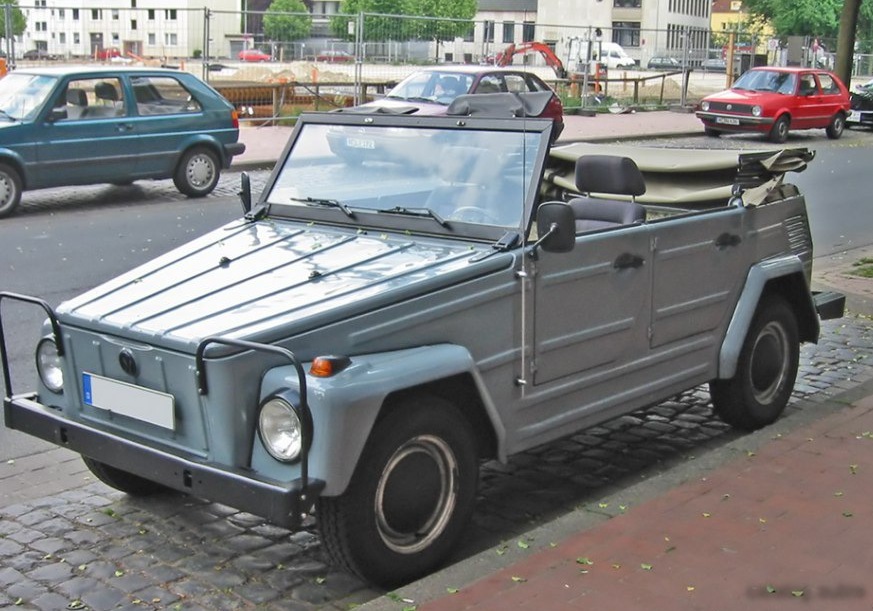
The Volkswagen Type 181, known as the Kübelwagen (German for “bucket car”) in its original military guise and later as the Thing in the United States, was a utility vehicle produced by Volkswagen from 1969 to 1983. The 1.5-liter, 44 horsepower variant, produced from 1969 to 1970, represents the earliest iteration of the civilian-market Type 181. It was designed as a successor to the original Kübelwagen used by the German military during World War II, but adapted for civilian use with a focus on affordability and rugged simplicity. This initial 1.5L model served as the foundation for the Type 181’s unique character and established its reputation as a capable, if spartan, off-road vehicle.
Technical Specifications
| Brand | Volkswagen |
| Model | 181 |
| Generation | 181 |
| Type (Engine) | 1.5 (44 Hp) |
| Start of production | 1969 |
| End of production | 1970 |
| Powertrain Architecture | Internal Combustion engine |
| Body type | Off-road vehicle, Cabriolet |
| Fuel Type | Petrol (Gasoline) |
| Power | 44 Hp |
| Engine aspiration | Naturally aspirated engine |
Powertrain & Engine Architecture
The 1969-1970 Volkswagen Type 181 1.5 featured an air-cooled, naturally aspirated 1.5-liter flat-four engine. This engine, derived from the Volkswagen Beetle, produced 44 horsepower at approximately 4,800 rpm and 86 lb-ft of torque at 3,000 rpm. The engine code for this specific variant is often identified as 1H. It utilized a single Solex carburetor for fuel delivery, a relatively simple system contributing to the vehicle’s ease of maintenance. The engine’s valvetrain consisted of pushrods operating overhead valves. Cooling was achieved through an engine-driven fan and strategically placed cooling fins on the cylinders and cylinder heads.
The 1.5L engine was paired with a four-speed manual transmission, as an automatic transmission wasn’t offered during this initial production run. The transmission was rear-mounted, a characteristic of many Volkswagen models of the era, and drove the rear wheels. The gear ratios were geared towards providing sufficient torque for off-road conditions, though acceleration was understandably modest. The transmission was known for its durability, but its mechanical linkage required periodic adjustment.
Driving Characteristics
The 1.5-liter Type 181 offered a utilitarian driving experience. With only 44 horsepower propelling a relatively lightweight vehicle (around 1,700 lbs), acceleration was slow. However, the engine’s torque characteristics provided adequate power for navigating moderate inclines and rough terrain. The four-speed manual transmission required frequent shifting to maintain momentum, especially when climbing hills or carrying a load. The vehicle’s high ground clearance and robust suspension allowed it to traverse obstacles that would challenge more conventional cars. Steering was direct, but required effort, and the lack of power steering meant that maneuvering at low speeds could be physically demanding. The ride quality was firm, reflecting the vehicle’s off-road focus and simple suspension design. Compared to later 1.6L versions, the 1.5L felt noticeably underpowered, particularly when fully loaded or traveling at highway speeds.
Equipment & Trim Levels
The 1969-1970 Type 181 1.5 was deliberately spartan in its equipment levels. It was designed as a functional vehicle, not a luxury one. Standard features included a folding canvas roof (which could be fully removed), simple steel wheels, and basic instrumentation consisting of a speedometer, fuel gauge, and warning lights. Seats were typically vinyl-covered and offered minimal cushioning. Interior trim was minimal, with painted metal surfaces dominating the cabin.
Optional extras were limited but included a heater (a popular addition, even in warmer climates), a spare wheel carrier, and various accessories for off-road use, such as a shovel mount or jerrycan holders. The vehicle’s simplicity meant that there were few opportunities for customization beyond these basic options. The target audience for this trim was buyers seeking a basic, reliable, and affordable off-road vehicle for work or recreational purposes.
Chassis & Braking
The Type 181 utilized a robust chassis based on the Volkswagen Beetle platform, but with significant modifications to enhance its off-road capability. It featured a reinforced floor pan and a higher ride height. The suspension consisted of independent trailing arms at the front and a swing axle rear suspension, both with transverse torsion bars. This setup provided a reasonable degree of wheel travel and articulation, allowing the vehicle to maintain traction on uneven surfaces.
Braking was accomplished via drum brakes on all four wheels. While adequate for the vehicle’s weight and performance, the drum brakes lacked the stopping power and fade resistance of disc brakes. Steering was a conventional worm-and-sector system, providing direct but unassisted control. The vehicle’s relatively narrow track width contributed to its maneuverability in tight spaces, but also made it susceptible to body roll during cornering.
Market Reception & Comparison
The initial reception to the Type 181 1.5 was mixed. Critics acknowledged its ruggedness and off-road capability, but many found its performance lacking, particularly in comparison to other vehicles in its price range. The spartan interior and lack of creature comforts were also points of criticism. However, the vehicle’s affordability and unique styling appealed to a niche market of buyers who valued practicality and simplicity over luxury.
Compared to the later 1.6-liter versions of the Type 181, the 1.5L model offered less power and refinement. The 1.6L engine provided a noticeable improvement in performance, making the vehicle more suitable for highway driving and carrying heavier loads. The 1.5L was also less fuel-efficient than the later models, due to its smaller displacement and less advanced engine management system. However, the 1.5L’s simplicity and early production status have made it a desirable collector’s item among Volkswagen enthusiasts.
Legacy
The Volkswagen Type 181 1.5, while short-lived in its original form, played a crucial role in establishing the Type 181’s identity as a unique and capable off-road vehicle. Its simple design and robust construction contributed to its long-term reliability, and many examples remain on the road today. The 1.5L variant is particularly sought after by collectors due to its rarity and historical significance.
In the used car market, well-maintained examples of the 1969-1970 Type 181 1.5 command a premium price. The engine, while relatively simple, requires regular maintenance to ensure its continued operation. Common issues include carburetor problems, oil leaks, and wear on the engine’s bearings. Despite these potential issues, the Type 181 1.5 remains a beloved and iconic vehicle, representing a unique chapter in Volkswagen’s history.
