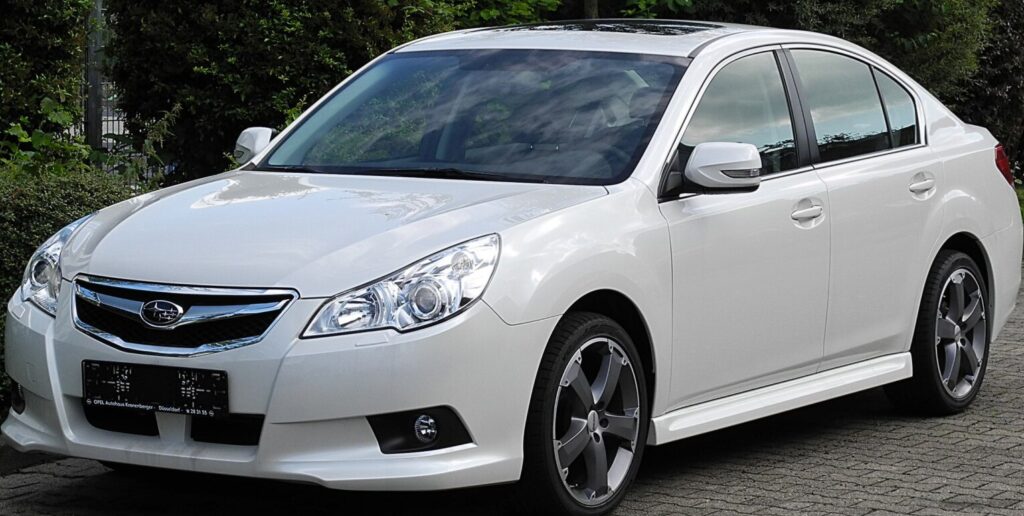
The Subaru Legacy V 2.0d, produced between 2009 and 2012, represented the fifth generation of Subaru’s mid-size sedan. This variant, equipped with a 2.0-liter turbocharged diesel engine producing 150 horsepower and paired with a six-speed manual transmission, and Subaru’s symmetrical all-wheel drive system, was a significant offering in the European market, where diesel engines held considerable popularity. It sat within the Legacy V range as a compelling option for drivers seeking a balance of fuel efficiency, performance, and all-weather capability. The Legacy V, built on the Subaru’s platform, aimed to provide a comfortable and practical family vehicle with a focus on safety and reliability.
Technical Specifications
| Brand | Subaru |
| Model | Legacy |
| Generation | Legacy V |
| Type (Engine) | 2.0d (150 Hp) AWD |
| Start of production | 2009 |
| End of production | 2012 |
| Powertrain Architecture | Internal Combustion engine |
| Body type | Sedan |
| Seats | 5 |
| Doors | 4 |
| Fuel consumption (urban) | 7.5 l/100 km (31.4 US mpg) |
| Fuel consumption (extra urban) | 5.1 l/100 km (46.1 US mpg) |
| Fuel consumption (combined) | 5.9 l/100 km (39.9 US mpg) |
| CO2 emissions | 156 g/km |
| Fuel Type | Diesel |
| Acceleration 0 – 100 km/h | 9.3 sec |
| Acceleration 0 – 62 mph | 9.3 sec |
| Acceleration 0 – 60 mph | 8.8 sec |
| Maximum speed | 206 km/h (128 mph) |
| Emission standard | Euro 5 |
| Weight-to-power ratio | 10.5 kg/Hp |
| Weight-to-torque ratio | 4.5 kg/Nm |
| Power | 150 Hp @ 3600 rpm |
| Torque | 350 Nm @ 1800-2400 rpm (258.15 lb.-ft.) |
| Engine layout | Front, Longitudinal |
| Engine Model/Code | EE20Z |
| Engine displacement | 1998 cm3 (121.93 cu. in.) |
| Number of cylinders | 4 |
| Engine configuration | Boxer |
| Cylinder Bore | 86 mm (3.39 in.) |
| Piston Stroke | 86 mm (3.39 in.) |
| Compression ratio | 16.3:1 |
| Number of valves per cylinder | 4 |
| Fuel injection system | Diesel Commonrail |
| Engine aspiration | Turbocharger, Intercooler |
| Valvetrain | DOHC |
| Engine oil capacity | 5.9 l (6.23 US qt | 5.19 UK qt) |
| Coolant capacity | 9 l (9.51 US qt | 7.92 UK qt) |
| Kerb Weight | 1575 kg (3472.28 lbs.) |
| Max. weight | 2045 kg (4508.45 lbs.) |
| Max load | 470 kg (1036.17 lbs.) |
| Trunk (boot) space – minimum | 486 l (17.16 cu. ft.) |
| Fuel tank capacity | 65 l (17.17 US gal | 14.3 UK gal) |
| Max. roof load | 80 kg (176.37 lbs.) |
| Permitted trailer load with brakes (12%) | 1700 kg (3747.86 lbs.) |
| Permitted trailer load without brakes | 750 kg (1653.47 lbs.) |
| Length | 4735 mm (186.42 in.) |
| Width | 1780 mm (70.08 in.) |
| Width including mirrors | 1820 mm (71.65 in.) |
| Height | 1505 mm (59.25 in.) |
| Wheelbase | 2750 mm (108.27 in.) |
| Front track | 1565 mm (61.61 in.) |
| Rear (Back) track | 1570 mm (61.81 in.) |
| Ride height (ground clearance) | 150 mm (5.91 in.) |
| Minimum turning circle | 11.4 m (37.4 ft.) |
| Drive wheel | All wheel drive (4×4) |
| Number of gears and type of gearbox | 6 gears, manual transmission |
| Front suspension | Independent type McPherson |
| Rear suspension | Double wishbone |
| Front brakes | Ventilated discs |
| Rear brakes | Disc |
| Assisting systems | ABS (Anti-lock braking system) |
| Steering type | Steering rack and pinion |
| Tires size | 205/60 R16H |
| Wheel rims size | 16 |
Powertrain & Engine Architecture
The heart of the Legacy V 2.0d was the EE20Z engine, a 2.0-liter horizontally-opposed (boxer) four-cylinder diesel. This engine was a key component of Subaru’s diesel strategy for the European market. The EE20Z featured a common rail direct injection system, delivering fuel at extremely high pressure for optimized combustion. A variable geometry turbocharger (VGT) and intercooler were employed to enhance power and torque across a broad RPM range. The engine’s boxer configuration, with its horizontally opposed pistons, contributed to a lower center of gravity, improving handling and stability. The six-speed manual transmission provided precise gear changes and allowed drivers to fully utilize the engine’s torque output.
Driving Characteristics
The 2.0d variant offered a distinctly different driving experience compared to the gasoline-powered Legacy models. While not as overtly sporty as some of its competitors, the 2.0d provided ample torque from low engine speeds, making it well-suited for everyday driving and long-distance cruising. The all-wheel drive system ensured excellent traction in various weather conditions. The manual transmission, while engaging for some drivers, required more driver involvement than the automatic options available on other Legacy trims. Acceleration from 0-60 mph took around 8.8 seconds, which was respectable for a diesel-powered sedan of its size. The gear ratios were tuned to prioritize fuel efficiency and smooth power delivery rather than outright performance.
Equipment & Trim Levels
The 2.0d trim typically included standard features such as air conditioning, power windows, power mirrors, a CD player with auxiliary input, and alloy wheels. Safety features were also a priority, with ABS, electronic brakeforce distribution, and multiple airbags included as standard equipment. Higher trim levels offered options like leather upholstery, a sunroof, a navigation system, and premium audio systems. The interior design was functional and comfortable, with a focus on practicality and ease of use. The dashboard layout was straightforward, and the controls were logically placed.
Chassis & Braking
The Legacy V 2.0d utilized a McPherson strut front suspension and a double-wishbone rear suspension, providing a comfortable ride and predictable handling. The all-wheel drive system distributed power to all four wheels, enhancing traction and stability. The braking system consisted of ventilated discs at the front and solid discs at the rear, providing adequate stopping power for most driving situations. ABS (Anti-lock Braking System) was standard, preventing wheel lockup during hard braking. The suspension was tuned to balance comfort and handling, offering a compliant ride without sacrificing too much responsiveness.
Market Reception & Comparison
The Legacy V 2.0d was generally well-received by automotive critics, who praised its fuel efficiency, comfortable ride, and all-weather capability. However, some reviewers noted that the engine was somewhat noisy compared to some of its competitors. Compared to the gasoline-powered Legacy models, the 2.0d offered significantly better fuel economy but slightly less outright performance. It competed with other mid-size diesel sedans such as the Volkswagen Passat, Ford Mondeo, and Opel/Vauxhall Insignia. The Legacy’s symmetrical all-wheel drive system was a key differentiator, providing a level of traction and stability that many competitors could not match.
Legacy
The EE20Z engine, while robust, is known to require diligent maintenance, particularly regarding the diesel particulate filter (DPF). Regular oil changes and the use of high-quality diesel fuel are crucial for preventing DPF issues. Today, well-maintained examples of the Legacy V 2.0d can still provide reliable transportation. The car’s all-wheel drive system and durable construction make it a popular choice for drivers in regions with harsh winters or challenging road conditions. While not a collector’s item, the Legacy V 2.0d remains a practical and affordable option in the used car market, offering a unique combination of fuel efficiency, all-weather capability, and Subaru’s renowned reliability.