
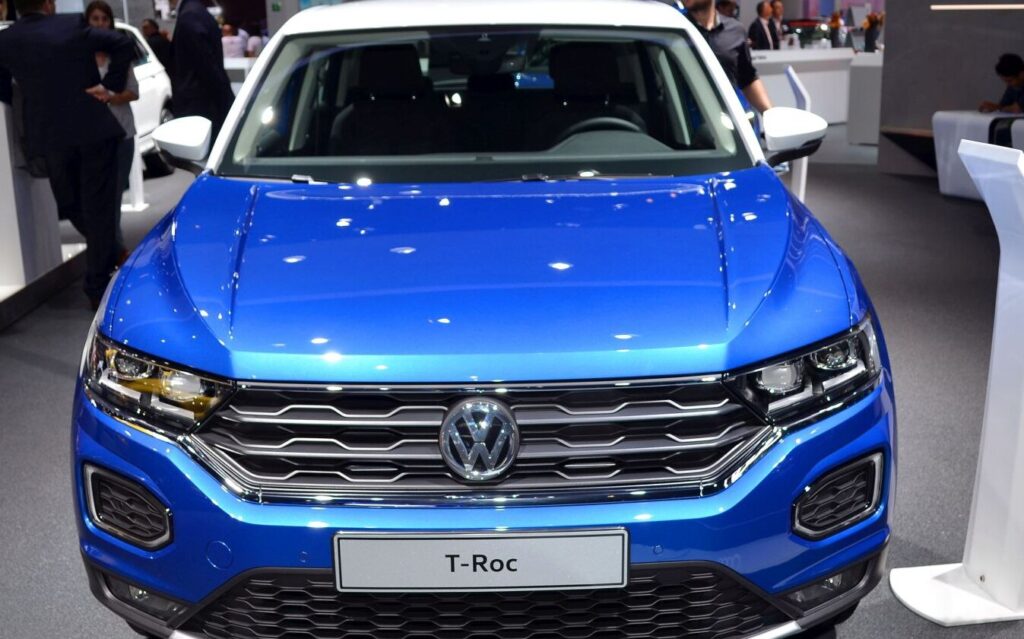
The Volkswagen T-Roc 1.0 TSI, producing 116 horsepower, was a key entry point into the T-Roc range when it launched in 2017. Positioned as a compact SUV, the T-Roc aimed to attract a younger demographic with its modern styling and accessible price point. This particular variant, powered by the three-cylinder 1.0 TSI engine, served as the base model for many European markets, offering a balance between fuel efficiency and everyday usability. Production of this specific configuration ran through 2018, before being superseded by updated engine options and trim levels. The T-Roc itself was Volkswagen’s response to the growing demand for subcompact SUVs, competing with models like the Nissan Juke and Opel/Vauxhall Crossland X.
Technical Specifications
| Brand | Volkswagen |
| Model | T-Roc |
| Generation | T-Roc I |
| Type (Engine) | 1.0 TSI (116 Hp) |
| Start of production | 2017 |
| End of production | 2018 |
| Powertrain Architecture | Internal Combustion engine |
| Body type | SUV |
| Seats | 5 |
| Doors | 5 |
| Fuel consumption (urban) | 6.1 l/100 km (38.6 US mpg, 46.3 UK mpg, 16.4 km/l) |
| Fuel consumption (extra urban) | 4.5 l/100 km (52.3 US mpg, 62.8 UK mpg, 22.2 km/l) |
| Fuel consumption (combined) | 5.1 l/100 km (46.1 US mpg, 55.4 UK mpg, 19.6 km/l) |
| CO2 emissions | 117 g/km |
| Fuel Type | Petrol (Gasoline) |
| Acceleration 0 – 100 km/h | 10.1 sec |
| Acceleration 0 – 62 mph | 10.1 sec |
| Acceleration 0 – 60 mph | 9.6 sec |
| Maximum speed | 187 km/h (116.2 mph) |
| Emission standard | Euro 6 |
| Weight-to-power ratio | 10.9 kg/Hp, 91.3 Hp/tonne |
| Weight-to-torque ratio | 6.4 kg/Nm, 157.5 Nm/tonne |
| Power | 116 Hp @ 5000-5500 rpm |
| Power per litre | 116.1 Hp/l |
| Torque | 200 Nm @ 2000-3500 rpm (147.51 lb.-ft. @ 2000-3500 rpm) |
| Engine layout | Front, Transverse |
| Engine Model/Code | CHZJ |
| Engine displacement | 999 cm3 (60.96 cu. in.) |
| Number of cylinders | 3 |
| Engine configuration | Inline |
| Number of valves per cylinder | 4 |
| Fuel injection system | Direct injection |
| Engine aspiration | Turbocharger, Intercooler |
| Engine oil capacity | 4 l (4.23 US qt | 3.52 UK qt) |
| Kerb Weight | 1270 kg (2799.87 lbs.) |
| Max. weight | 1780 kg (3924.23 lbs.) |
| Max load | 510 kg (1124.36 lbs.) |
| Fuel tank capacity | 50 l (13.21 US gal | 11 UK gal) |
| Max. roof load | 75 kg (165.35 lbs.) |
| Permitted trailer load with brakes (8%) | 1500 kg (3306.93 lbs.) |
| Permitted trailer load with brakes (12%) | 1300 kg (2866.01 lbs.) |
| Permitted trailer load without brakes | 630 kg (1388.91 lbs.) |
| Permitted towbar download | 80 kg (176.37 lbs.) |
| Length | 4234 mm (166.69 in.) |
| Width | 1819 mm (71.61 in.) |
| Height | 1573 mm (61.93 in.) |
| Wheelbase | 2590 mm (101.97 in.) |
| Front track | 1538-1546 mm (60.55 – 60.87 in.) |
| Rear track | 1533-1541 mm (60.35 – 60.67 in.) |
| Minimum turning circle | 11.1 m (36.42 ft.) |
| Front brakes | Ventilated discs |
| Rear brakes | Ventilated discs |
| Number of gears | 6 |
| Type of gearbox | Manual transmission |
Powertrain & Engine Architecture
The heart of the T-Roc 1.0 TSI is the CHZJ engine code, a 999cc inline three-cylinder petrol engine. This engine is part of Volkswagen’s EA211 family, known for its compact size and efficiency. It utilizes direct fuel injection and a single turbocharger with an intercooler to boost power output. The engine’s 116 horsepower is achieved at between 5000 and 5500 rpm, while peak torque of 200 Nm (147.51 lb-ft) is available from 2000 to 3500 rpm. This broad torque band helps provide reasonable responsiveness in everyday driving situations. The engine is paired with a six-speed manual transmission, which was the standard offering for this variant. The transmission’s gear ratios are tuned for a balance of fuel economy and acceleration, with a relatively long final drive to aid efficiency.
Driving Characteristics
The 1.0 TSI engine in the T-Roc, coupled with the manual transmission, delivers a driving experience that prioritizes fuel economy over outright performance. Acceleration from 0-60 mph takes around 9.6 seconds, and while adequate for urban and highway driving, it won’t provide particularly brisk performance. The turbocharger does provide a noticeable boost in power when accelerating, but the engine can feel somewhat strained at higher speeds or when fully loaded. Compared to the more powerful 1.5 TSI or 2.0 TSI variants, the 1.0 TSI feels noticeably less responsive. However, the manual transmission allows for greater driver control and engagement, and the relatively light weight of the engine contributes to nimble handling.
Equipment & Trim Levels
The 1.0 TSI T-Roc typically came with a fairly basic level of standard equipment. This included air conditioning, a touchscreen infotainment system with Bluetooth connectivity, alloy wheels, and a suite of safety features such as ABS, ESC (Electronic Stability Control), and multiple airbags. Higher trim levels, such as ‘SE’ or ‘SEL’, added features like automatic climate control, parking sensors, a larger touchscreen display, and upgraded interior trim. Optional extras included a panoramic sunroof, adaptive cruise control, and a premium sound system. Interior upholstery was typically cloth, with the option of leather upgrades on higher trims.
Chassis & Braking
The T-Roc’s chassis is based on the MQB platform, shared with other Volkswagen Group vehicles like the Audi A3 and SEAT Leon. The suspension consists of MacPherson struts at the front and a multi-link setup at the rear, providing a comfortable and controlled ride. The 1.0 TSI variant typically featured smaller diameter alloy wheels and tires compared to higher-powered models. Braking is handled by ventilated discs on all four wheels, providing adequate stopping power for the vehicle’s weight and performance. ABS (Anti-lock Braking System) and ESC (Electronic Stability Control) are standard safety features.
Market Reception & Comparison
The T-Roc 1.0 TSI was generally well-received by critics as an affordable and practical entry point into the compact SUV segment. Its fuel efficiency was a major selling point, and its modern styling appealed to a younger audience. However, some reviewers noted that the engine could feel underpowered, particularly when fully loaded or on steep inclines. Compared to the 1.5 TSI variant, the 1.0 TSI offered significantly lower performance but also a lower price tag. The 1.5 TSI provided a more refined driving experience and better acceleration, but at a higher cost. In terms of reliability, the 1.0 TSI engine has proven to be generally robust, although some owners have reported issues with the turbocharger and fuel injectors.
Legacy
The Volkswagen T-Roc 1.0 TSI remains a popular choice in the used car market, particularly for buyers seeking an affordable and fuel-efficient compact SUV. The 1.0 TSI engine has proven to be relatively reliable, although regular maintenance is essential to prevent potential issues. The T-Roc’s modern styling and practical interior have also contributed to its enduring appeal. While it may not offer the performance of higher-powered variants, the 1.0 TSI provides a comfortable and economical driving experience that suits many drivers’ needs. As the T-Roc continues to evolve, the 1.0 TSI variant represents an important chapter in its history, establishing the model as a competitive player in the crowded compact SUV market.
