
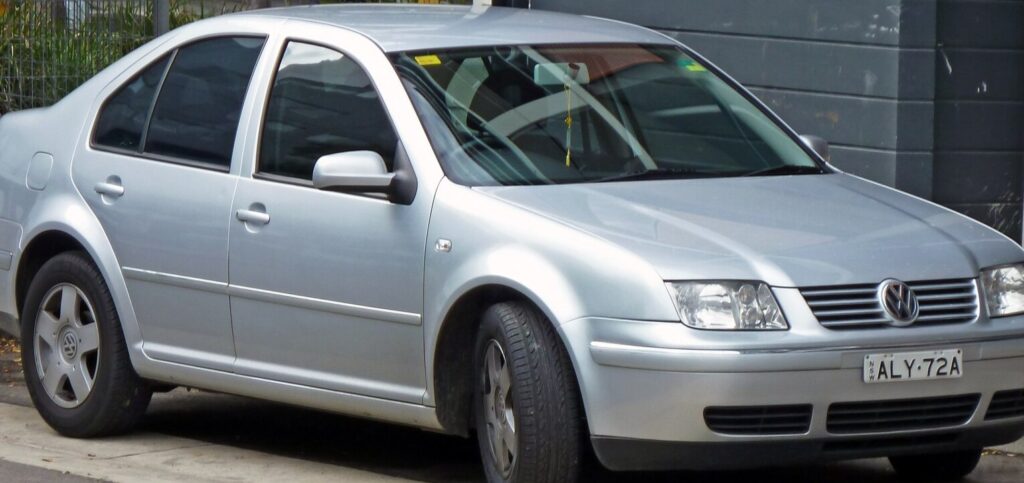
The Volkswagen Bora 1.6 16V, produced between 1999 and 2005, represented an entry-level offering within the Bora (1J2) lineup, Volkswagen’s compact sedan designed primarily for the European market. Positioned as a more affordable alternative to the higher-performance variants like the 1.8T and VR6, the 1.6 16V aimed at buyers prioritizing fuel efficiency and practicality. The Bora itself was essentially the European equivalent of the Jetta sold in North America, sharing the A4/1J platform with the Golf Mk4, Audi A3, and SEAT Leon. This model year saw Volkswagen attempting to broaden its appeal within the competitive C-segment.
Technical Specifications
| Brand | Volkswagen |
| Model | Bora |
| Generation | Bora (1J2) |
| Type (Engine) | 1.6 16V (105 Hp) |
| Start of production | 1999 year |
| End of production | 2005 year |
| Powertrain Architecture | Internal Combustion engine |
| Body type | Sedan |
| Seats | 5 |
| Doors | 4 |
| Fuel consumption (economy) – urban | 9.5 l/100 km (24.8 US mpg, 29.7 UK mpg, 10.5 km/l) |
| Fuel consumption (economy) – extra urban | 5.7 l/100 km (41.3 US mpg, 49.6 UK mpg, 17.5 km/l) |
| Fuel consumption (economy) – combined | 7.1 l/100 km (33.1 US mpg, 39.8 UK mpg, 14.1 km/l) |
| CO2 emissions | 170 g/km |
| Fuel Type | Petrol (Gasoline) |
| Acceleration 0 – 100 km/h | 11.3 sec |
| Acceleration 0 – 62 mph | 11.3 sec |
| Acceleration 0 – 60 mph | 10.7 sec |
| Maximum speed | 192 km/h (119.3 mph) |
| Emission standard | Euro 4 |
| Weight-to-power ratio | 13 kg/Hp, 77.2 Hp/tonne |
| Weight-to-torque ratio | 9.2 kg/Nm, 108.8 Nm/tonne |
| Power | 105 Hp @ 5700 rpm |
| Power per litre | 65.7 Hp/l |
| Torque | 148 Nm @ 4500 rpm (109.16 lb.-ft. @ 4500 rpm) |
| Engine layout | Front, Transverse |
| Engine Model/Code | ATN, AUS, AZD, BCB |
| Engine displacement | 1598 cm3 (97.52 cu. in.) |
| Number of cylinders | 4 |
| Engine configuration | Inline |
| Cylinder Bore | 76.5 mm (3.01 in.) |
| Piston Stroke | 86.9 mm (3.42 in.) |
| Compression ratio | 11.5:1 |
| Number of valves per cylinder | 4 |
| Fuel injection system | Multi-port manifold injection |
| Engine aspiration | Naturally aspirated engine |
| Valvetrain | DOHC |
| Engine oil capacity | 3.5 l (3.7 US qt | 3.08 UK qt) |
| Coolant | 6 l (6.34 US qt | 5.28 UK qt) |
| Kerb Weight | 1360 kg (2998.29 lbs.) |
| Max. weight | 1760 kg (3880.14 lbs.) |
| Max load | 400 kg (881.85 lbs.) |
| Trunk (boot) space – minimum | 455 l (16.07 cu. ft.) |
| Trunk (boot) space – maximum | 785 l (27.72 cu. ft.) |
| Fuel tank capacity | 55 l (14.53 US gal | 12.1 UK gal) |
| Max. roof load | 75 kg (165.35 lbs.) |
| Permitted trailer load with brakes (12%) | 1200 kg (2645.55 lbs.) |
| Permitted trailer load without brakes | 600 kg (1322.77 lbs.) |
| Permitted towbar download | 75 kg (165.35 lbs.) |
| Length | 4376 mm (172.28 in.) |
| Width | 1735 mm (68.31 in.) |
| Width including mirrors | 2018 mm (79.45 in.) |
| Height | 1446 mm (56.93 in.) |
| Wheelbase | 2519 mm (99.17 in.) |
| Front track | 1513 mm (59.57 in.) |
| Rear (Back) track | 1494 mm (58.82 in.) |
| Drag coefficient (Cd) | 0.32 |
| Minimum turning circle (turning diameter) | 10.9 m (35.76 ft.) |
| Drivetrain Architecture | The Internal combustion engine (ICE) drives the front wheels of the vehicle. |
| Drive wheel | Front wheel drive |
| Number of gears and type of gearbox | 5 gears, manual transmission |
| Front suspension | Independent, type McPherson with coil spring and anti-roll bar |
| Rear suspension | Semi-independent, coil spring |
| Front brakes | Ventilated discs |
| Rear brakes | Disc |
| Assisting systems | ABS (Anti-lock braking system) |
| Steering type | Steering rack and pinion |
| Power steering | Hydraulic Steering |
| Tires size | 195/65 R15 |
| Wheel rims size | 6J x 15 |
INTRODUCTION
The Volkswagen Bora 1.6 16V, launched in 1999 and continuing through 2005, was a key component of Volkswagen’s strategy to offer a broad range of options within the compact sedan segment. Built on the 1J2 platform – shared with the Golf Mk4, Audi A3, and SEAT Leon – the Bora aimed to provide a practical and affordable alternative to more expensive and performance-oriented models. The 1.6-liter engine and five-speed manual transmission combination was designed to appeal to drivers seeking fuel economy and ease of use, making it a popular choice for everyday commuting and family transportation in Europe.
Powertrain & Engine Architecture
The heart of the Bora 1.6 16V is the 1.6-liter, inline-four cylinder engine, typically identified by engine codes ATN, AUS, AZD, or BCB. This engine utilizes a multi-port fuel injection system, delivering fuel directly into the intake ports. The 16-valve dual overhead camshaft (DOHC) configuration enhances breathing and contributes to a reasonable power output for its displacement. The engine’s design prioritized efficiency and reliability over outright performance. The five-speed manual transmission was the standard offering, providing a relatively direct connection between the engine and the front wheels. Gear ratios were tuned for fuel economy and smooth operation, rather than aggressive acceleration. The transmission itself is a conventional manual unit, known for its durability and relatively low maintenance requirements.
Driving Characteristics
The driving experience in the Bora 1.6 16V is characterized by its smooth and predictable nature. With 105 horsepower and 148 Nm (109 lb-ft) of torque, acceleration is adequate for everyday driving, but it’s not a particularly quick car. The 0-60 mph time of around 10.7 seconds reflects this. The engine feels most comfortable in the mid-range, providing sufficient power for overtaking maneuvers on open roads. The five-speed manual transmission allows drivers to keep the engine in its optimal power band. Compared to the 1.8T or VR6 versions, the 1.6 16V feels noticeably less powerful, especially at higher speeds. However, the lighter engine weight contributes to slightly better handling and a more balanced feel in corners. The steering is precise and provides good feedback, typical of Volkswagen vehicles of this era.
Equipment & Trim Levels
The Bora 1.6 16V typically came with a fairly basic level of equipment, reflecting its position as an entry-level model. Standard features generally included power steering, central locking, electric front windows, and an adjustable steering column. Interior upholstery was typically cloth, and the dashboard featured a straightforward design with easy-to-read gauges. Optional extras included air conditioning, alloy wheels, a CD stereo system, and upgraded interior trim. Higher trim levels, such as the Trendline or Comfortline, added more features as standard, but the 1.6 16V remained the most affordable option.
Chassis & Braking
The Bora 1.6 16V utilized a McPherson strut front suspension and a semi-independent coil spring rear suspension. This setup provided a comfortable ride quality, absorbing bumps and imperfections in the road effectively. The front brakes were ventilated discs, offering good stopping power, while the rear brakes were solid discs. Anti-lock Braking System (ABS) was standard, enhancing safety and control during emergency braking situations. The suspension was tuned for comfort rather than sporty handling, resulting in a slight degree of body roll during cornering. Stabilizer bars were fitted to both the front and rear axles to help reduce body roll and improve stability.
Market Reception & Comparison
The Bora 1.6 16V was generally well-received by critics as a practical and affordable family sedan. Its fuel economy was a major selling point, particularly in Europe where fuel prices are higher. However, some reviewers criticized its lack of power compared to the more expensive variants. Compared to the 1.8T, the 1.6 16V offered significantly less performance but also lower running costs. The 1.9 TDI diesel version provided even better fuel economy but came with a higher purchase price. The 1.6 16V appealed to buyers who prioritized value for money and practicality over outright performance.
Legacy
The Volkswagen Bora 1.6 16V has proven to be a relatively reliable vehicle, with the 1.6-liter engine known for its durability. Common maintenance issues include wear and tear on suspension components and occasional problems with the fuel injection system. Today, the Bora 1.6 16V can be found on the used car market at very affordable prices. It remains a popular choice for first-time car buyers or those seeking a reliable and economical mode of transportation. While not a particularly exciting car to drive, its practicality, affordability, and relatively low maintenance costs have ensured its continued relevance in the used car market.
