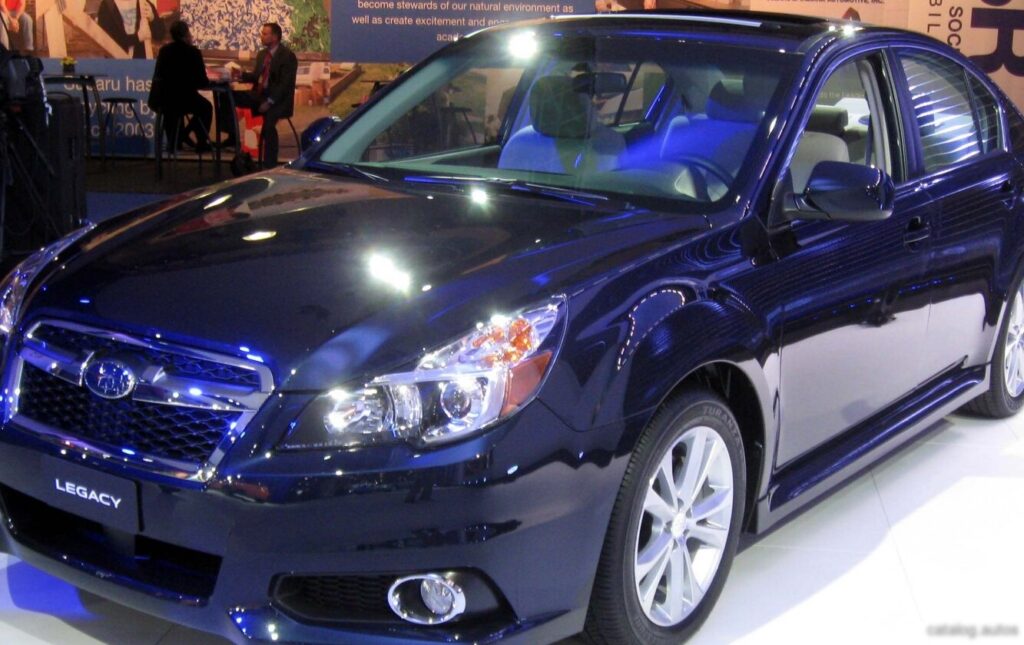
The Subaru Legacy V (facelift, 2012-2014) 2.0L AWD CVT represents a mid-cycle refresh of the fifth-generation Legacy, a model that continued Subaru’s commitment to all-wheel drive and practical, reliable transportation. Introduced as part of a broader update to the Legacy line, this variant aimed to balance fuel efficiency with adequate performance for the North American market, where the Legacy competed with established mid-size sedans like the Toyota Camry, Honda Accord, and Ford Fusion. The facelift brought revised styling, improved interior materials, and enhancements to the infotainment system. This specific 2.0-liter, continuously variable transmission (CVT) combination occupied a key position in the lineup, serving as a popular choice for buyers prioritizing fuel economy and all-weather capability over outright performance.
Technical Specifications
| Brand | Subaru |
| Model | Legacy |
| Generation | Legacy V (facelift 2012) |
| Type (Engine) | 2.0 (150 Hp) AWD CVT |
| Start of production | 2012 |
| End of production | 2014 |
| Powertrain Architecture | Internal Combustion engine |
| Body type | Sedan |
| Seats | 5 |
| Doors | 4 |
| Fuel consumption (urban) | 10.8 l/100 km (21.8 US mpg) |
| Fuel consumption (extra urban) | 6.4 l/100 km (36.8 US mpg) |
| Fuel consumption (combined) | 8 l/100 km (29.4 US mpg) |
| Fuel Type | Petrol (Gasoline) |
| Acceleration 0 – 100 km/h | 11.1 sec |
| Acceleration 0 – 62 mph | 11.1 sec |
| Acceleration 0 – 60 mph | 10.5 sec |
| Maximum speed | 203 km/h (126.14 mph) |
| Weight-to-power ratio | 9.7 kg/Hp |
| Weight-to-torque ratio | 7.4 kg/Nm |
| Power | 150 Hp @ 6000 rpm |
| Torque | 196 Nm @ 3000 rpm (144.56 lb.-ft. @ 3000 rpm) |
| Engine layout | Front, Longitudinal |
| Engine Model/Code | EJ20 |
| Engine displacement | 1994 cm3 (121.68 cu. in.) |
| Number of cylinders | 4 |
| Engine configuration | Boxer |
| Cylinder Bore | 92 mm (3.62 in.) |
| Piston Stroke | 75 mm (2.95 in.) |
| Compression ratio | 10.2:1 |
| Number of valves per cylinder | 4 |
| Fuel injection system | Direct injection |
| Engine aspiration | Naturally aspirated engine |
| Valvetrain | DOHC |
| Engine oil capacity | 4.2 l (4.44 US qt | 3.7 UK qt) |
| Coolant | 6.5 l (6.87 US qt | 5.72 UK qt) |
| Kerb Weight | 1460 kg (3218.75 lbs.) |
| Trunk (boot) space – minimum | 416 l (14.69 cu. ft.) |
| Fuel tank capacity | 70 l (18.49 US gal | 15.4 UK gal) |
| Length | 4745 mm (186.81 in.) |
| Width | 1821 mm (71.69 in.) |
| Height | 1506 mm (59.29 in.) |
| Wheelbase | 2751 mm (108.31 in.) |
| Front track | 1565 mm (61.61 in.) |
| Rear (Back) track | 1575 mm (62.01 in.) |
| Ride height (ground clearance) | 150 mm (5.91 in.) |
| Minimum turning circle | 11.2 m (36.75 ft.) |
| Drive wheel | All wheel drive (4×4) |
| Number of gears and type of gearbox | automatic transmission CVT |
| Front suspension | Independent type McPherson |
| Rear suspension | Double wishbone |
| Front brakes | Ventilated discs |
| Rear brakes | Disc |
| Assisting systems | ABS (Anti-lock braking system) |
| Steering type | Steering rack and pinion |
| Tires size | 215/50 R17 |
| Wheel rims size | 7.0J x 17 |
INTRODUCTION
The 2012-2014 Subaru Legacy V facelift, equipped with the 2.0-liter engine and CVT, was a key offering in Subaru’s lineup. Built on the Subaru Global Platform (SGP) – internally designated as the 1HX0/A3 platform – this generation of Legacy aimed to improve upon its predecessor in terms of refinement, fuel efficiency, and safety. The facelift brought subtle but noticeable changes to the exterior styling, including a revised front grille, headlights, and bumper. Inside, improvements were made to the dashboard design and materials. This particular variant was positioned as the entry-level or mid-range option, depending on the specific package and optional extras selected, appealing to buyers seeking a practical, reliable, and all-weather capable sedan.
Powertrain & Engine Architecture
At the heart of this Legacy variant lies the EJ20 2.0-liter naturally aspirated boxer engine. Subaru’s horizontally-opposed “boxer” configuration is renowned for its inherent balance, contributing to smoother operation and reduced vibration. The EJ20 features a single overhead camshaft (SOHC) design per cylinder bank, operating four valves per cylinder. Direct fuel injection (DI) was employed to enhance combustion efficiency and power output. The engine produced 150 horsepower at 6000 rpm and 196 Nm (144.56 lb-ft) of torque at 3000 rpm. Paired with this engine is a continuously variable transmission (CVT), which offered seamless gear changes and optimized engine operation for fuel economy. Subaru’s CVT was designed for durability and featured simulated shift points to mimic the feel of a traditional automatic transmission.
Driving Characteristics
The 2.0L CVT Legacy delivered a comfortable and predictable driving experience. While not particularly sporty, the engine provided adequate power for everyday driving situations. The CVT, while efficient, did exhibit the characteristic “rubber band” feel common to these transmissions, where engine speed doesn’t always directly correlate with vehicle acceleration. Compared to the more powerful 2.5-liter engine option, the 2.0L felt less responsive, especially during quick acceleration or overtaking maneuvers. However, the CVT’s ability to keep the engine in its optimal power band helped to mitigate some of this difference. The all-wheel-drive system provided excellent traction in various weather conditions, enhancing stability and confidence. The gear ratios in the CVT were tuned for fuel efficiency, prioritizing smooth cruising over aggressive acceleration.
Equipment & Trim Levels
The 2.0L CVT Legacy typically came standard with features such as air conditioning, power windows and locks, a basic audio system with auxiliary input, and stability control. Higher trim levels, such as the Limited, added features like leather upholstery, a sunroof, upgraded audio system, and automatic climate control. Optional extras included a navigation system, Bluetooth connectivity, and advanced safety features like Subaru’s EyeSight driver-assist technology. Interior upholstery was typically cloth on base models, with leather available on higher trims. The dashboard layout was functional and straightforward, with easy-to-read gauges and controls.
Chassis & Braking
The Legacy V utilized an independent McPherson strut suspension in the front and a double-wishbone suspension in the rear, providing a comfortable ride and predictable handling. The suspension was tuned for a balance between comfort and control. Braking duties were handled by ventilated discs in the front and solid discs in the rear. Anti-lock brakes (ABS) were standard, enhancing braking performance and stability. The chassis was designed to provide a rigid and stable platform, contributing to the car’s overall handling characteristics. Stabilizer bars were fitted to both the front and rear suspension to reduce body roll during cornering.
Market Reception & Comparison
The 2012-2014 Subaru Legacy V 2.0L CVT received generally positive reviews, with critics praising its standard all-wheel drive, comfortable ride, and good fuel economy. However, some reviewers noted that the 2.0-liter engine felt underpowered compared to competitors, and the CVT transmission lacked the responsiveness of a traditional automatic. Compared to the 2.5-liter Legacy, the 2.0L offered better fuel economy but sacrificed some performance. The 2.0L was often seen as a more sensible choice for buyers prioritizing practicality and fuel efficiency over sporty driving dynamics. Reliability was generally good, with the EJ20 engine proving to be a durable and dependable powerplant.
Legacy
The EJ20 engine, while not without its quirks, has proven to be a relatively reliable powerplant when properly maintained. The CVT transmission, while initially met with some skepticism, has also demonstrated good long-term durability. In the used car market, the 2012-2014 Legacy V 2.0L CVT represents a good value proposition, offering all-wheel-drive capability and a comfortable ride at an affordable price. Regular maintenance, including oil changes and CVT fluid replacements, is crucial to ensure the longevity of this powertrain. These Legacies continue to be a popular choice for buyers seeking a practical and reliable mid-size sedan, particularly in regions with inclement weather.