
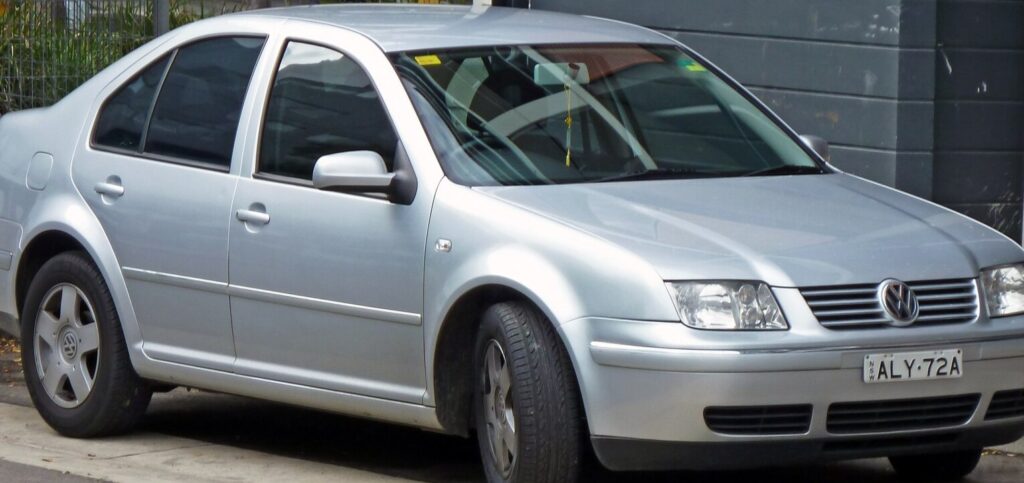
The Volkswagen Bora 1.8 Turbo 20V, produced between 2001 and 2005, represented a significant offering in the compact sedan segment, particularly in European markets. Based on the Volkswagen Group’s A4 platform (internally designated 1J2), the Bora was essentially the saloon/sedan version of the Golf Mk4, designed to offer a more traditional three-box body style. This 180 horsepower variant occupied a mid-range position within the Bora lineup, bridging the gap between the more economical base models and the performance-focused VR6 versions. It aimed to provide a balance of performance, fuel efficiency, and practicality for buyers seeking a refined and capable family car.
Technical Specifications
| Brand | Volkswagen |
| Model | Bora |
| Generation | Bora (1J2) |
| Type (Engine) | 1.8 Turbo 20V (180 Hp) |
| Start of production | 2001 |
| End of production | 2005 |
| Powertrain Architecture | Internal Combustion engine |
| Body type | Sedan |
| Seats | 5 |
| Doors | 4 |
| Fuel consumption (urban) | 11.9 l/100 km (19.8 US mpg, 23.7 UK mpg, 8.4 km/l) |
| Fuel consumption (extra urban) | 6.7 l/100 km (35.1 US mpg, 42.2 UK mpg, 14.9 km/l) |
| Fuel consumption (combined) | 8.6 l/100 km (27.4 US mpg, 32.8 UK mpg, 11.6 km/l) |
| CO2 emissions | 206 g/km |
| Fuel Type | Petrol (Gasoline) |
| Acceleration 0 – 100 km/h | 8.2 sec |
| Acceleration 0 – 62 mph | 8.2 sec |
| Acceleration 0 – 60 mph | 7.8 sec |
| Maximum speed | 228 km/h (141.67 mph) |
| Emission standard | Euro 4 |
| Weight-to-power ratio | 8 kg/Hp, 125.4 Hp/tonne |
| Weight-to-torque ratio | 6.1 kg/Nm, 163.8 Nm/tonne |
| Power | 180 Hp @ 5500 rpm |
| Power per litre | 101.1 Hp/l |
| Torque | 235 Nm @ 1950-5000 rpm (173.33 lb.-ft. @ 1950-5000 rpm) |
| Engine layout | Front, Transverse |
| Engine Model/Code | AUQ |
| Engine displacement | 1781 cm3 (108.68 cu. in.) |
| Number of cylinders | 4 |
| Engine configuration | Inline |
| Cylinder Bore | 81 mm (3.19 in.) |
| Piston Stroke | 86.4 mm (3.4 in.) |
| Compression ratio | 9.5:1 |
| Number of valves per cylinder | 5 |
| Fuel injection system | Multi-port manifold injection |
| Engine aspiration | Turbocharger, Intercooler |
| Valvetrain | DOHC |
| Engine oil capacity | 4.5 l (4.76 US qt | 3.96 UK qt) |
| Coolant | 5 l (5.28 US qt | 4.4 UK qt) |
| Kerb Weight | 1435 kg (3163.63 lbs.) |
| Max. weight | 1840 kg (4056.51 lbs.) |
| Max load | 405 kg (892.87 lbs.) |
| Trunk (boot) space – minimum | 455 l (16.07 cu. ft.) |
| Trunk (boot) space – maximum | 785 l (27.72 cu. ft.) |
| Fuel tank capacity | 55 l (14.53 US gal | 12.1 UK gal) |
| Max. roof load | 75 kg (165.35 lbs.) |
| Permitted trailer load with brakes (12%) | 1300 kg (2866.01 lbs.) |
| Permitted trailer load without brakes | 600 kg (1322.77 lbs.) |
| Permitted towbar download | 75 kg (165.35 lbs.) |
| Length | 4376 mm (172.28 in.) |
| Width | 1735 mm (68.31 in.) |
| Width including mirrors | 2018 mm (79.45 in.) |
| Height | 1446 mm (56.93 in.) |
| Wheelbase | 2519 mm (99.17 in.) |
| Front track | 1513 mm (59.57 in.) |
| Rear (Back) track | 1494 mm (58.82 in.) |
| Drag coefficient (Cd) | 0.32 |
| Minimum turning circle (turning diameter) | 10.9 m (35.76 ft.) |
| Drivetrain Architecture | The Internal combustion engine (ICE) drives the front wheels of the vehicle. |
| Drive wheel | Front wheel drive |
| Number of gears and type of gearbox | 6 gears, manual transmission |
| Front suspension | Independent, type McPherson with coil spring and anti-roll bar |
| Rear suspension | Semi-independent, coil spring |
| Front brakes | Ventilated discs |
| Rear brakes | Disc |
| Assisting systems | ABS (Anti-lock braking system) |
| Steering type | Steering rack and pinion |
| Power steering | Hydraulic Steering |
| Tires size | 205/55 R16 |
| Wheel rims size | 6.5J x 16 |
Powertrain & Engine Architecture
The heart of the Bora 1.8 Turbo 20V was the AUQ engine code, a 1.8-liter inline-four cylinder powerplant. This engine was a member of Volkswagen’s EA827 family, known for its robust construction and tuning potential. The “20V” designation refers to the five valves per cylinder (three intake, two exhaust) configuration, contributing to improved breathing and higher-RPM performance. A single turbocharger, typically a Garrett GT28, provided forced induction, boosting power output significantly over naturally aspirated versions. Fuel delivery was managed by a Bosch Motronic electronic fuel injection system, utilizing multi-point sequential injection. The engine featured an intercooler to reduce intake air temperatures, further enhancing performance and preventing knock. While a five-speed manual transmission was available, this variant was commonly paired with a four-speed automatic transmission, offering convenience but at the expense of some performance and fuel economy.
Driving Characteristics
The 1.8 Turbo 20V automatic Bora offered a comfortable and refined driving experience. Acceleration from 0-60 mph took around 8.2 seconds, respectable for its time, but noticeably slower than the manual transmission or VR6 models. The automatic transmission, while smooth, had relatively long gear ratios, prioritizing fuel efficiency over outright performance. The turbocharger provided a noticeable surge of power in the mid-range, making overtaking maneuvers relatively easy. However, the automatic transmission could sometimes feel hesitant during quick downshifts. The suspension, tuned for comfort, provided a compliant ride, absorbing bumps and imperfections in the road well. Steering was precise and well-weighted, offering a good level of feedback.
Equipment & Trim Levels
The 1.8 Turbo 20V Bora typically came equipped with a reasonable level of standard features. These included power windows, central locking, air conditioning, and an integrated stereo system. Interior upholstery was usually cloth, with options for leather available at an extra cost. Higher trim levels, such as the ‘Comfort’ or ‘Sport’ packages, added features like alloy wheels, upgraded audio systems, and climate control. Optional extras included a sunroof, heated seats, and parking sensors.
Chassis & Braking
The Bora’s chassis featured an independent McPherson strut suspension at the front and a semi-independent torsion beam suspension at the rear. This setup provided a good balance of ride comfort and handling. Braking duties were handled by ventilated disc brakes at the front and solid disc brakes at the rear. Anti-lock Braking System (ABS) was standard, enhancing safety and control during emergency braking situations. The steering system utilized a hydraulic power steering rack and pinion, providing precise and responsive steering feel.
Market Reception & Comparison
The Bora 1.8 Turbo 20V was generally well-received by automotive critics. It was praised for its comfortable ride, refined interior, and strong engine performance. However, some critics noted that the automatic transmission could detract from the driving experience. Compared to the base 1.6-liter models, the 1.8 Turbo offered a significant performance upgrade. Against the more powerful VR6 versions, it provided a more affordable and fuel-efficient alternative, appealing to buyers who prioritized practicality and economy over outright performance. The 1.9 TDI diesel variant was also a popular choice, offering even better fuel economy but with less horsepower.
Legacy
The Volkswagen Bora 1.8 Turbo 20V has proven to be a relatively reliable vehicle, with the AUQ engine being known for its durability. However, like all turbocharged engines, it requires regular maintenance, including oil changes and inspection of the turbocharger and associated components. Today, the Bora 1.8 Turbo 20V can be found on the used car market at affordable prices. It remains a popular choice for buyers seeking a comfortable, practical, and relatively fuel-efficient compact sedan. Its robust engine and relatively simple mechanical design make it a relatively easy vehicle to maintain and repair, contributing to its continued appeal.
