
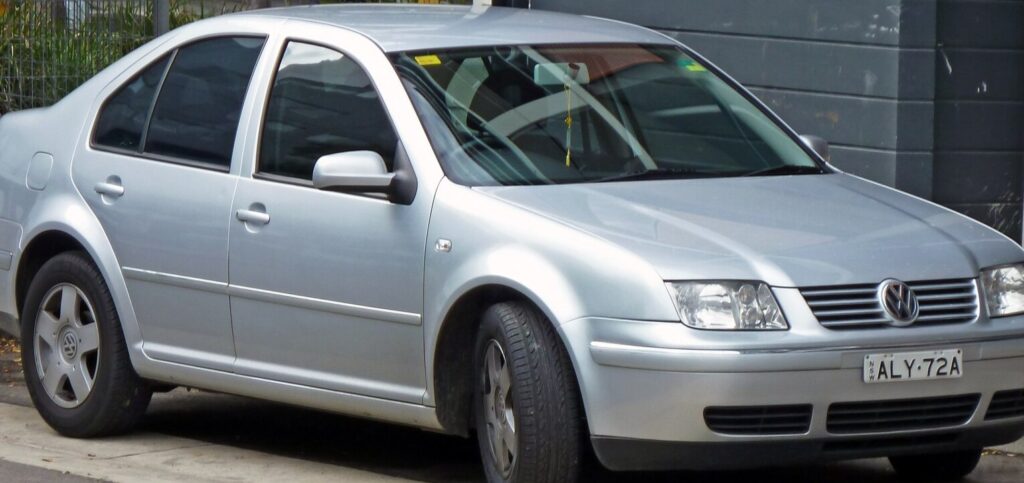
The Volkswagen Bora 1.9 SDI, produced between 1998 and 2005, represented an entry-level offering within the first generation (1J2) Bora lineup. Positioned as a fuel-efficient and practical sedan, it served as a more affordable alternative to the higher-performance petrol variants and the more sophisticated 1.9 TDI diesel. The Bora itself was Volkswagen’s replacement for the Jetta in Europe, sharing its platform – the A4 – with the Golf, Audi A3, and SEAT Leon. This particular 68 horsepower SDI version was primarily aimed at buyers prioritizing economy and low running costs over outright performance, making it a popular choice for fleet vehicles and budget-conscious consumers.
Technical Specifications
| Brand | Volkswagen |
| Model | Bora |
| Generation | Bora (1J2) |
| Type (Engine) | 1.9 SDI (68 Hp) |
| Start of production | 1998 |
| End of production | 2005 |
| Powertrain Architecture | Internal Combustion engine |
| Body type | Sedan |
| Seats | 5 |
| Doors | 4 |
| Fuel consumption (urban) | 6.6 l/100 km (35.6 US mpg, 42.8 UK mpg, 15.2 km/l) |
| Fuel consumption (extra urban) | 4.3 l/100 km (54.7 US mpg, 65.7 UK mpg, 23.3 km/l) |
| Fuel consumption (combined) | 5.1 l/100 km (46.1 US mpg, 55.4 UK mpg, 19.6 km/l) |
| Fuel Type | Diesel |
| Acceleration 0 – 100 km/h | 14.1 sec |
| Acceleration 0 – 62 mph | 14.1 sec |
| Acceleration 0 – 60 mph | 13.4 sec |
| Maximum speed | 175 km/h (108.74 mph) |
| Weight-to-power ratio | 18.6 kg/Hp, 53.8 Hp/tonne |
| Weight-to-torque ratio | 9.5 kg/Nm, 105.1 Nm/tonne |
| Power | 68 Hp @ 4200 rpm |
| Power per litre | 35.9 Hp/l |
| Torque | 133 Nm @ 2200 rpm (98.1 lb.-ft. @ 2200 rpm) |
| Engine layout | Front, Transverse |
| Engine Model/Code | AGP, AQM |
| Engine displacement | 1896 cm3 (115.7 cu. in.) |
| Number of cylinders | 4 |
| Engine configuration | Inline |
| Cylinder Bore | 79.5 mm (3.13 in.) |
| Piston Stroke | 95.5 mm (3.76 in.) |
| Compression ratio | 19.5:1 |
| Number of valves per cylinder | 2 |
| Fuel injection system | Direct injection |
| Engine aspiration | Naturally aspirated engine |
| Valvetrain | SOHC |
| Engine oil capacity | 4.5 l (4.76 US qt | 3.96 UK qt) |
| Coolant | 6 l (6.34 US qt | 5.28 UK qt) |
| Kerb Weight | 1265 kg (2788.85 lbs.) |
| Max. weight | 1820 kg (4012.41 lbs.) |
| Max load | 555 kg (1223.57 lbs.) |
| Trunk (boot) space – minimum | 455 l (16.07 cu. ft.) |
| Trunk (boot) space – maximum | 785 l (27.72 cu. ft.) |
| Fuel tank capacity | 55 l (14.53 US gal | 12.1 UK gal) |
| Length | 4376 mm (172.28 in.) |
| Width | 1735 mm (68.31 in.) |
| Width including mirrors | 2018 mm (79.45 in.) |
| Height | 1446 mm (56.93 in.) |
| Wheelbase | 2519 mm (99.17 in.) |
| Front track | 1513 mm (59.57 in.) |
| Rear (Back) track | 1494 mm (58.82 in.) |
| Minimum turning circle | 10.9 m (35.76 ft.) |
| Drivetrain Architecture | Front wheel drive |
| Number of gears and type of gearbox | 5 gears, manual transmission |
| Front suspension | Independent, type McPherson with coil spring and anti-roll bar |
| Rear suspension | Semi-independent, coil spring, Transverse stabilizer |
| Front brakes | Ventilated discs |
| Rear brakes | Disc |
| Assisting systems | ABS (Anti-lock braking system) |
| Steering type | Steering rack and pinion |
| Power steering | Hydraulic Steering |
| Tires size | 195/65 R15 |
| Wheel rims size | 6J x 15 |
Powertrain & Engine Architecture
The Bora 1.9 SDI utilized the Volkswagen AG 1.9-liter inline-four cylinder diesel engine, specifically the AGP or AQM engine codes. This engine was a naturally aspirated, direct injection (DI) diesel, a technology that allowed for improved fuel efficiency and reduced emissions compared to older indirect injection systems. The SDI (Silent Diesel Injection) system employed a pump-injector design, which delivered fuel directly into the combustion chamber at extremely high pressure. This resulted in a more complete combustion process. The engine featured a single overhead camshaft (SOHC) valvetrain operating two valves per cylinder. Unlike the more powerful 1.9 TDI variants, the SDI engine did not employ a turbocharger or intercooler, contributing to its lower power output but also its simplicity and reliability. The five-speed manual transmission was the standard offering, providing a relatively long-geared setup optimized for fuel economy.
Driving Characteristics
The 1.9 SDI Bora offered modest performance. With 68 horsepower and 133 Nm (98 lb-ft) of torque, acceleration was leisurely, taking approximately 14 seconds to reach 60 mph. The engine’s torque delivery was relatively flat, providing adequate pulling power for everyday driving, but lacked the punch of the turbocharged TDI models. The long gearing of the five-speed manual transmission further emphasized fuel economy over acceleration. The car felt stable and predictable, but not particularly engaging to drive. Compared to the 1.8-liter petrol versions, the SDI offered significantly better fuel economy, but at the expense of performance. The TDI models, with their turbocharging, provided a substantial performance upgrade, but also came with a higher price tag and potentially more complex maintenance requirements.
Equipment & Trim Levels
The 1.9 SDI Bora typically came with a basic level of equipment. Standard features generally included power steering, central locking, electric front windows, and an anti-lock braking system (ABS). Interior upholstery was typically cloth, and the dashboard featured a functional, if somewhat spartan, design. Optional extras included air conditioning, alloy wheels, a radio/cassette player, and upgraded interior trim. The SDI trim level was generally considered the entry point to the Bora range, with higher trims offering more luxurious features and upgraded engines.
Chassis & Braking
The Bora 1.9 SDI utilized a McPherson strut front suspension with coil springs and an anti-roll bar, providing a comfortable and predictable ride. The rear suspension was a semi-independent torsion beam setup, which was cost-effective and space-efficient. Brakes consisted of ventilated discs at the front and solid discs at the rear. The braking system was adequate for the car’s performance, but lacked the stopping power of the larger brake systems found on higher-performance Bora models. The car’s relatively light weight helped to compensate for the modest braking performance.
Market Reception & Comparison
The Bora 1.9 SDI was generally well-received as a practical and economical family car. Critics praised its fuel efficiency and low running costs, but noted its lack of performance. Compared to the petrol-powered Boras, the SDI offered significantly better fuel economy, making it a popular choice for high-mileage drivers. The TDI models were often seen as a more desirable option for those seeking a balance of performance and economy. However, the SDI’s simplicity and reliability appealed to buyers who prioritized dependability over driving excitement.
Legacy
The 1.9 SDI engine, in various forms, proved to be a remarkably durable and reliable powerplant. Many examples are still on the road today, testament to its robust construction and relatively simple design. The Bora 1.9 SDI remains a relatively affordable used car, appealing to buyers seeking a practical and economical mode of transportation. While not a performance icon, it represents a solid and dependable option within the Volkswagen lineup of the late 1990s and early 2000s. Maintenance is generally straightforward, and parts availability remains good, making it a viable choice for those willing to accept its modest performance in exchange for its fuel efficiency and reliability.
