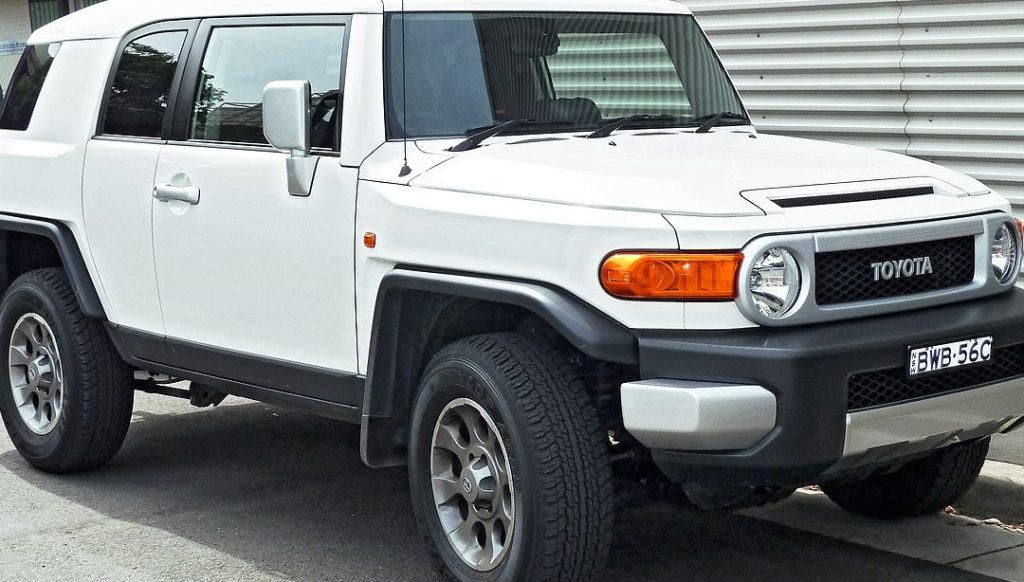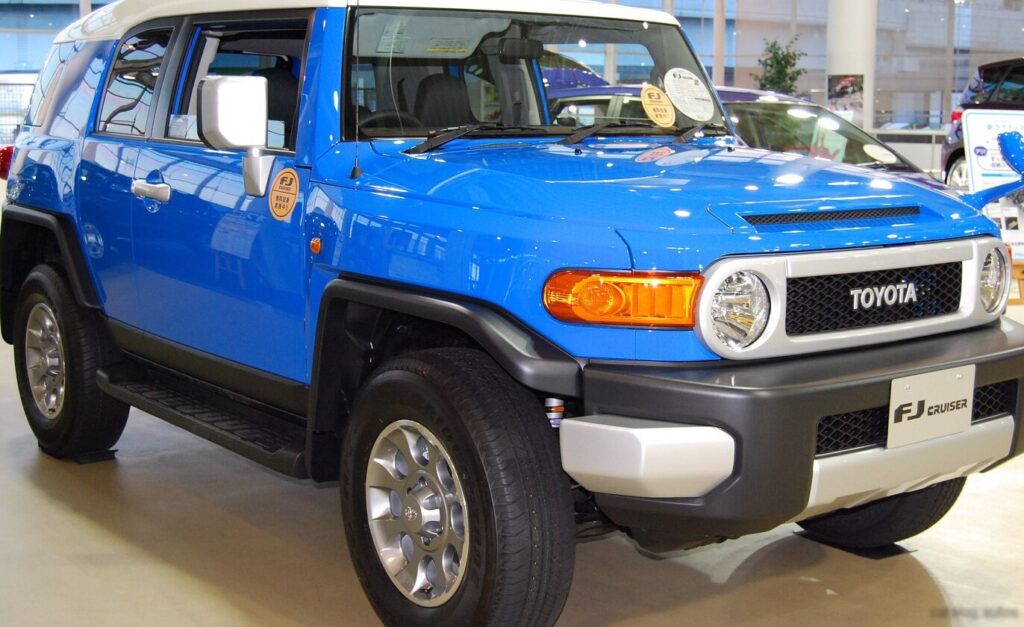
The Toyota FJ Cruiser 4.0 V6, equipped with a 260 horsepower engine and a four-wheel drive automatic transmission, was a distinctive SUV produced from 2010 to 2014. It represented Toyota’s attempt to recapture the spirit of the original FJ40 Land Cruiser, blending retro styling with modern technology and capability. This variant occupied a unique position in the FJ Cruiser lineup, offering a balance between off-road prowess and everyday usability, appealing to a broader audience than the more basic trims. It was primarily sold in North America, the Middle East, and Australia, where demand for rugged, body-on-frame SUVs remained strong.
Technical Specifications
| Brand | Toyota |
| Model | FJ Cruiser |
| Generation | FJ Cruiser |
| Type (Engine) | 4.0 V6 (260 Hp) 4WD Automatic |
| Start of production | 2010 |
| End of production | 2014 |
| Powertrain Architecture | Internal Combustion engine |
| Body type | Off-road vehicle, SUV |
| Seats | 5 |
| Doors | 5 |
| Fuel consumption (urban) | 13.8 l/100 km (17 US mpg, 20.5 UK mpg, 7.2 km/l) |
| Fuel consumption (extra urban) | 11.2 l/100 km (21 US mpg, 25.2 UK mpg, 8.9 km/l) |
| Fuel Type | Petrol (Gasoline) |
| Emission standard | LEV-II |
| Weight-to-power ratio | 7.6 kg/Hp, 132 Hp/tonne |
| Weight-to-torque ratio | 5.4 kg/Nm, 186.3 Nm/tonne |
| Power | 260 Hp @ 5600 rpm |
| Power per litre | 65.7 Hp/l |
| Torque | 367 Nm @ 4400 rpm (270.69 lb.-ft. @ 4400 rpm) |
| Engine layout | Front, Longitudinal |
| Engine Model/Code | 1GR-FE |
| Engine displacement | 3956 cm3 (241.41 cu. in.) |
| Number of cylinders | 6 |
| Engine configuration | V-engine |
| Cylinder Bore | 94 mm (3.7 in.) |
| Piston Stroke | 95 mm (3.74 in.) |
| Compression ratio | 10.4:1 |
| Number of valves per cylinder | 4 |
| Fuel injection system | Multi-port manifold injection |
| Engine aspiration | Naturally aspirated engine |
| Valvetrain | DOHC, Dual VVT-i |
| Engine oil capacity | 6.1 l (6.45 US qt | 5.37 UK qt) |
| Coolant capacity | 9.8 l (10.36 US qt | 8.62 UK qt) |
| Kerb Weight | 1970 kg (4343.11 lbs.) |
| Max. weight | 2527 kg (5571.08 lbs.) |
| Max load | 557 kg (1227.97 lbs.) |
| Trunk (boot) space – minimum | 790 l (27.9 cu. ft.) |
| Trunk (boot) space – maximum | 1892 l (66.82 cu. ft.) |
| Fuel tank capacity | 72 l (19.02 US gal | 15.84 UK gal) |
| Permitted trailer load with brakes (12%) | 2268 kg (5000.08 lbs.) |
| Length | 4671 mm (183.9 in.) |
| Width | 1905 mm (75 in.) |
| Height | 1829 mm (72.01 in.) |
| Wheelbase | 2690 mm (105.91 in.) |
| Front track | 1605 mm (63.19 in.) |
| Rear (Back) track | 1615 mm (63.58 in.) |
| Ride height (ground clearance) | 244 mm (9.61 in.) |
| Minimum turning circle (turning diameter) | 12.4 m (40.68 ft.) |
| Approach angle | 34° |
| Departure angle | 31° |
| Ramp-over (brakeover) angle | 27° |
| Drivetrain Architecture | The Internal combustion engine (ICE) drives permanently the four wheels of the vehicle. |
| Drive wheel | All wheel drive (4×4) |
| Number of gears and type of gearbox | 5 gears, automatic transmission ECT-i |
| Front suspension | Double wishbone, Transverse stabilizer |
| Rear suspension | Independent multi-link spring suspension with stabilizer |
| Front brakes | Disc |
| Rear brakes | Ventilated discs |
| Assisting systems | ABS (Anti-lock braking system) |
| Steering type | Steering rack and pinion |
| Power steering | Hydraulic Steering |
| Tires size | 265/70 R17 |
| Wheel rims size | 7.5J x 17 |
INTRODUCTION
The Toyota FJ Cruiser 4.0 V6 4WD Automatic, produced between 2010 and 2014, was a key variant within the second generation of the FJ Cruiser (J10 platform). Designed as a retro-inspired off-road vehicle, it aimed to evoke the ruggedness and simplicity of the original FJ40 Land Cruiser while offering modern comfort and safety features. This particular configuration, pairing the 4.0-liter V6 engine with a five-speed automatic transmission and four-wheel drive, was positioned as a mid-range offering, providing a balance of power, convenience, and capability. It was a popular choice for buyers seeking a capable off-roader that didn’t require the involvement of a manual transmission.
Powertrain & Engine Architecture
At the heart of the FJ Cruiser 4.0 V6 is the 1GR-FE engine, a 3.956-liter (241.41 cubic inches) naturally aspirated V6. This engine utilizes a cast iron block and aluminum cylinder heads, incorporating Toyota’s Dual VVT-i (Variable Valve Timing-intelligent) technology for both intake and exhaust valves. This system optimizes engine performance and fuel efficiency across a wider range of engine speeds. Fuel delivery is managed by a multi-port fuel injection system. The engine produces 260 horsepower at 5600 rpm and 367 Nm (270.69 lb-ft) of torque at 4400 rpm. The five-speed automatic transmission (ECT-i – Electronically Controlled Transmission – intelligent) was specifically tuned to handle the engine’s torque output and provide smooth shifting in both on-road and off-road conditions. The transmission features overdrive and a manual shift mode for greater driver control.
Driving Characteristics
The FJ Cruiser 4.0 V6 Automatic offered a comfortable and capable driving experience. While not a performance-oriented vehicle, the 4.0-liter V6 provided ample power for everyday driving and tackling moderate off-road trails. The automatic transmission, while smooth, wasn’t particularly quick to downshift, resulting in a slightly less responsive feel compared to the available six-speed manual transmission. The gear ratios were optimized for low-end torque, making it well-suited for rock crawling and navigating challenging terrain. Compared to the base 4-cylinder engine, the V6 offered a significant performance boost, and compared to potential aftermarket modifications, it provided a reliable and factory-backed power upgrade. The 4WD system, selectable between two-wheel drive, four-wheel drive high, and four-wheel drive low, enhanced its off-road capabilities.
Equipment & Trim Levels
The 4.0 V6 Automatic trim typically included standard features such as air conditioning, power windows and locks, a CD player with auxiliary input, and keyless entry. Higher trim levels added features like a premium audio system, leather upholstery, heated front seats, and a backup camera. The interior was designed with durability in mind, featuring water-resistant materials and easy-to-clean surfaces. Optional extras included a sunroof, navigation system, and various off-road accessories like a winch and rock rails. The distinctive rear swing-gate mounted spare tire was a standard feature across all trims.
Chassis & Braking
The FJ Cruiser utilized a body-on-frame construction, providing a robust and durable platform for off-road adventures. The front suspension consisted of a double wishbone setup with a transverse stabilizer bar, while the rear featured an independent multi-link spring suspension, also with a stabilizer bar. This suspension configuration provided a comfortable ride on paved roads while maintaining excellent articulation for off-road use. Braking duties were handled by disc brakes on all four wheels, with ventilated discs at the rear for improved heat dissipation. An Anti-lock Braking System (ABS) was standard, enhancing safety and control during emergency braking situations.
Market Reception & Comparison
The FJ Cruiser 4.0 V6 Automatic received generally positive reviews from automotive critics. It was praised for its unique styling, off-road capability, and comfortable interior. However, some critics noted its relatively poor fuel economy and limited on-road handling due to its high center of gravity. Compared to other SUVs in its class, the FJ Cruiser stood out for its retro design and focus on off-road performance. The V6 Automatic variant offered a more refined driving experience than the base 4-cylinder model, but it came at a higher price point. Compared to the manual transmission version, the automatic offered greater convenience, particularly in urban driving conditions, but sacrificed some driver engagement.
Legacy
The Toyota FJ Cruiser, including the 4.0 V6 Automatic variant, has developed a loyal following among off-road enthusiasts. The 1GR-FE engine is known for its reliability and durability, and with proper maintenance, it can provide many years of service. The FJ Cruiser’s unique styling and rugged character have made it a popular choice for customization and modification. On the used car market, well-maintained FJ Cruisers hold their value relatively well, particularly those with the V6 engine and four-wheel drive. While production ended in 2014, the FJ Cruiser remains a distinctive and capable SUV that continues to appeal to those seeking a vehicle that can handle both on-road and off-road adventures.