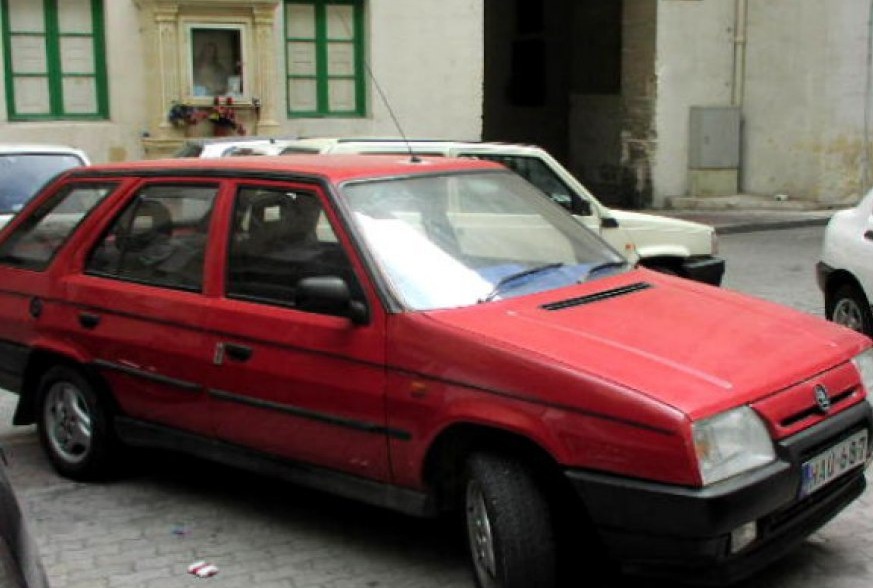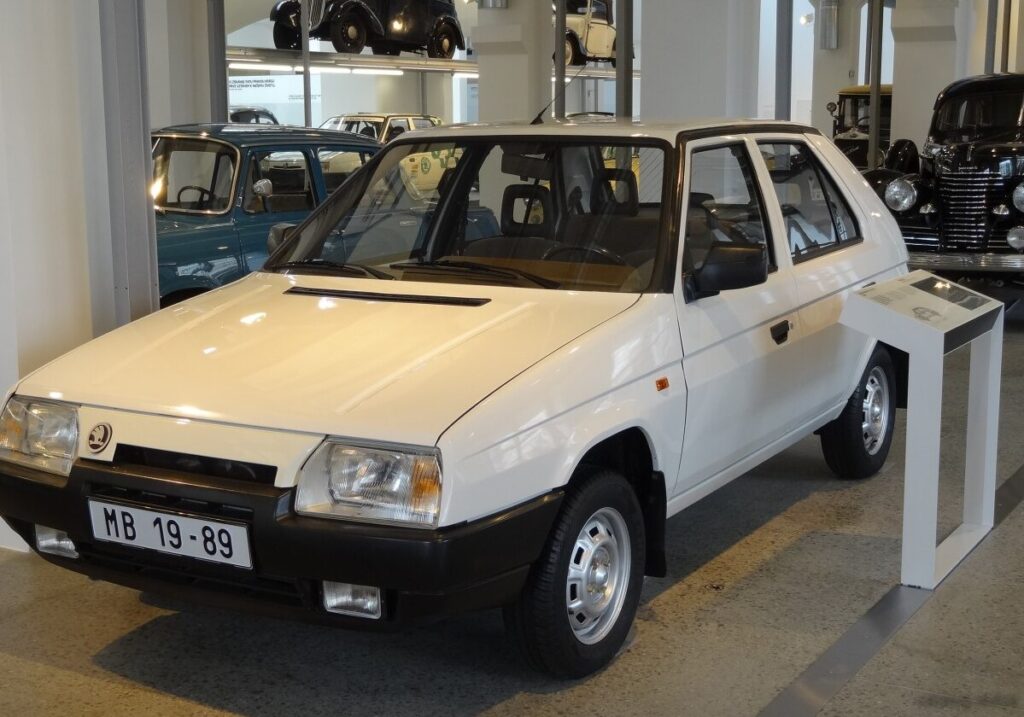
The Skoda Favorit 1.3, designated model code 781.136, was a mainstay of the Czech automaker’s lineup from 1990 to 1994. Representing a significant step forward for Skoda, the Favorit was the first model developed entirely under the ownership of the Volkswagen Group, though still heavily based on pre-existing designs. This 1.3-liter variant, producing 63 horsepower, served as the entry point to the Favorit range, aimed at providing affordable and practical transportation for families in both Czechoslovakia and export markets. It occupied a crucial position in Skoda’s transition from a domestically-focused manufacturer to a player on the European automotive stage.
Technical Specifications
| Brand | Skoda |
| Model | Favorit |
| Generation | Favorit (781) |
| Type (Engine) | 1.3 136 (781) (63 Hp) |
| Start of production | 1990 |
| End of production | 1994 |
| Powertrain Architecture | Internal Combustion engine |
| Body type | Hatchback |
| Seats | 5 |
| Doors | 5 |
| Fuel Type | Petrol (Gasoline) |
| Acceleration 0 – 100 km/h | 19 sec |
| Acceleration 0 – 62 mph | 19 sec |
| Acceleration 0 – 60 mph | 18.1 sec |
| Maximum speed | 152 km/h (94.45 mph) |
| Power | 63 Hp |
| Power per litre | 48.9 Hp/l |
| Engine layout | Middle, Transverse |
| Engine Model/Code | 781.136 |
| Engine displacement | 1289 cm3 (78.66 cu. in.) |
| Fuel injection system | Carburettor |
| Engine aspiration | Naturally aspirated engine |
| Engine oil capacity | 3.3 l (3.49 US qt | 2.9 UK qt) |
| Coolant | 6 l (6.34 US qt | 5.28 UK qt) |
| Fuel tank capacity | 45 l (11.89 US gal | 9.9 UK gal) |
| Front brakes | Disc |
| Rear brakes | Drum |
Powertrain & Engine Architecture
The heart of the Favorit 1.3 was the 781.136 engine, a 1.3-liter, inline-four cylinder petrol engine. This engine was a development of earlier Skoda designs, but significantly updated for the Favorit. It featured a cast iron block and an aluminum cylinder head. Crucially, this variant utilized a single-barrel carburetor for fuel delivery, a cost-saving measure that positioned it as the base model. The engine employed a simple overhead valve (OHV) valvetrain with two valves per cylinder. The engine was transversely mounted, a relatively modern configuration for its time, contributing to improved space efficiency within the compact Favorit chassis. The 781.136 engine produced 63 horsepower at 5500 rpm and 84 lb-ft of torque at 3200 rpm. The transmission paired with this engine was typically a four-speed automatic, though a five-speed manual was also available. The automatic transmission, while offering convenience, was known for its relatively slow shift times and tendency to hunt for gears, especially under load.
Driving Characteristics
The Favorit 1.3 with the automatic transmission offered a decidedly unhurried driving experience. Acceleration was slow, taking approximately 19 seconds to reach 62 mph (100 km/h). The automatic gearbox, while providing ease of use, noticeably sapped power, making overtaking maneuvers require careful planning. The gear ratios were optimized for fuel economy rather than performance. Compared to the five-speed manual version, the automatic suffered a significant performance penalty. The manual transmission allowed the engine to operate more efficiently and deliver a more responsive driving experience. Handling was adequate for everyday driving, but the Favorit’s suspension was tuned for comfort rather than sporty handling. The car felt stable enough at highway speeds, but body roll was noticeable in corners.
Equipment & Trim Levels
The Favorit 1.3 served as the entry-level trim, and as such, came with a relatively basic level of equipment. Standard features typically included cloth upholstery, a simple dashboard layout with analog gauges, and manual windows and door locks. Power steering was not standard on this trim level, requiring more effort at low speeds. Optional extras included a radio, upgraded interior trim, and, on later models, central locking. The interior was functional and durable, prioritizing practicality over luxury. The dashboard was constructed from hard plastics, but the overall design was clean and easy to use.
Chassis & Braking
The Favorit 1.3 utilized a relatively simple chassis design. The front suspension consisted of MacPherson struts, while the rear suspension employed a twist-beam axle. This setup provided a comfortable ride, but didn’t offer particularly sophisticated handling characteristics. The braking system featured disc brakes on the front wheels and drum brakes on the rear. This configuration was typical for cars in this price range during the early 1990s. The brakes were adequate for normal driving conditions, but lacked the stopping power of more modern braking systems. Anti-lock braking (ABS) was not available on the Favorit 1.3.
Market Reception & Comparison
The Skoda Favorit 1.3 Automatic was generally viewed as a practical and affordable option for budget-conscious buyers. Critics praised its spacious interior and relatively low running costs. However, the performance of the automatic transmission was often criticized. Compared to other cars in its class, such as the Fiat Uno or the Renault Clio, the Favorit offered a similar level of practicality and affordability, but often lagged behind in terms of performance and refinement. The manual transmission versions of the Favorit were generally better received by reviewers, who appreciated their improved performance and fuel economy. Fuel economy was a strong point for the 1.3, averaging around 35-40 mpg in mixed driving conditions.
Legacy
The Skoda Favorit 1.3, while not a performance icon, played a vital role in Skoda’s modernization and integration into the Volkswagen Group. The 781.136 engine, while simple, proved to be relatively reliable, and many examples are still on the road today. The automatic transmission, however, is often cited as a potential weak point, with some units experiencing issues with wear and tear. In the used car market, the Favorit 1.3 is valued for its affordability and simplicity. It represents a piece of automotive history, showcasing Skoda’s transition from a communist-era manufacturer to a modern European automaker. Parts availability can be a challenge, but a dedicated community of Skoda enthusiasts continues to support the preservation of these classic vehicles.