Technical Specifications
| Brand | Ford |
| Model | Kuga |
| Generation | Kuga II (facelift 2016) |
| Type (Engine) | 1.5 TDCI (120 Hp) PowerShift |
| Start of production | 2016 |
| End of production | 2019 |
| Powertrain Architecture | Internal Combustion engine |
| Body type | SUV |
| Seats | 5 |
| Doors | 5 |
| Fuel consumption (urban) | 5.1 l/100 km (46.1 US mpg, 55.4 UK mpg, 19.6 km/l) |
| Fuel consumption (extra urban) | 4.6 l/100 km (51.1 US mpg, 61.4 UK mpg, 21.7 km/l) |
| Fuel consumption (combined) | 4.8 l/100 km (49 US mpg, 58.9 UK mpg, 20.8 km/l) |
| CO2 emissions | 124 g/km |
| Fuel Type | Diesel |
| Acceleration 0 – 100 km/h | 12.4 sec |
| Acceleration 0 – 62 mph | 12.4 sec |
| Acceleration 0 – 60 mph | 11.8 sec |
| Maximum speed | 171 km/h (106.25 mph) |
| Emission standard | Euro 6 |
| Weight-to-power ratio | 13.4 kg/Hp, 74.8 Hp/tonne |
| Weight-to-torque ratio | 5.9 kg/Nm, 168.2 Nm/tonne |
| Power | 120 Hp @ 3600 rpm |
| Power per litre | 80.1 Hp/l |
| Torque | 270 Nm @ 1500-2000 rpm (199.14 lb.-ft. @ 1500-2000 rpm) |
| Engine layout | Front, Transverse |
| Engine Model/Code | XWMB |
| Engine displacement | 1499 cm3 (91.47 cu. in.) |
| Number of cylinders | 4 |
| Engine configuration | Inline |
| Cylinder Bore | 73.5 mm (2.89 in.) |
| Piston Stroke | 88.3 mm (3.48 in.) |
| Compression ratio | 16:1 |
| Number of valves per cylinder | 2 |
| Fuel injection system | Diesel Commonrail |
| Engine aspiration | Turbocharger, Intercooler |
| Valvetrain | SOHC |
| Engine oil capacity | 3.85 l (4.07 US qt | 3.39 UK qt) |
| Coolant | 7.3 l (7.71 US qt | 6.42 UK qt) |
| Kerb Weight | 1605 kg (3538.42 lbs.) |
| Max. weight | 2100 kg (4629.71 lbs.) |
| Max load | 495 kg (1091.29 lbs.) |
| Trunk (boot) space – minimum | 456 l (16.1 cu. ft.) |
| Trunk (boot) space – maximum | 1603 l (56.61 cu. ft.) |
| Fuel tank capacity | 60 l (15.85 US gal | 13.2 UK gal) |
| Max. roof load | 75 kg (165.35 lbs.) |
| Permitted trailer load with brakes (12%) | 1200 kg (2645.55 lbs.) |
| Permitted trailer load without brakes | 750 kg (1653.47 lbs.) |
| Permitted towbar download | 100 kg (220.46 lbs.) |
| Length | 4531 mm (178.39 in.) |
| Width | 1838 mm (72.36 in.) |
| Width with mirrors folded | 1911 mm (75.24 in.) |
| Width including mirrors | 2086 mm (82.13 in.) |
| Height | 1703 mm (67.05 in.) |
| Wheelbase | 2690 mm (105.91 in.) |
| Front track | 1573 mm (61.93 in.) |
| Rear (Back) track | 1583 mm (62.32 in.) |
| Minimum turning circle | 11.1 m (36.42 ft.) |
| Drivetrain Architecture | Front wheel drive |
| Number of gears and type of gearbox | 6 gears, automatic transmission PowerShift |
| Front suspension | Independent type McPherson |
| Rear suspension | Independent multi-link suspension |
| Front brakes | Ventilated discs |
| Rear brakes | Disc |
| Tires size | 235/50 R18 |
| Wheel rims size | 7.5 J x 18 |
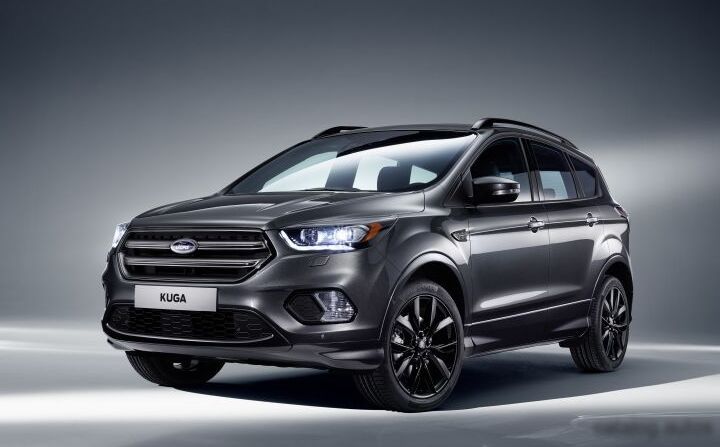
The Ford Kuga II (facelift, produced 2016-2019) 1.5 TDCI 120 horsepower PowerShift variant represented a key offering in Ford’s European compact SUV lineup. Introduced as part of the mid-cycle refresh of the second-generation Kuga, this model aimed to balance fuel efficiency with reasonable performance and practicality for family buyers. Positioned as a mid-range option, it slotted between the lower-powered diesel variants and the more potent gasoline engines, offering a compelling alternative for those prioritizing economy and a smoother automatic driving experience. The Kuga II itself was built on the C-platform, shared with models like the Ford Focus and C-Max, and was designed to compete with vehicles like the Nissan Qashqai, Kia Sportage, and Hyundai Tucson.
Powertrain & Engine Architecture
The 1.5 TDCI engine, designated with the code XWMB, is a four-cylinder diesel engine utilizing a common-rail direct injection system. This system, supplied by Bosch, allowed for precise fuel delivery and optimized combustion, contributing to both efficiency and reduced emissions. The engine featured a single overhead camshaft (SOHC) valvetrain operating two valves per cylinder. A turbocharger with an intercooler was employed to boost power output and improve torque across a wider rev range. The PowerShift transmission is a dual-clutch transmission (DCT) developed by Getrag, offering quicker and smoother gear changes compared to a traditional torque-converter automatic. It essentially combines the efficiency of a manual gearbox with the convenience of an automatic.
Driving Characteristics
The 120 horsepower output, coupled with the PowerShift transmission, provided adequate performance for everyday driving. Acceleration from 0-60 mph took around 11.8 seconds, and top speed was approximately 106 mph. While not particularly sporty, the engine delivered a respectable 270 Nm (199 lb-ft) of torque between 1500-2000 rpm, providing good low-end grunt for overtaking and navigating urban environments. Compared to the higher-powered 1.5 TDCI variants or the gasoline engines, this version felt less responsive, but the PowerShift transmission helped to mitigate some of the performance deficit by ensuring quick gearshifts. The automatic transmission also made it a more comfortable option for drivers prioritizing ease of use over outright performance.
Equipment & Trim Levels
The 1.5 TDCI 120 hp PowerShift Kuga typically came equipped with features such as air conditioning, alloy wheels, a basic infotainment system with Bluetooth connectivity, and a suite of safety features including ABS, ESP, and multiple airbags. Higher trim levels, such as Titanium, added features like automatic climate control, parking sensors, a more advanced infotainment system with navigation, and leather upholstery. Optional extras included a panoramic sunroof, heated seats, and a premium sound system.
Chassis & Braking
The Kuga II featured independent suspension all around – McPherson struts at the front and a multi-link setup at the rear – providing a comfortable ride quality. Front brakes were ventilated discs, while rear brakes were solid discs. The suspension was tuned to prioritize comfort over sporty handling, making it well-suited for everyday driving. Stabilizer bars were fitted front and rear to reduce body roll during cornering.
Market Reception & Comparison
The 1.5 TDCI 120 hp PowerShift Kuga was generally well-received by critics as a practical and fuel-efficient SUV. It offered a good balance between running costs and usability, making it a popular choice for families. Compared to the more powerful diesel variants, it was more affordable to purchase and run, but offered less performance. Fuel economy was a strong point, with combined figures around 49 mpg. Reliability was generally good, although some owners reported issues with the PowerShift transmission, a common concern across Ford models equipped with this gearbox.
Legacy
The 1.5 TDCI 120 hp PowerShift Kuga remains a relatively common sight on used car markets. While the PowerShift transmission requires careful maintenance and potential rebuilds, the engine itself is generally considered durable. The Kuga II, in general, established Ford as a serious contender in the European compact SUV segment, and this variant played a significant role in its success by offering an accessible and efficient option for budget-conscious buyers. Its blend of practicality, fuel economy, and comfortable ride continues to appeal to used car buyers today.