
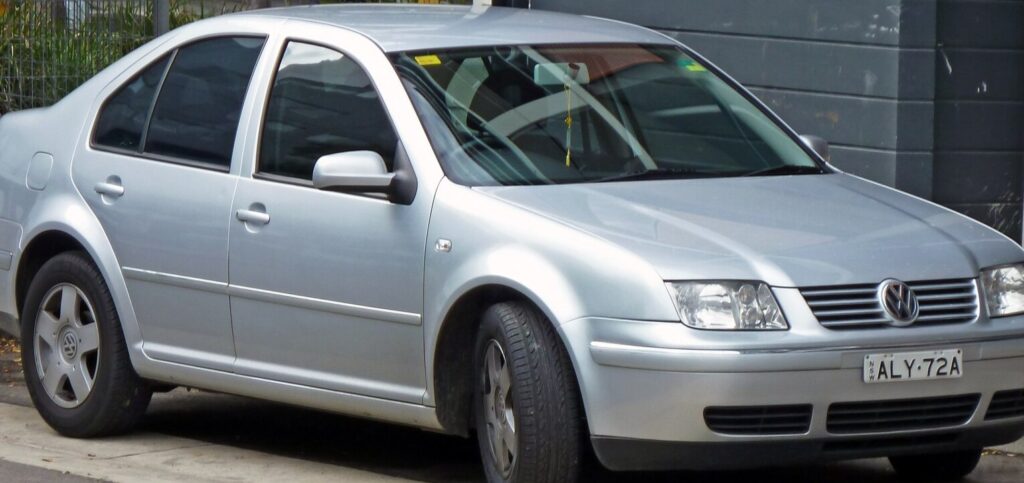
The Volkswagen Bora 1.9 TDI (100 hp) represents a significant offering within the first generation (1J2) Bora lineup, produced between 2000 and 2005. Positioned as a fuel-efficient and practical sedan, the Bora – known as the Jetta in North America – aimed to provide a comfortable and economical option for families and commuters. This particular variant, powered by the 1.9-liter turbocharged diesel engine, was a mainstay in European markets where diesel fuel was prevalent and valued for its economy. It served as a bridge between the base gasoline models and the more powerful, higher-trim TDI variants.
Technical Specifications
| Brand | Volkswagen |
| Model | Bora |
| Generation | Bora (1J2) |
| Type (Engine) | 1.9 TDI (100 Hp) |
| Start of production | 2000 year |
| End of production | 2005 year |
| Powertrain Architecture | Internal Combustion engine |
| Body type | Sedan |
| Seats | 5 |
| Doors | 4 |
| Fuel consumption (economy) – urban | 6.8 l/100 km (34.6 US mpg, 41.5 UK mpg, 14.7 km/l) |
| Fuel consumption (economy) – extra urban | 4.4 l/100 km (53.5 US mpg, 64.2 UK mpg, 22.7 km/l) |
| Fuel consumption (economy) – combined | 5.3 l/100 km (44.4 US mpg, 53.3 UK mpg, 18.9 km/l) |
| CO2 emissions | 143 g/km |
| Fuel Type | Diesel |
| Acceleration 0 – 100 km/h | 12.1 sec |
| Acceleration 0 – 62 mph | 12.1 sec |
| Acceleration 0 – 60 mph | 11.5 sec |
| Maximum speed | 188 km/h (116.82 mph) |
| Emission standard | Euro 3 |
| Weight-to-power ratio | 14.3 kg/Hp, 70.1 Hp/tonne |
| Weight-to-torque ratio | 5.9 kg/Nm, 168.2 Nm/tonne |
| Power | 100 Hp @ 4000 rpm |
| Power per litre | 52.7 Hp/l |
| Torque | 240 Nm @ 1800 rpm (177.01 lb.-ft. @ 1800 rpm) |
| Engine layout | Front, Transverse |
| Engine Model/Code | ATD, AXR, BEW |
| Engine displacement | 1896 cm3 (115.7 cu. in.) |
| Number of cylinders | 4 |
| Engine configuration | Inline |
| Cylinder Bore | 79.5 mm (3.13 in.) |
| Piston Stroke | 95.5 mm (3.76 in.) |
| Compression ratio | 19:1 |
| Number of valves per cylinder | 2 |
| Fuel injection system | Pump-nozzle (Unit Injector) |
| Engine aspiration | Turbocharger, Intercooler |
| Valvetrain | OHC |
| Engine oil capacity | 4.5 l (4.76 US qt | 3.96 UK qt) |
| Coolant | 6 l (6.34 US qt | 5.28 UK qt) |
| Kerb Weight | 1427 kg (3146 lbs.) |
| Max. weight | 1830 kg (4034.46 lbs.) |
| Max load | 403 kg (888.46 lbs.) |
| Trunk (boot) space – minimum | 455 l (16.07 cu. ft.) |
| Trunk (boot) space – maximum | 785 l (27.72 cu. ft.) |
| Fuel tank capacity | 55 l (14.53 US gal | 12.1 UK gal) |
| Max. roof load | 75 kg (165.35 lbs.) |
| Permitted trailer load with brakes (12%) | 1300 kg (2866.01 lbs.) |
| Permitted trailer load without brakes | 600 kg (1322.77 lbs.) |
| Permitted towbar download | 75 kg (165.35 lbs.) |
| Length | 4376 mm (172.28 in.) |
| Width | 1735 mm (68.31 in.) |
| Width including mirrors | 2018 mm (79.45 in.) |
| Height | 1446 mm (56.93 in.) |
| Wheelbase | 2519 mm (99.17 in.) |
| Front track | 1513 mm (59.57 in.) |
| Rear (Back) track | 1494 mm (58.82 in.) |
| Minimum turning circle (turning diameter) | 10.9 m (35.76 ft.) |
| Drivetrain Architecture | The Internal combustion engine (ICE) drives the front wheels of the vehicle. |
| Drive wheel | Front wheel drive |
| Number of gears and type of gearbox | 5 gears, manual transmission |
| Front suspension | Independent, type McPherson with coil spring and anti-roll bar |
| Rear suspension | Semi-independent, coil spring |
| Front brakes | Ventilated discs |
| Rear brakes | Disc |
| Assisting systems | ABS (Anti-lock braking system) |
| Steering type | Steering rack and pinion |
| Power steering | Hydraulic Steering |
| Tires size | 195/65 R15 |
| Wheel rims size | 6J x 15 |
Powertrain & Engine Architecture
The heart of the Bora 1.9 TDI is the 1.9-liter (1896 cc) inline-four cylinder diesel engine. Common engine codes for this variant include ATD, AXR, and BEW, each with minor variations. This engine utilizes a pump-nozzle (unit injector) fuel injection system, a technology that delivers highly precise fuel delivery for improved efficiency and reduced emissions compared to older diesel injection systems. The engine is turbocharged and intercooled, boosting power output to 100 horsepower at 4000 rpm and 240 Nm (177 lb-ft) of torque at 1800 rpm. The overhead camshaft (OHC) valvetrain operates two valves per cylinder. The engine’s robust construction and relatively simple design contributed to its longevity and reliability. The 5-speed manual transmission was the standard offering, providing a balance between fuel economy and drivability.
Driving Characteristics
The 100 hp 1.9 TDI Bora offered a practical and economical driving experience. Acceleration was modest, taking approximately 12.1 seconds to reach 62 mph (100 km/h), and a calculated 11.5 seconds to 60 mph. However, the engine’s strong low-end torque made it feel more responsive in everyday driving situations, such as merging onto highways or overtaking slower vehicles. Compared to the higher-output TDI variants (like the 130 hp or 150 hp versions), this engine prioritized fuel efficiency over outright performance. The manual transmission’s gear ratios were geared towards maximizing fuel economy, resulting in a slightly less engaging driving experience than the sportier trims.
Equipment & Trim Levels
The 1.9 TDI (100 hp) Bora typically came with a reasonable level of standard equipment. This included power windows, central locking, power steering, and an ABS anti-lock braking system. Interior upholstery was typically cloth, and the dashboard featured a functional, if somewhat basic, design. Optional extras included alloy wheels, air conditioning, a radio/cassette player (or CD player), and upgraded interior trim. The trim level often dictated the availability of these options, with higher trims offering more features as standard.
Chassis & Braking
The Bora 1.9 TDI utilized a McPherson strut front suspension with coil springs and an anti-roll bar, providing a comfortable ride and predictable handling. The rear suspension was a semi-independent coil spring setup. Braking consisted of ventilated discs at the front and solid discs at the rear. The braking system was adequate for the vehicle’s weight and performance, but lacked the stopping power of the higher-performance trims. The hydraulic power steering provided light and easy steering, making it suitable for urban driving.
Market Reception & Comparison
The Bora 1.9 TDI (100 hp) was well-received in European markets as a practical and economical family car. Critics praised its fuel efficiency, reliability, and comfortable ride. However, some noted its relatively modest performance compared to the more powerful TDI variants. Compared to the gasoline-powered Bora models, the 1.9 TDI offered significantly better fuel economy and torque, making it a popular choice for drivers who covered long distances. The 1.9 TDI also proved to be more reliable than some of the early gasoline direct injection (FSI) engines offered in the Bora lineup.
Legacy
The 1.9 TDI engine, in various iterations, became renowned for its durability and longevity. The Bora 1.9 TDI (100 hp) continues to be a relatively common sight on used car markets today, often with high mileage but still running reliably. While maintenance costs can increase with age, the engine’s robust construction and readily available parts contribute to its continued viability. The Bora 1.9 TDI remains a popular choice for those seeking an affordable, fuel-efficient, and dependable used car.
