
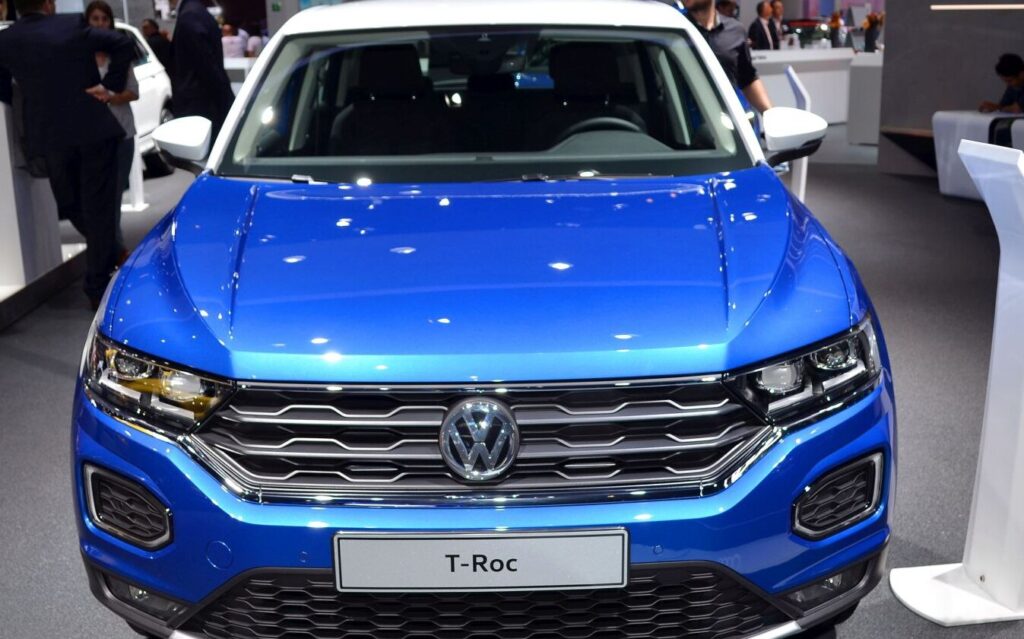
The Volkswagen T-Roc 2.0 TDI 150 hp 4MOTION DSG was a compact SUV produced from 2017 to 2018, representing a key variant within the first generation (T-Roc I) of the T-Roc model line. Introduced as Volkswagen expanded its SUV offerings, the T-Roc aimed to attract a younger demographic with its modern styling and available technology. This particular configuration, combining a 2.0-liter turbocharged diesel engine with a seven-speed dual-clutch transmission (DSG) and Volkswagen’s 4MOTION all-wheel-drive system, positioned itself as a versatile and capable option within the T-Roc range, appealing to buyers seeking both efficiency and all-weather performance.
Technical Specifications
| Brand | Volkswagen |
| Model | T-Roc |
| Generation | T-Roc I |
| Type (Engine) | 2.0 TDI (150 Hp) 4MOTION DSG |
| Start of production | 2017 |
| End of production | 2018 |
| Powertrain Architecture | Internal Combustion engine |
| Body type | SUV |
| Seats | 5 |
| Doors | 5 |
| Fuel consumption (urban) | 5.6 l/100 km (42 US mpg, 50.4 UK mpg, 17.9 km/l) |
| Fuel consumption (extra urban) | 4.8 l/100 km (49 US mpg, 58.9 UK mpg, 20.8 km/l) |
| Fuel consumption (combined) | 5.1 l/100 km (46.1 US mpg, 55.4 UK mpg, 19.6 km/l) |
| CO2 emissions | 134 g/km |
| Fuel Type | Diesel |
| Acceleration 0 – 100 km/h | 8.4 sec |
| Acceleration 0 – 62 mph | 8.4 sec |
| Acceleration 0 – 60 mph | 8 sec |
| Maximum speed | 200 km/h (124.27 mph) |
| Emission standard | Euro 6 |
| Weight-to-power ratio | 10.2 kg/Hp, 98 Hp/tonne |
| Weight-to-torque ratio | 4.5 kg/Nm, 222.2 Nm/tonne |
| Power | 150 Hp @ 3500-4000 rpm |
| Power per litre | 76.2 Hp/l |
| Torque | 340 Nm @ 1750-3000 rpm (250.77 lb.-ft. @ 1750-3000 rpm) |
| Engine layout | Front, Transverse |
| Engine Model/Code | DFFA |
| Engine displacement | 1968 cm3 (120.09 cu. in.) |
| Number of cylinders | 4 |
| Engine configuration | Inline |
| Number of valves per cylinder | 4 |
| Fuel injection system | Diesel Commonrail |
| Engine aspiration | Turbocharger, Intercooler |
| Engine oil capacity | 4.7 l (4.97 US qt | 4.14 UK qt) |
| Kerb Weight | 1530 kg (3373.07 lbs.) |
| Max. weight | 2040 kg (4497.43 lbs.) |
| Max load | 510 kg (1124.36 lbs.) |
| Fuel tank capacity | 55 l (14.53 US gal | 12.1 UK gal) |
| Max. roof load | 75 kg (165.35 lbs.) |
| Permitted trailer load with brakes (8%) | 1900 kg (4188.78 lbs.) |
| Permitted trailer load with brakes (12%) | 1700 kg (3747.86 lbs.) |
| Permitted trailer load without brakes | 750 kg (1653.47 lbs.) |
| Permitted towbar download | 80 kg (176.37 lbs.) |
| Length | 4234 mm (166.69 in.) |
| Width | 1819 mm (71.61 in.) |
| Height | 1573 mm (61.93 in.) |
| Wheelbase | 2593 mm (102.09 in.) |
| Front track | 1538-1546 mm (60.55 – 60.87 in.) |
| Rear (Back) track | 1539-1547 mm (60.59 – 60.91 in.) |
| Minimum turning circle | 11.1 m (36.42 ft.) |
| Drive wheel | All wheel drive (4×4) |
| Number of gears | 7 |
| Gearbox type | automatic transmission DSG |
| Front brakes | Ventilated discs |
| Rear brakes | Ventilated discs |
Powertrain & Engine Architecture
The heart of the T-Roc 2.0 TDI 150 hp 4MOTION DSG is the DFFA engine code, a 2.0-liter inline-four cylinder diesel engine. This engine utilizes a common rail direct injection system, delivering fuel directly into the combustion chamber at extremely high pressure for optimized combustion. A turbocharger with an intercooler is employed to increase power output and improve efficiency. The engine produces 150 horsepower at 3500-4000 rpm and a substantial 340 Nm (250.77 lb.-ft.) of torque between 1750 and 3000 rpm. This broad torque curve provides strong pulling power across a wide range of engine speeds. The engine also incorporates a diesel particulate filter (DPF) to meet stringent Euro 6 emission standards.
The engine is paired with a seven-speed dual-clutch transmission (DSG). This transmission offers quick and smooth gear changes, contributing to both performance and fuel efficiency. The DSG automatically selects the optimal gear based on driving conditions and driver input. The 4MOTION all-wheel-drive system is a sophisticated setup that distributes power between the front and rear axles as needed, providing enhanced traction and stability, particularly in adverse weather conditions.
Driving Characteristics
The 2.0 TDI 150 hp 4MOTION DSG T-Roc delivers a composed and refined driving experience. While not overtly sporty, the engine provides ample power for everyday driving and confident overtaking. The DSG transmission ensures responsive acceleration, and the 4MOTION system inspires confidence on slippery surfaces. Compared to the base 1.0-liter TSI gasoline engine, the 2.0 TDI offers significantly more torque, resulting in stronger acceleration, especially at lower speeds. Compared to higher-output TDI variants (like the 184 hp version), this engine prioritizes fuel economy and offers a more relaxed driving experience. The gear ratios in the DSG are tuned for a balance between performance and efficiency, with taller gears for highway cruising and shorter gears for quicker acceleration.
Equipment & Trim Levels
The T-Roc 2.0 TDI 150 hp 4MOTION DSG typically came equipped with a respectable level of standard features. These included air conditioning, a touchscreen infotainment system with Bluetooth connectivity, alloy wheels, and a suite of safety features such as ABS, electronic stability control, and multiple airbags. Higher trim levels offered options such as automatic climate control, a larger touchscreen display, navigation system, parking sensors, and adaptive cruise control. Interior upholstery was typically cloth, with leather options available as an upgrade. The dashboard layout was modern and driver-focused, with a clear instrument cluster and intuitive controls.
Chassis & Braking
The T-Roc’s chassis is designed to provide a comfortable ride and stable handling. The suspension consists of MacPherson struts at the front and a multi-link setup at the rear. The 4MOTION system adds to the vehicle’s stability, particularly during cornering. Braking duties are handled by ventilated discs on all four wheels, providing ample stopping power. The steering is electrically assisted, offering a light and precise feel.
Market Reception & Comparison
The T-Roc 2.0 TDI 150 hp 4MOTION DSG was generally well-received by automotive critics. It was praised for its fuel efficiency, comfortable ride, and all-weather capability. However, some reviewers noted that the interior materials could be of higher quality. Compared to competitors like the Nissan Qashqai and Kia Sportage, the T-Roc offered a more refined driving experience and a more modern design. Fuel economy was a strong point, with combined figures around 5.1 l/100 km (46.1 US mpg), making it an attractive option for drivers seeking a practical and economical SUV.
Legacy
The 2.0 TDI engine, in various iterations, has proven to be a reliable and durable powertrain within the Volkswagen Group. While diesel engines have faced increased scrutiny in recent years, the DFFA engine is generally considered to be a robust unit when properly maintained. The DSG transmission, while complex, is also generally reliable, although regular servicing is crucial. In the used car market, the T-Roc 2.0 TDI 150 hp 4MOTION DSG remains a popular choice, offering a good balance of practicality, efficiency, and all-weather capability. Its continued presence in the used market is a testament to its overall quality and appeal.
