
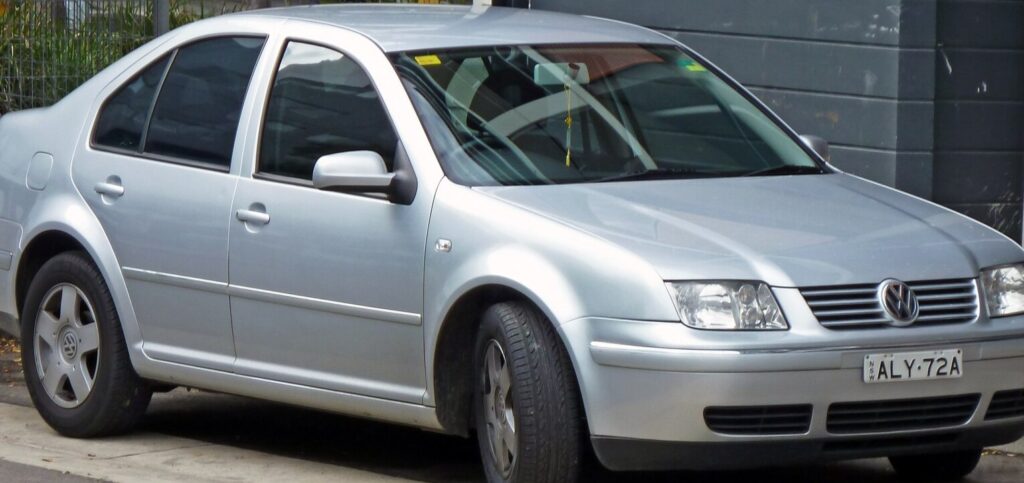
The Volkswagen Bora 1.9 TDI with the Tiptronic automatic transmission, produced between 2000 and 2005, represents a significant offering within the first generation (1J2) of the Bora compact sedan. Positioned as a fuel-efficient and comfortable option, it catered to buyers seeking a practical and refined vehicle. The Bora, essentially a rebadged version of the Jetta sold in North America, was Volkswagen’s attempt to create a more globally appealing sedan, replacing the aging Vento. This 1.9 TDI Tiptronic variant occupied a middle ground in the Bora lineup, offering a balance between performance, economy, and convenience, slotting below the more powerful petrol variants and above the base-level diesel models.
Technical Specifications
| Brand | Volkswagen |
| Model | Bora |
| Generation | Bora (1J2) |
| Type (Engine) | 1.9 TDI (100 Hp) Tiptronic |
| Start of production | 2000 year |
| End of production | 2005 year |
| Powertrain Architecture | Internal Combustion engine |
| Body type | Sedan |
| Seats | 5 |
| Doors | 4 |
| Fuel consumption (economy) – urban | 8.8 l/100 km (26.7 US mpg, 32.1 UK mpg, 11.4 km/l) |
| Fuel consumption (economy) – extra urban | 5.3 l/100 km (44.4 US mpg, 53.3 UK mpg, 18.9 km/l) |
| Fuel consumption (economy) – combined | 6.6 l/100 km (35.6 US mpg, 42.8 UK mpg, 15.2 km/l) |
| CO2 emissions | 178 g/km |
| Fuel Type | Diesel |
| Acceleration 0 – 100 km/h | 13.5 sec |
| Acceleration 0 – 62 mph | 13.5 sec |
| Acceleration 0 – 60 mph | 12.8 sec |
| Maximum speed | 185 km/h (114.95 mph) |
| Emission standard | Euro 3 |
| Weight-to-power ratio | 12.8 kg/Hp, 78.1 Hp/tonne |
| Weight-to-torque ratio | 5.3 kg/Nm, 187.5 Nm/tonne |
| Power | 100 Hp @ 4000 rpm |
| Power per litre | 52.7 Hp/l |
| Torque | 240 Nm @ 1800 rpm (177.01 lb.-ft. @ 1800 rpm) |
| Engine layout | Front, Transverse |
| Engine Model/Code | ATD, AXR, BEW |
| Engine displacement | 1896 cm3 (115.7 cu. in.) |
| Number of cylinders | 4 |
| Engine configuration | Inline |
| Cylinder Bore | 79.5 mm (3.13 in.) |
| Piston Stroke | 95.5 mm (3.76 in.) |
| Compression ratio | 19:1 |
| Number of valves per cylinder | 2 |
| Fuel injection system | Pump-nozzle (Unit Injector) |
| Engine aspiration | Turbocharger, Intercooler |
| Valvetrain | OHC |
| Engine oil capacity | 4.5 l (4.76 US qt | 3.96 UK qt) |
| Coolant | 6 l (6.34 US qt | 5.28 UK qt) |
| Kerb Weight | 1280 kg (2821.92 lbs.) |
| Max. weight | 1820 kg (4012.41 lbs.) |
| Max load | 540 kg (1190.5 lbs.) |
| Trunk (boot) space – minimum | 455 l (16.07 cu. ft.) |
| Trunk (boot) space – maximum | 785 l (27.72 cu. ft.) |
| Fuel tank capacity | 55 l (14.53 US gal | 12.1 UK gal) |
| Max. roof load | 75 kg (165.35 lbs.) |
| Permitted trailer load with brakes (12%) | 1300 kg (2866.01 lbs.) |
| Permitted trailer load without brakes | 600 kg (1322.77 lbs.) |
| Permitted towbar download | 75 kg (165.35 lbs.) |
| Length | 4376 mm (172.28 in.) |
| Width | 1735 mm (68.31 in.) |
| Width including mirrors | 2018 mm (79.45 in.) |
| Height | 1446 mm (56.93 in.) |
| Wheelbase | 2519 mm (99.17 in.) |
| Front track | 1513 mm (59.57 in.) |
| Rear (Back) track | 1494 mm (58.82 in.) |
| Minimum turning circle (turning diameter) | 10.9 m (35.76 ft.) |
| Drivetrain Architecture | The Internal combustion engine (ICE) drives the front wheels of the vehicle. |
| Drive wheel | Front wheel drive |
| Number of gears and type of gearbox | 5 gears, automatic transmission Tiptronic |
| Front suspension | Independent, type McPherson with coil spring and anti-roll bar |
| Rear suspension | Semi-independent, coil spring |
| Front brakes | Ventilated discs |
| Rear brakes | Disc |
| Assisting systems | ABS (Anti-lock braking system) |
| Steering type | Steering rack and pinion |
| Power steering | Hydraulic Steering |
| Tires size | 195/65 R15 |
| Wheel rims size | 6J x 15 |
INTRODUCTION
The Volkswagen Bora 1.9 TDI Tiptronic, manufactured from 2000 to 2005, was a key variant within the Bora (1J2) range. Built on the Volkswagen Group’s A4 (or 1HX0) platform – shared with the Audi A3, SEAT Leon, and Skoda Octavia – the Bora aimed to provide a modern and spacious alternative to traditional compact sedans. The 1.9 TDI engine, a mainstay of Volkswagen’s diesel offerings, was paired with a four-speed Tiptronic automatic transmission, offering a blend of fuel efficiency and driving convenience. This combination targeted buyers who prioritized practicality and ease of use over outright performance.
Powertrain & Engine Architecture
At the heart of the Bora 1.9 TDI Tiptronic lies the 1.9-liter (1896 cc) inline-four cylinder diesel engine. Common engine codes for this variant include ATD, AXR, and BEW, each with minor variations. This engine utilizes a pump-nozzle (unit injector) fuel injection system, a technology known for its precision and efficiency. The engine is turbocharged and intercooled, boosting power output to 100 horsepower at 4000 rpm and 240 Nm (177 lb-ft) of torque at 1800 rpm. The overhead camshaft (OHC) valvetrain operates two valves per cylinder. The Tiptronic transmission is a four-speed automatic with a manual shift mode, allowing drivers some control over gear selection. It’s a torque converter-based system, providing smooth shifts but not the direct feel of a dual-clutch transmission.
Driving Characteristics
The 1.9 TDI Tiptronic Bora delivers a comfortable and relaxed driving experience. Acceleration is adequate, with a 0-60 mph time of around 12.8 seconds, but it’s not a particularly sporty vehicle. The Tiptronic transmission prioritizes smooth shifts over rapid acceleration. The gear ratios are tuned for fuel economy, meaning the engine doesn’t rev as high as it could. Compared to the manual transmission versions of the 1.9 TDI, the Tiptronic feels slightly less responsive. Higher-output petrol variants, such as the 1.8T, offer significantly more performance, but at the expense of fuel efficiency. The torque available from low engine speeds makes it well-suited for everyday driving and overtaking maneuvers, even with the automatic transmission.
Equipment & Trim Levels
The Bora 1.9 TDI Tiptronic typically came with a reasonable level of standard equipment. This included power windows, central locking, air conditioning, and an audio system. Interior upholstery was usually cloth, with options for upgraded materials. Dashboard configuration was fairly standard for the era, with a functional and straightforward layout. Optional extras included alloy wheels, a sunroof, and upgraded audio systems. Safety features such as ABS (Anti-lock Braking System) and airbags were standard. Trim levels varied by market, but generally, this variant sat in the mid-range, offering a good balance of features and affordability.
Chassis & Braking
The Bora 1.9 TDI Tiptronic utilizes an independent McPherson strut front suspension with coil springs and an anti-roll bar. The rear suspension is a semi-independent coil spring setup. This configuration provides a comfortable ride, although it’s not particularly sporty. Braking duties are handled by ventilated discs at the front and solid discs at the rear. The ABS system helps to maintain control during hard braking. The steering is rack and pinion with hydraulic power assistance, providing a reasonably direct feel.
Market Reception & Comparison
The Bora 1.9 TDI Tiptronic was generally well-received by critics as a practical and economical family car. Its fuel economy – around 35.6 US mpg combined – was a major selling point. Compared to the petrol-powered Boras, the TDI offered significantly better fuel efficiency. However, some reviewers criticized the Tiptronic transmission for its lack of responsiveness. The 1.9 TDI manual versions were often preferred by driving enthusiasts. Reliability was generally good, although the pump-nozzle injection system could be prone to issues if not properly maintained. Compared to competitors like the Ford Focus and Opel Astra, the Bora offered a more refined interior and a more sophisticated driving experience.
Legacy
The Volkswagen Bora 1.9 TDI Tiptronic has proven to be a relatively durable and reliable vehicle. The 1.9 TDI engine is known for its longevity, and many examples are still on the road today. However, age-related issues, such as wear and tear on suspension components and potential problems with the Tiptronic transmission, are common. In the used car market, these Boras are often sought after by buyers looking for an affordable and fuel-efficient sedan. The combination of a robust diesel engine and a comfortable automatic transmission continues to appeal to those prioritizing practicality and economy.
