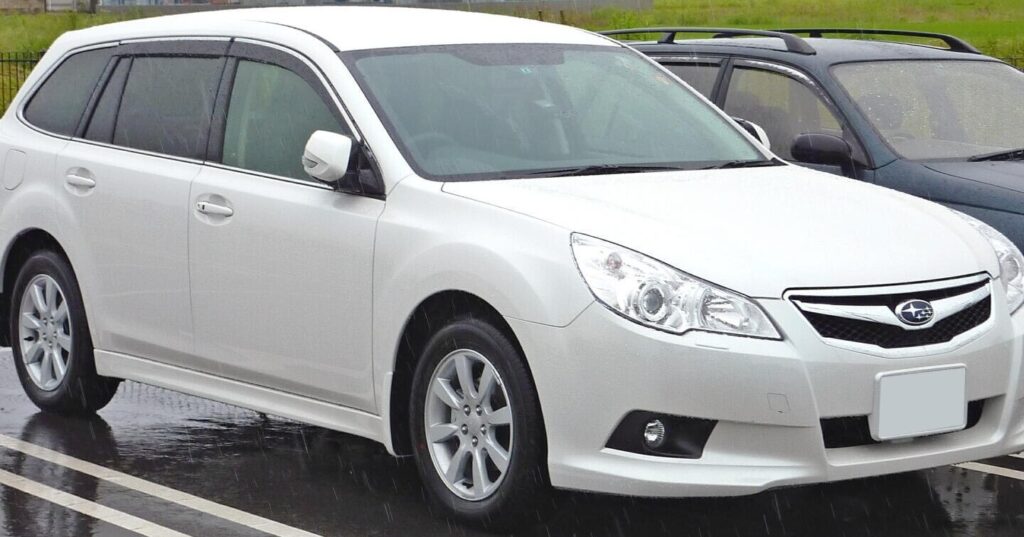
The Subaru Legacy V Station Wagon 2.0d Sport, produced between 2009 and 2012, represented a key offering in Subaru’s European and Asian markets. Part of the fifth-generation Legacy (BP/BR chassis), this variant combined the practicality of a station wagon with Subaru’s renowned symmetrical all-wheel drive system and a fuel-efficient diesel engine. It occupied a mid-range position within the Legacy V lineup, appealing to buyers seeking a balance between performance, economy, and space. While not officially sold in the United States during this generation, the Legacy remained a popular choice for families and outdoor enthusiasts in regions where diesel engines and wagons were favored.
Technical Specifications
| Brand | Subaru |
| Model | Legacy |
| Generation | Legacy V Station Wagon |
| Type (Engine) | 2.0d sport (150 Hp) AWD |
| Start of production | 2009 |
| End of production | 2012 |
| Powertrain Architecture | Internal Combustion engine |
| Body type | Station wagon (estate) |
| Seats | 5 |
| Doors | 5 |
| Fuel consumption (urban) | 7.9 l/100 km (29.8 US mpg, 35.8 UK mpg, 12.7 km/l) |
| Fuel consumption (extra urban) | 5.5 l/100 km (42.8 US mpg, 51.4 UK mpg, 18.2 km/l) |
| Fuel consumption (combined) | 6.4 l/100 km (36.8 US mpg, 44.1 UK mpg, 15.6 km/l) |
| CO2 emissions | 168 g/km |
| Fuel Type | Diesel |
| Acceleration 0 – 100 km/h | 9.3 sec |
| Acceleration 0 – 62 mph | 9.3 sec |
| Acceleration 0 – 60 mph | 8.8 sec |
| Maximum speed | 206 km/h (128 mph) |
| Emission standard | Euro 5 |
| Weight-to-power ratio | 10.8 kg/Hp, 92.3 Hp/tonne |
| Weight-to-torque ratio | 4.6 kg/Nm, 215.4 Nm/tonne |
| Power | 150 Hp @ 3600 rpm |
| Power per litre | 75.1 Hp/l |
| Torque | 350 Nm @ 1800-2400 rpm (258.15 lb.-ft. @ 1800-2400 rpm) |
| Engine layout | Front, Longitudinal |
| Engine Model/Code | EE20Z |
| Engine displacement | 1998 cm3 (121.93 cu. in.) |
| Number of cylinders | 4 |
| Engine configuration | Boxer |
| Cylinder Bore | 86 mm (3.39 in.) |
| Piston Stroke | 86 mm (3.39 in.) |
| Compression ratio | 16.3:1 |
| Number of valves per cylinder | 4 |
| Fuel injection system | Diesel Commonrail |
| Engine aspiration | Turbocharger, Intercooler |
| Valvetrain | DOHC |
| Engine oil capacity | 5.9 l (6.23 US qt | 5.19 UK qt) |
| Coolant | 9 l (9.51 US qt | 7.92 UK qt) |
| Kerb Weight | 1625 kg (3582.51 lbs.) |
| Max. weight | 2055 kg (4530.5 lbs.) |
| Max load | 430 kg (947.99 lbs.) |
| Trunk (boot) space – minimum | 526 l (18.58 cu. ft.) |
| Trunk (boot) space – maximum | 1660 l (58.62 cu. ft.) |
| Fuel tank capacity | 65 l (17.17 US gal | 14.3 UK gal) |
| Max. roof load | 80 kg (176.37 lbs.) |
| Permitted trailer load with brakes (12%) | 1700 kg (3747.86 lbs.) |
| Permitted trailer load without brakes | 750 kg (1653.47 lbs.) |
| Length | 4775 mm (187.99 in.) |
| Width | 1780 mm (70.08 in.) |
| Height | 1535 mm (60.43 in.) |
| Wheelbase | 2750 mm (108.27 in.) |
| Front track | 1565 mm (61.61 in.) |
| Rear (Back) track | 1570 mm (61.81 in.) |
| Minimum turning circle | 11.4 m (37.4 ft.) |
| Drive wheel | All wheel drive (4×4) |
| Number of gears and type of gearbox | 6 gears, manual transmission |
| Front suspension | Independent type McPherson |
| Rear suspension | Double wishbone |
| Front brakes | Ventilated discs |
| Rear brakes | Disc |
| Assisting systems | ABS (Anti-lock braking system) |
| Steering type | Steering rack and pinion |
| Tires size | 225/45 R18W |
| Wheel rims size | 7.5J x 18 |
Powertrain & Engine Architecture
The heart of the Legacy 2.0d Sport was the EE20Z engine, a 2.0-liter horizontally-opposed (boxer) four-cylinder diesel. This engine was a significant development for Subaru, incorporating a common-rail direct injection system and a variable geometry turbocharger. The common-rail system, delivering fuel at extremely high pressure, allowed for finer control over combustion, improving efficiency and reducing emissions. The turbocharger, with its variable vanes, provided a broad torque curve, delivering 350 Nm (258 lb-ft) of torque between 1800 and 2400 rpm. The engine featured a DOHC (Dual Overhead Camshaft) valvetrain and a compression ratio of 16.3:1. The 6-speed manual transmission was chosen for its efficiency and driver engagement, although an automatic transmission was also available in some markets. The longitudinally-mounted engine and symmetrical all-wheel drive system were hallmarks of Subaru’s engineering philosophy, contributing to balanced handling and all-weather capability.
Driving Characteristics
The 2.0d Sport offered a comfortable and capable driving experience. While not a performance-oriented model, the 150 horsepower and 350 Nm of torque provided adequate acceleration, with a 0-60 mph time of around 8.8 seconds. The manual transmission allowed for precise control, and the turbocharger minimized turbo lag, providing a responsive feel. The all-wheel drive system instilled confidence in various road conditions, particularly in wet or snowy environments. Compared to the gasoline-powered Legacy variants, the 2.0d Sport prioritized fuel economy and low-end torque, making it well-suited for long-distance driving and everyday commuting. The gear ratios were tuned for efficiency, with a taller final drive contributing to improved highway fuel consumption.
Equipment & Trim Levels
The “Sport” trim level of the Legacy V Station Wagon 2.0d typically included features such as alloy wheels, sports suspension, and upgraded interior trim. Standard equipment often included air conditioning, a CD player with auxiliary input, power windows and mirrors, and ABS brakes. Optional extras could include a sunroof, leather upholstery, a navigation system, and a premium sound system. The interior featured a functional and straightforward design, with comfortable seating and ample storage space. The station wagon body style provided a generous cargo area, making it ideal for families and those needing to transport larger items.
Chassis & Braking
The Legacy V Station Wagon utilized an independent McPherson strut suspension at the front and a double wishbone suspension at the rear. This setup provided a good balance between ride comfort and handling precision. The chassis was designed to be rigid, contributing to stability and responsiveness. The braking system consisted of ventilated discs at the front and solid discs at the rear, providing adequate stopping power. ABS (Anti-lock Braking System) was standard, enhancing safety in emergency braking situations. The steering was a rack and pinion system, offering precise and responsive control.
Market Reception & Comparison
The Subaru Legacy V Station Wagon 2.0d Sport was generally well-received by automotive critics for its practicality, fuel efficiency, and all-weather capability. It was often praised for its comfortable ride and spacious interior. Compared to other diesel-powered station wagons in its class, the Legacy offered a unique combination of features, including Subaru’s symmetrical all-wheel drive system. However, some critics noted that the interior design was somewhat conservative and that the engine, while efficient, lacked the refinement of some competitors. Fuel economy figures of around 36.8 US mpg combined were competitive for the segment.
Legacy
The EE20Z engine proved to be a reliable and durable powerplant, with many examples still on the road today. While diesel engines generally require more diligent maintenance than their gasoline counterparts, the EE20Z has a reputation for longevity when properly cared for. The Legacy V Station Wagon 2.0d Sport remains a popular choice in the used car market, particularly for buyers seeking a practical, fuel-efficient, and all-weather capable vehicle. Its combination of space, comfort, and Subaru’s renowned reliability continues to appeal to a wide range of drivers.