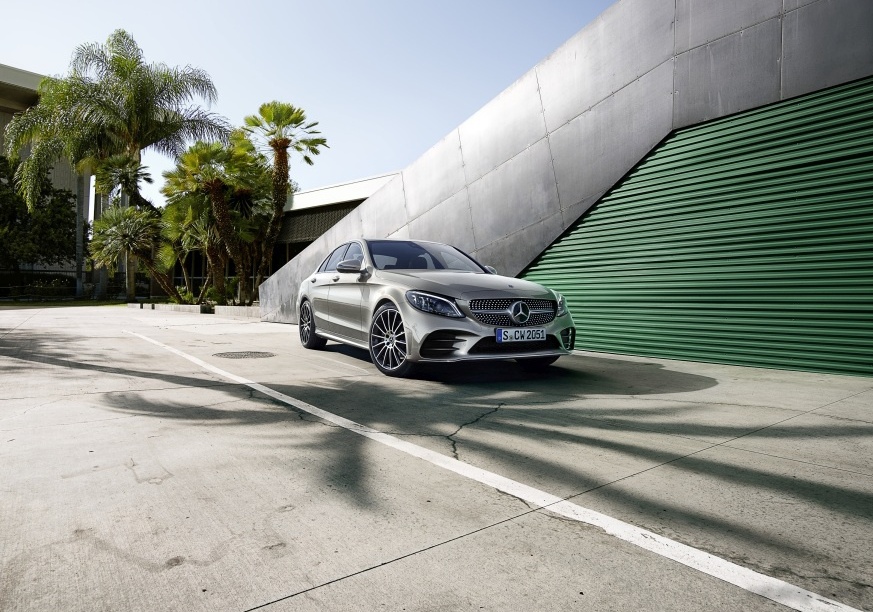
The Mercedes-Benz C 300e EQ Power, produced from 2019 to 2021, represents a significant step in the W205 C-Class facelift’s evolution, integrating plug-in hybrid technology into the compact executive car segment. Positioned as a premium offering within the W205 range, the C 300e aimed to deliver both enhanced fuel efficiency and respectable performance. It was a key component of Mercedes-Benz’s EQ Power strategy, designed to offer customers a bridge between traditional internal combustion engines and fully electric vehicles. This variant was primarily marketed in Europe and other regions with established charging infrastructure and incentives for hybrid vehicles.
Technical Specifications
| Brand | Mercedes-Benz |
| Model | C-class |
| Generation | C-class (W205, facelift 2018) |
| Type (Engine) | C 300e (320 Hp) EQ Power 9G-TRONIC |
| Start of production | 2019 |
| End of production | 2021 |
| Powertrain Architecture | PHEV (Plug-in Hybrid Electric Vehicle) |
| Body type | Sedan |
| Seats | 5 |
| Doors | 4 |
| Combined fuel consumption (WLTP) | 1.5-1.6 l/100 km (156.8 – 147 US mpg) |
| CO2 emissions (WLTP) | 34 g/km |
| Fuel consumption (NEDC) – combined | 1.6-1.9 l/100 km (147 – 123.8 US mpg) |
| CO2 emissions (NEDC) | 36-42 g/km |
| Fuel Type | Petrol / electricity |
| Acceleration 0 – 100 km/h | 5.4 sec |
| Acceleration 0 – 62 mph | 5.4 sec |
| Acceleration 0 – 60 mph | 5.1 sec |
| Maximum speed | 250 km/h (155.34 mph) |
| Emission standard | Euro 6d-TEMP-EVAP-ISC |
| Weight-to-power ratio | 5.4 kg/Hp |
| Weight-to-torque ratio | 2.5 kg/Nm |
| Gross battery capacity | 13.5 kWh |
| Battery technology | Lithium-ion (Li-Ion) |
| Battery location | Inside the trunk |
| All-electric range (NEDC) | 54-58 km (33.55 – 36.04 mi) |
| Average Energy consumption (NEDC) | 13.4-14.3 kWh/100 km |
| Max speed (electric) | 130 km/h (80.78 mph) |
| Electric motor power | 122 Hp @ 2500 rpm |
| Electric motor Torque | 440 Nm @ 0-2000 rpm (324.53 lb.-ft. @ 0-2000 rpm) |
| System power | 320 Hp |
| System torque | 700 Nm (516.29 lb.-ft.) |
| Power | 211 Hp @ 5500 rpm |
| Torque | 350 Nm @ 1200-4000 rpm (258.15 lb.-ft. @ 1200-4000 rpm) |
| Engine layout | Front, Longitudinal |
| Engine Model/Code | M 274.920 |
| Engine displacement | 1991 cm3 (121.5 cu. in.) |
| Number of cylinders | 4 |
| Engine configuration | Inline |
| Cylinder Bore | 83 mm (3.27 in.) |
| Piston Stroke | 92 mm (3.62 in.) |
| Compression ratio | 9.8:1 |
| Number of valves per cylinder | 4 |
| Fuel injection system | Direct injection |
| Engine aspiration | Turbocharger, Intercooler |
| Valvetrain | DOHC |
| Engine oil capacity | 7 l (7.4 US qt | 6.16 UK qt) |
| Coolant | 10.6 l (11.2 US qt | 9.33 UK qt) |
| Kerb Weight | 1740 kg (3836.04 lbs.) |
| Max. weight | 2350 kg (5180.86 lbs.) |
| Max load | 610 kg (1344.82 lbs.) |
| Trunk (boot) space – minimum | 300 l (10.59 cu. ft.) |
| Fuel tank capacity | 50 l (13.21 US gal | 11 UK gal) |
| Permitted trailer load with brakes (12%) | 1800 kg (3968.32 lbs.) |
| Permitted trailer load without brakes | 750 kg (1653.47 lbs.) |
| Length | 4686 mm (184.49 in.) |
| Width | 1810 mm (71.26 in.) |
| Width including mirrors | 2020 mm (79.53 in.) |
| Height | 1442 mm (56.77 in.) |
| Wheelbase | 2840 mm (111.81 in.) |
| Front track | 1588 mm (62.52 in.) |
| Rear (Back) track | 1570 mm (61.81 in.) |
| Front overhang | 790 mm (31.1 in.) |
| Rear overhang | 1056 mm (41.57 in.) |
| Minimum turning circle (turning diameter) | 11 m (36.09 ft.) |
| Front brakes | Ventilated discs |
| Rear brakes | Ventilated discs |
| Number of gears and type of gearbox | 9 gears, automatic transmission G-TRONIC |
INTRODUCTION
The C 300e EQ Power, launched in 2019 as part of the W205 C-Class facelift, combined a 2.0-liter turbocharged four-cylinder gasoline engine with an electric motor and a 13.5 kWh battery pack. This plug-in hybrid powertrain delivered a combined output of 320 horsepower and 700 Nm (516 lb-ft) of torque. The C 300e was positioned above the base C 200 and C 220d models, offering a more efficient and powerful alternative to the traditional combustion engine options. It represented Mercedes-Benz’s commitment to electrification and provided a stepping stone towards their fully electric EQ range.
Powertrain & Engine Architecture
At the heart of the C 300e lies the M274.920 2.0-liter inline-four cylinder engine, a mainstay of the Mercedes-Benz lineup. This engine utilizes direct fuel injection and a single turbocharger with an intercooler to produce 211 horsepower and 350 Nm (258 lb-ft) of torque. The electric motor, integrated between the engine and the 9G-TRONIC nine-speed automatic transmission, adds an additional 122 horsepower and 440 Nm (324 lb-ft) of torque. The 13.5 kWh lithium-ion battery pack is located under the trunk floor, slightly reducing cargo capacity. The 9G-TRONIC transmission is specifically calibrated for hybrid operation, allowing for smooth transitions between electric and gasoline power. The system prioritizes electric driving whenever possible, and can operate in various modes, including pure electric, hybrid, and battery-saving modes.
Driving Characteristics
The C 300e offers a refined and responsive driving experience. In electric mode, it provides near-silent acceleration and a range of up to 54-58 kilometers (33.55-36.04 miles) on the NEDC cycle. When combined with the gasoline engine, the C 300e achieves a 0-60 mph time of around 5.1 seconds, making it a genuinely quick vehicle. The 9G-TRONIC transmission provides smooth and seamless gear changes, enhancing the overall driving comfort. Compared to the C 300 with the traditional gasoline engine, the C 300e offers improved fuel economy and lower emissions, while maintaining similar performance levels. The added weight of the battery pack is noticeable, but the instant torque from the electric motor helps to offset this.
Equipment & Trim Levels
The C 300e EQ Power typically came well-equipped, reflecting its premium positioning. Standard features included Mercedes-Benz’s MBUX infotainment system with a touchscreen display, leather upholstery, automatic climate control, and a suite of safety features such as automatic emergency braking and lane-keeping assist. Optional extras included a panoramic sunroof, premium sound system, and advanced driver-assistance systems like adaptive cruise control. Interior trim options varied, allowing customers to personalize the cabin to their preferences. The C 300e often featured unique EQ Power badging and styling cues to differentiate it from other C-Class models.
Chassis & Braking
The C 300e utilizes a sophisticated chassis setup, featuring a four-link front suspension and a multi-link rear suspension. This configuration provides a comfortable ride and precise handling. Ventilated disc brakes are fitted on all four wheels, providing ample stopping power. The electronic stability program (ESP) is specifically tuned to work with the hybrid powertrain, ensuring optimal control in various driving conditions. The suspension settings were generally tuned for comfort, but the C 300e still offered a reasonably engaging driving experience.
Market Reception & Comparison
The C 300e EQ Power was generally well-received by automotive critics, who praised its fuel efficiency, performance, and refined driving experience. It was often compared to other plug-in hybrid models in the compact executive segment, such as the BMW 330e and the Volvo XC60 Recharge. The C 300e’s advantage lay in its balanced combination of performance, efficiency, and luxury. However, some critics noted the reduced trunk space due to the battery pack. Fuel economy figures varied depending on driving conditions and charging habits, but the C 300e consistently delivered significantly better fuel economy than its gasoline-powered counterparts.
Legacy
The C 300e EQ Power played a crucial role in establishing Mercedes-Benz’s presence in the plug-in hybrid market. It demonstrated the potential of hybrid technology to deliver both environmental benefits and a premium driving experience. While production ended in 2021, the C 300e remains a popular choice in the used car market, offering a compelling combination of efficiency, performance, and luxury. The powertrain proved to be relatively reliable, with few widespread issues reported. The C 300e paved the way for Mercedes-Benz’s future electric vehicles and helped to accelerate the adoption of plug-in hybrid technology in the automotive industry.