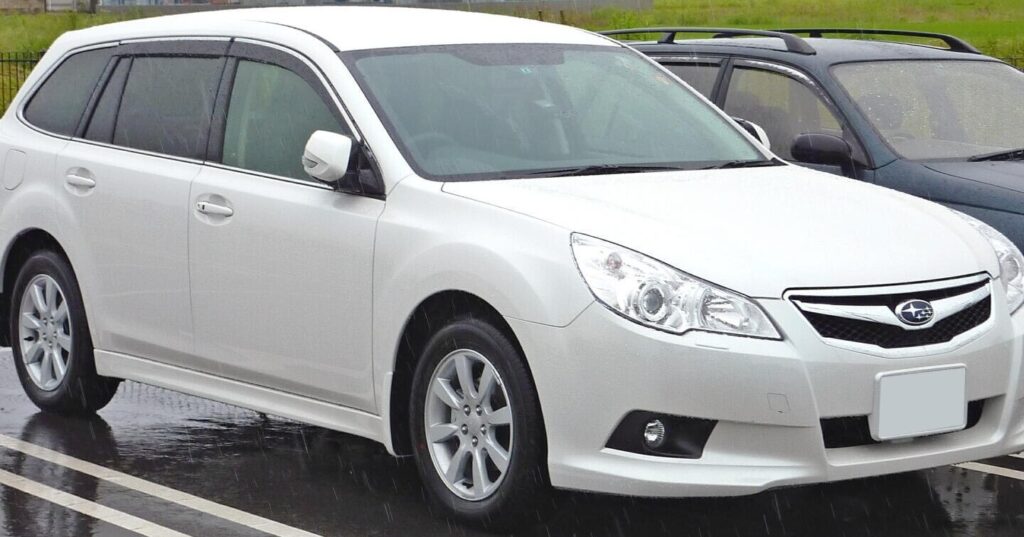
The Subaru Legacy V Station Wagon 2.5 GT, produced between 2009 and 2012, represented a performance-oriented variant within the fifth generation (BP/BR) Legacy lineup. Positioned as a premium trim, it catered to buyers seeking a blend of practicality, all-weather capability, and spirited driving dynamics. This model was primarily sold in markets like North America, Europe, and Australia, where station wagons retained significant popularity. The 2.5 GT distinguished itself with a turbocharged engine, standard all-wheel drive, and a more aggressive aesthetic compared to lower-spec Legacy wagons.
Technical Specifications
| Brand | Subaru |
| Model | Legacy |
| Generation | Legacy V Station Wagon |
| Type (Engine) | 2.5 GT (265 Hp) AWD |
| Start of production | 2009 |
| End of production | 2012 |
| Powertrain Architecture | Internal Combustion engine |
| Body type | Station wagon (estate) |
| Seats | 5 |
| Doors | 5 |
| Fuel consumption (urban) | 14.9 l/100 km (15.8 US mpg, 19 UK mpg, 6.7 km/l) |
| Fuel consumption (extra urban) | 8.1 l/100 km (29 US mpg, 34.9 UK mpg, 12.3 km/l) |
| Fuel consumption (combined) | 10.6 l/100 km (22.2 US mpg, 26.6 UK mpg, 9.4 km/l) |
| Fuel Type | Petrol (Gasoline) |
| Acceleration 0 – 100 km/h | 6.3 sec |
| Acceleration 0 – 62 mph | 6.3 sec |
| Acceleration 0 – 60 mph | 6 sec |
| Maximum speed | 245 km/h (152.24 mph) |
| Emission standard | Euro 5 |
| Weight-to-power ratio | 5.8 kg/Hp, 171.9 Hp/tonne |
| Weight-to-torque ratio | 4.4 kg/Nm, 227 Nm/tonne |
| Power | 265 Hp @ 5600 rpm |
| Power per litre | 107.9 Hp/l |
| Torque | 350 Nm @ 2000-5200 rpm (258.15 lb.-ft. @ 2000-5200 rpm) |
| Engine layout | Front, Longitudinal |
| Engine Model/Code | EJ255 |
| Engine displacement | 2457 cm3 (149.94 cu. in.) |
| Number of cylinders | 4 |
| Engine configuration | Boxer |
| Cylinder Bore | 99.5 mm (3.92 in.) |
| Piston Stroke | 79 mm (3.11 in.) |
| Compression ratio | 8.4:1 |
| Number of valves per cylinder | 4 |
| Fuel injection system | Multi-port manifold injection |
| Engine aspiration | Turbocharger, Intercooler |
| Valvetrain | DOHC |
| Engine oil capacity | 4.3 l (4.54 US qt | 3.78 UK qt) |
| Coolant | 6.5 l (6.87 US qt | 5.72 UK qt) |
| Kerb Weight | 1542 kg (3399.53 lbs.) |
| Trunk (boot) space – minimum | 526 l (18.58 cu. ft.) |
| Trunk (boot) space – maximum | 1660 l (58.62 cu. ft.) |
| Fuel tank capacity | 70 l (18.49 US gal | 15.4 UK gal) |
| Length | 4775 mm (187.99 in.) |
| Width | 1780 mm (70.08 in.) |
| Height | 1535 mm (60.43 in.) |
| Wheelbase | 2750 mm (108.27 in.) |
| Front track | 1550 mm (61.02 in.) |
| Rear (Back) track | 1555 mm (61.22 in.) |
| Minimum turning circle | 11.4 m (37.4 ft.) |
| Drive wheel | All wheel drive (4×4) |
| Number of gears | 5 |
| Gearbox type | Manual transmission |
| Front suspension | Independent type McPherson |
| Rear suspension | Double wishbone |
| Front brakes | Ventilated discs |
| Rear brakes | Ventilated discs |
| Assisting systems | ABS (Anti-lock braking system) |
| Steering type | Steering rack and pinion |
| Tires size | 225/45 R18 |
| Wheel rims size | 7.5J x 18 |
INTRODUCTION
The 2009-2012 Subaru Legacy V Station Wagon 2.5 GT was a key offering in Subaru’s lineup, building upon the established reputation of the Legacy for reliability and all-weather performance. It was built on the Subaru’s “H4” platform, also known as the 1HX0/A3 platform, shared with other models like the Outback and Forester. The “GT” designation signified a higher level of performance and equipment, differentiating it from the base and more fuel-efficient Legacy variants. The station wagon body style, while declining in popularity in some markets, remained a strong selling point for Subaru, appealing to customers needing ample cargo space and versatility.
Powertrain & Engine Architecture
At the heart of the 2.5 GT was the EJ255 2.5-liter turbocharged boxer-four engine. This engine was a significant upgrade over the naturally aspirated engines offered in other Legacy trims. The EJ255 featured a single twin-scroll turbocharger with an intercooler, boosting power output to 265 horsepower and 258 lb-ft of torque. The engine utilized multi-port fuel injection and a dual overhead camshaft (DOHC) valvetrain. Subaru’s symmetrical all-wheel-drive system was standard, distributing power to all four wheels for enhanced traction and stability. The 2.5 GT was exclusively offered with a 5-speed manual transmission, providing drivers with direct control over the engine’s power. The engine’s boxer configuration, with horizontally opposed pistons, contributed to a low center of gravity, improving handling characteristics.
Driving Characteristics
The 2.5 GT offered a noticeably more engaging driving experience than other Legacy variants. The turbocharger provided a surge of power in the mid-range, making overtaking and highway merging effortless. The 5-speed manual transmission allowed for precise gear selection, maximizing the engine’s performance. While not a dedicated sports car, the Legacy 2.5 GT delivered brisk acceleration – 0-60 mph in around 6 seconds – and confident handling. The all-wheel-drive system provided excellent grip in various weather conditions. Compared to the naturally aspirated 2.5i models, the 2.5 GT felt significantly more responsive and powerful. The manual transmission, while engaging, required more driver involvement than the automatic transmissions available in other Legacy trims.
Equipment & Trim Levels
The 2.5 GT trim came well-equipped as standard. Interior features typically included sport seats upholstered in a combination of leather and Alcantara, a leather-wrapped steering wheel, and a premium audio system. Standard equipment also included automatic climate control, power windows and locks, and keyless entry. Optional extras included a power sunroof, navigation system, and upgraded alloy wheels. The exterior styling of the 2.5 GT was also more aggressive, with a unique front bumper, side skirts, and rear spoiler. The overall interior design prioritized functionality and comfort, with a focus on providing a user-friendly experience.
Chassis & Braking
The Legacy 2.5 GT featured a robust chassis designed to handle the increased power output. The front suspension utilized McPherson struts, while the rear employed a double-wishbone setup. Stabilizer bars were fitted to both the front and rear axles to reduce body roll during cornering. Braking duties were handled by ventilated disc brakes on all four wheels, providing ample stopping power. The ABS (Anti-lock Braking System) was standard, enhancing safety and control during emergency braking situations. The suspension tuning was firmer than that of the base Legacy models, providing a more controlled and responsive ride.
Market Reception & Comparison
The Legacy 2.5 GT was generally well-received by automotive critics, who praised its performance, handling, and all-weather capability. However, some reviewers noted that the fuel economy was relatively poor compared to other vehicles in its class. Compared to the naturally aspirated Legacy 2.5i, the 2.5 GT offered a significant performance upgrade but came at the cost of increased fuel consumption and a slightly higher price point. Against competitors like the Acura TSX wagon or the Volvo V60, the Legacy 2.5 GT offered a unique combination of performance, practicality, and standard all-wheel drive. Reliability was generally good, although turbocharger maintenance was a consideration for long-term ownership.
Legacy
The Subaru Legacy V Station Wagon 2.5 GT has maintained a loyal following among enthusiasts. The EJ255 engine, while known for requiring regular maintenance, is considered a robust and tunable powerplant. The symmetrical all-wheel-drive system continues to be a hallmark of Subaru vehicles, and the Legacy 2.5 GT remains a capable and versatile vehicle in the used car market. Parts availability is generally good, and the Legacy’s reputation for reliability contributes to its continued desirability. Today, these wagons are often sought after by those looking for a practical and engaging driving experience, offering a unique blend of performance and functionality.