
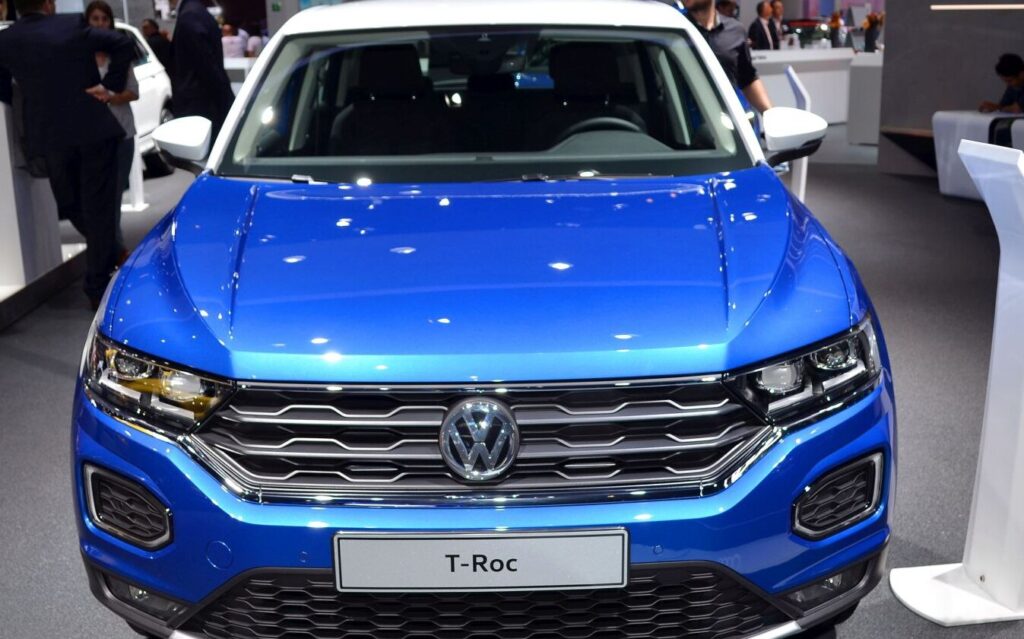
The Volkswagen T-Roc 2.0 TDI SCR 4MOTION DSG represents a compelling blend of practicality, efficiency, and all-weather capability within the compact SUV segment. Produced from 2018 to 2019, this variant occupied a mid-to-upper position in the first generation (T-Roc I) lineup, appealing to buyers seeking a diesel-powered option with the added security of Volkswagen’s 4MOTION all-wheel-drive system and the convenience of a dual-clutch transmission. It was primarily marketed in Europe, where diesel engines remained popular due to their fuel economy and torque characteristics.
Technical Specifications
| Brand | Volkswagen |
| Model | T-Roc |
| Generation | T-Roc I |
| Type (Engine) | 2.0 TDI SCR (150 Hp) 4MOTION DSG |
| Start of production | 2018 |
| End of production | 2019 |
| Powertrain Architecture | Internal Combustion engine |
| Body type | SUV |
| Seats | 5 |
| Doors | 5 |
| Fuel consumption (urban) | 5.8 l/100 km (40.6 US mpg, 48.7 UK mpg, 17.2 km/l) |
| Fuel consumption (extra urban) | 4.6-4.7 l/100 km (51.1 – 50 US mpg, 61.4 – 60.1 UK mpg, 21.7 – 21.3 km/l) |
| Fuel consumption (combined) | 5.0-5.1 l/100 km (47 – 46.1 US mpg, 56.5 – 55.4 UK mpg, 20 – 19.6 km/l) |
| CO2 emissions | 132-134 g/km |
| Fuel Type | Diesel |
| Acceleration 0 – 100 km/h | 8.4 sec |
| Acceleration 0 – 62 mph | 8.4 sec |
| Acceleration 0 – 60 mph | 8 sec |
| Maximum speed | 200 km/h (124.27 mph) |
| Emission standard | Euro 6d-TEMP |
| Weight-to-power ratio | 10.2 kg/Hp, 98 Hp/tonne |
| Weight-to-torque ratio | 4.5 kg/Nm, 222.2 Nm/tonne |
| Power | 150 Hp |
| Power per litre | 76.2 Hp/l |
| Torque | 340 Nm @ 1750-3000 rpm (250.77 lb.-ft. @ 1750-3000 rpm) |
| Engine layout | Front, Transverse |
| Engine Model/Code | DFFA |
| Engine displacement | 1968 cm3 (120.09 cu. in.) |
| Number of cylinders | 4 |
| Engine configuration | Inline |
| Number of valves per cylinder | 4 |
| Fuel injection system | Diesel Commonrail |
| Engine aspiration | Turbocharger, Intercooler |
| Engine oil capacity | 4.7 l (4.97 US qt | 4.14 UK qt) |
| Kerb Weight | 1530 kg (3373.07 lbs.) |
| Max. weight | 2040 kg (4497.43 lbs.) |
| Max load | 510 kg (1124.36 lbs.) |
| Trunk (boot) space – minimum | 445 l (15.72 cu. ft.) |
| Trunk (boot) space – maximum | 1290 l (45.56 cu. ft.) |
| Fuel tank capacity | 55 l (14.53 US gal | 12.1 UK gal) |
| Max. roof load | 75 kg (165.35 lbs.) |
| Permitted trailer load with brakes (8%) | 1900 kg (4188.78 lbs.) |
| Permitted trailer load with brakes (12%) | 1700 kg (3747.86 lbs.) |
| Permitted trailer load without brakes | 750 kg (1653.47 lbs.) |
| Permitted towbar download | 80 kg (176.37 lbs.) |
| Length | 4234 mm (166.69 in.) |
| Width | 1819 mm (71.61 in.) |
| Width including mirrors | 1992 mm (78.43 in.) |
| Height | 1573 mm (61.93 in.) |
| Wheelbase | 2590 mm (101.97 in.) |
| Front track | 1538-1546 mm (60.55 – 60.87 in.) |
| Rear (Back) track | 1533-1541 mm (60.35 – 60.67 in.) |
| Ride height (ground clearance) | 161 mm (6.34 in.) |
| Minimum turning circle | 11.1 m (36.42 ft.) |
| Drive wheel | All wheel drive (4×4) |
| Number of gears and type of gearbox | 7 gears, automatic transmission DSG |
| Front brakes | Ventilated discs |
| Rear brakes | Ventilated discs |
| Tires size | 215/55 R17; 215/50 R18 |
| Wheel rims size | 7J x 17; 7J x 18 |
Powertrain & Engine Architecture
At the heart of the T-Roc 2.0 TDI SCR 4MOTION DSG lies the DFFA engine code, a 2.0-liter inline-four cylinder diesel engine. This engine is part of Volkswagen’s modular engine family and features common-rail direct injection, a turbocharger with an intercooler, and four valves per cylinder. The ‘SCR’ designation indicates the inclusion of a Selective Catalytic Reduction system, designed to reduce nitrogen oxide (NOx) emissions by injecting AdBlue (Diesel Exhaust Fluid) into the exhaust stream. The engine produces 150 horsepower and a substantial 340 Nm (250.77 lb.-ft.) of torque between 1750 and 3000 rpm. This torque output, readily available at relatively low engine speeds, is a hallmark of diesel engines and contributes to the T-Roc’s usable performance. The engine is paired with a 7-speed dual-clutch transmission (DSG), known for its quick and smooth gear changes. The DSG transmission allows for both fully automatic operation and manual gear selection via steering wheel-mounted paddles or the gear selector.
Driving Characteristics
The 2.0 TDI SCR 4MOTION DSG powertrain delivers a balanced driving experience. Acceleration from 0 to 100 km/h (0-62 mph) takes approximately 8.4 seconds. While not overtly sporty, the readily available torque provides strong mid-range acceleration, making overtaking maneuvers and merging onto highways relatively effortless. The DSG transmission contributes to a responsive feel, and the 4MOTION all-wheel-drive system provides enhanced traction, particularly in adverse weather conditions. Compared to the base 1.0 TSI petrol engine, the 2.0 TDI offers significantly more torque and a more relaxed driving experience, especially when fully loaded or towing. However, it lacks the outright punch of higher-output TDI variants, such as the 184 hp version. The gear ratios in the DSG transmission are tuned for a balance of fuel efficiency and performance, prioritizing smooth operation over aggressive shifts.
Equipment & Trim Levels
The T-Roc 2.0 TDI SCR 4MOTION DSG typically came equipped with a generous level of standard features. These included air conditioning, a touchscreen infotainment system with Bluetooth connectivity, alloy wheels, and a suite of safety features such as ABS, ESC (Electronic Stability Control), and multiple airbags. Higher trim levels offered options such as navigation, adaptive cruise control, park assist, and upgraded interior upholstery. Interior appointments generally featured a functional and modern design, with a focus on ergonomics. The standard seats were cloth-upholstered, with leather options available as an upgrade.
Chassis & Braking
The T-Roc’s chassis is based on the MQB platform, providing a solid foundation for its handling characteristics. The suspension consists of MacPherson struts at the front and a multi-link setup at the rear. The 4MOTION all-wheel-drive system utilizes a Haldex clutch to distribute torque between the front and rear axles as needed. Braking duties are handled by ventilated discs on all four wheels, providing ample stopping power. The steering is electrically assisted, offering a light and precise feel. Stabilizer bars are fitted to both the front and rear axles to reduce body roll during cornering.
Market Reception & Comparison
The T-Roc 2.0 TDI SCR 4MOTION DSG was generally well-received by automotive critics. It was praised for its fuel efficiency, comfortable ride, and all-weather capability. The combination of the diesel engine and DSG transmission was considered a good match for the vehicle’s intended purpose. Compared to petrol-powered T-Roc variants, the TDI offered superior fuel economy and torque. However, some critics noted that the diesel engine was slightly noisier than the petrol alternatives. In terms of reliability, the 2.0 TDI engine has proven to be generally robust, although the DSG transmission can be prone to issues if not properly maintained.
Legacy
The Volkswagen T-Roc 2.0 TDI SCR 4MOTION DSG remains a popular choice in the used car market, particularly for buyers seeking a practical and efficient compact SUV. The 2.0 TDI engine, while subject to increasing scrutiny regarding diesel emissions, continues to be valued for its fuel economy and durability. Regular maintenance, including timely servicing of the DSG transmission and the SCR system, is crucial to ensure the long-term reliability of this powertrain. The T-Roc’s blend of style, practicality, and technology has cemented its position as a competitive offering in the crowded compact SUV segment.
