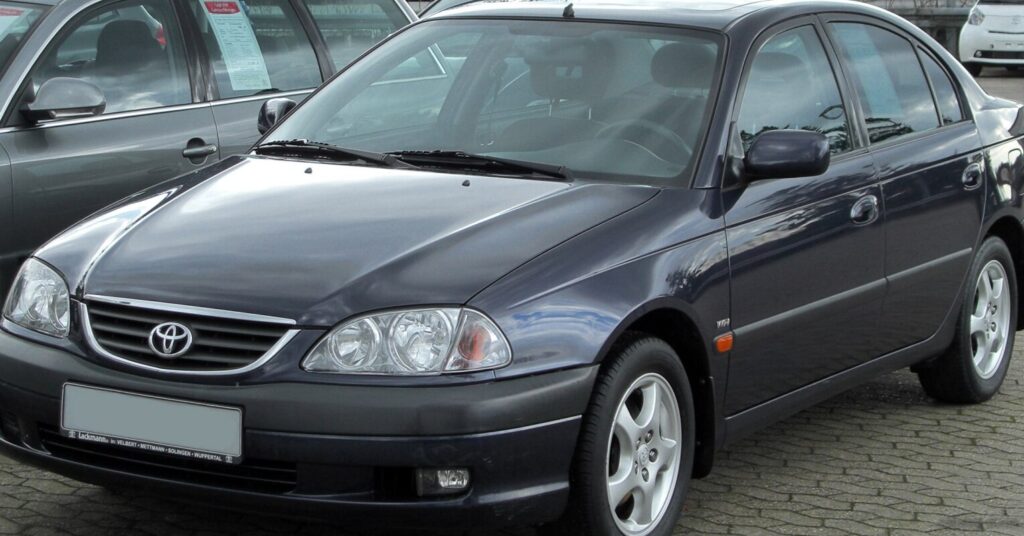
The Toyota Avensis (T22) 1.8, produced between 1997 and 2003, represented a key offering in Toyota’s mid-size sedan lineup, primarily aimed at the European and Asian markets. Positioned as an entry to mid-level trim, it provided a balance of practicality, reliability, and affordability. The T22 generation Avensis was Toyota’s attempt to create a genuinely competitive vehicle in a segment dominated by established European and Japanese rivals, built upon the platform code 1HX0. This 1.8-liter variant, delivering 110 horsepower, served as a popular choice for buyers prioritizing fuel efficiency and comfortable daily driving over outright performance.
Technical Specifications
| Brand | Toyota |
| Model | Avensis |
| Generation | Avensis (T22) |
| Type (Engine) | 1.8 (110 Hp) |
| Start of production | 1997 |
| End of production | 2003 |
| Powertrain Architecture | Internal Combustion engine |
| Body type | Sedan |
| Seats | 5 |
| Doors | 4 |
| Fuel consumption (urban) | 9.6 l/100 km (24.5 US mpg) |
| Fuel consumption (extra urban) | 6.2 l/100 km (37.9 US mpg) |
| Fuel Type | Petrol (Gasoline) |
| Acceleration 0 – 100 km/h | 11 sec |
| Acceleration 0 – 62 mph | 11 sec |
| Acceleration 0 – 60 mph | 10.5 sec |
| Maximum speed | 195 km/h (121.17 mph) |
| Weight-to-power ratio | 11.5 kg/Hp |
| Weight-to-torque ratio | 8.4 kg/Nm |
| Power | 110 Hp @ 5800 rpm |
| Torque | 150 Nm @ 2800 rpm (110.63 lb.-ft. @ 2800 rpm) |
| Engine layout | Front, Transverse |
| Engine Model/Code | 7A-FE |
| Engine displacement | 1762 cm3 (107.52 cu. in.) |
| Number of cylinders | 4 |
| Engine configuration | Inline |
| Cylinder Bore | 81 mm (3.19 in.) |
| Piston Stroke | 85.5 mm (3.37 in.) |
| Compression ratio | 9.5:1 |
| Number of valves per cylinder | 4 |
| Fuel injection system | Multi-port manifold injection |
| Engine aspiration | Naturally aspirated engine |
| Valvetrain | DOHC |
| Engine oil capacity | 3.7 l (3.91 US qt | 3.26 UK qt) |
| Coolant capacity | 6.2 l (6.55 US qt | 5.46 UK qt) |
| Kerb Weight | 1260 kg (2777.82 lbs.) |
| Max. weight | 1790 kg (3946.27 lbs.) |
| Max load | 530 kg (1168.45 lbs.) |
| Trunk (boot) space – minimum | 500 l (17.66 cu. ft.) |
| Fuel tank capacity | 60 l (15.85 US gal | 13.2 UK gal) |
| Length | 4490 mm (176.77 in.) |
| Width | 1710 mm (67.32 in.) |
| Height | 1425 mm (56.1 in.) |
| Wheelbase | 2630 mm (103.54 in.) |
| Front track | 1480 mm (58.27 in.) |
| Rear track | 1450 mm (57.09 in.) |
| Drivetrain Architecture | Front wheel drive |
| Number of gears | 5 |
| Gearbox type | Manual transmission |
| Front suspension | Spring Strut |
| Rear suspension | Coil spring |
| Front brakes | Ventilated discs |
| Rear brakes | Drum |
| Assisting systems | ABS (Anti-lock braking system) |
| Steering type | Steering rack and pinion |
| Power steering | Hydraulic Steering |
| Tires size | 185/65R14 |
Powertrain & Engine Architecture
The heart of the Avensis 1.8 was the 7A-FE engine, a 1.8-liter (1762 cc) inline-four cylinder gasoline engine. This engine was a staple in Toyota’s lineup during the late 1990s and early 2000s, known for its reliability and relatively simple design. It featured a double overhead camshaft (DOHC) valvetrain with four valves per cylinder, contributing to its respectable power output for its displacement. Fuel delivery was handled by a multi-port fuel injection system, optimizing fuel atomization and combustion efficiency. The 7A-FE engine produced 110 horsepower at 5800 rpm and 150 Nm (110.63 lb-ft) of torque at 2800 rpm. The five-speed manual transmission was the standard offering, providing a reasonably direct connection between the engine and the front wheels. The transmission was chosen for its durability and relatively low cost.
Driving Characteristics
The Avensis 1.8 with the manual transmission offered adequate, though not exhilarating, performance. Acceleration from 0 to 60 mph took around 10.5 seconds, and top speed was approximately 121 mph. The engine felt somewhat strained at higher RPMs, and the car was best suited for relaxed cruising and city driving. The gear ratios were tuned for fuel economy rather than outright acceleration. Compared to higher-output versions of the Avensis, such as those equipped with the 2.0-liter engine, the 1.8 felt noticeably less powerful, particularly when fully loaded or tackling steep inclines. However, the 1.8’s lighter weight and more efficient engine contributed to better fuel economy.
Equipment & Trim Levels
The 1.8-liter Avensis typically came with a reasonable level of standard equipment. Base models included power steering, central locking, electric front windows, and an AM/FM radio. Higher trim levels added features such as air conditioning, alloy wheels, a CD player, and upgraded interior upholstery. Interior materials were generally durable and functional, though not particularly luxurious. The dashboard layout was straightforward and easy to use, prioritizing practicality over aesthetic flair. Optional extras included a sunroof, rear electric windows, and upgraded sound systems.
Chassis & Braking
The Avensis T22 utilized a front-engine, front-wheel-drive layout. The front suspension consisted of MacPherson strut springs, while the rear employed a coil spring setup. This suspension configuration provided a comfortable ride quality, absorbing bumps and imperfections in the road surface effectively. Braking duties were handled by ventilated discs at the front and drum brakes at the rear. Anti-lock Braking System (ABS) was standard, enhancing braking performance and stability, especially in adverse conditions. The chassis was designed to provide a balance of rigidity and weight, contributing to the car’s overall handling characteristics.
Market Reception & Comparison
The Avensis 1.8 was generally well-received by automotive critics as a solid, reliable, and practical family sedan. However, it wasn’t often praised for its exciting driving dynamics or luxurious interior. Compared to other trims in the Avensis lineup, the 1.8 offered the most affordable entry point, making it attractive to budget-conscious buyers. Its fuel economy was a key selling point, particularly in Europe where gasoline prices were relatively high. The 2.0-liter Avensis offered more performance but at a higher price point and with slightly reduced fuel efficiency. The diesel variants, while offering excellent fuel economy, were often more expensive to purchase and maintain.
Legacy
The Toyota Avensis T22 1.8 has proven to be a remarkably durable and reliable vehicle. Many examples are still on the road today, testament to Toyota’s engineering prowess. The 7A-FE engine is known for its longevity and relatively low maintenance requirements. In the used car market, the 1.8-liter Avensis remains a popular choice for buyers seeking an affordable, dependable, and fuel-efficient family sedan. While it may not offer the performance or features of more modern vehicles, its reputation for reliability and low running costs continues to make it a worthwhile consideration.