
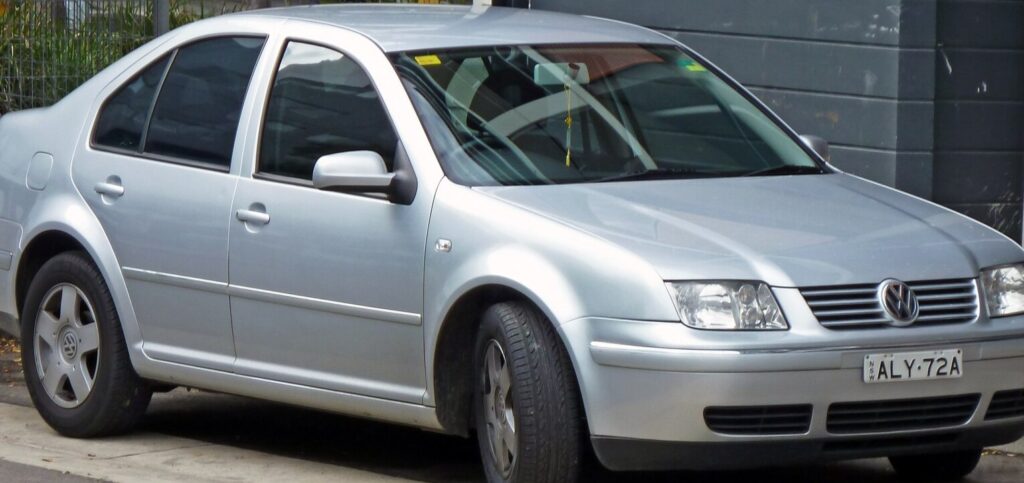
The Volkswagen Bora 1.9 TDI with the Tiptronic automatic transmission, produced between 2000 and 2001, represents a significant offering within the first generation (1J2) of the Bora compact sedan. Positioned as a mid-range option, it aimed to provide a balance between fuel efficiency, comfortable automatic operation, and respectable performance. The Bora itself was Volkswagen’s replacement for the Jetta in Europe, sharing its platform (the A4/1HX0 platform group) with the Golf, Audi A3, and SEAT Leon. This variant catered to drivers seeking the benefits of a diesel engine – namely, low running costs and strong torque – without the need for a manual gearbox.
Technical Specifications
| Brand | Volkswagen |
| Model | Bora |
| Generation | Bora (1J2) |
| Type (Engine) | 1.9 TDI (115 Hp) Tiptronic |
| Start of production | 2000 |
| End of production | 2001 |
| Powertrain Architecture | Internal Combustion engine |
| Body type | Sedan |
| Seats | 5 |
| Doors | 4 |
| Fuel consumption (urban) | 8.5 l/100 km (27.7 US mpg, 33.2 UK mpg, 11.8 km/l) |
| Fuel consumption (extra urban) | 5.1 l/100 km (46.1 US mpg, 55.4 UK mpg, 19.6 km/l) |
| Fuel consumption (combined) | 6.3 l/100 km (37.3 US mpg, 44.8 UK mpg, 15.9 km/l) |
| CO2 emissions | 170 g/km |
| Fuel Type | Diesel |
| Acceleration 0 – 100 km/h | 11.5 sec |
| Acceleration 0 – 62 mph | 11.5 sec |
| Acceleration 0 – 60 mph | 10.9 sec |
| Maximum speed | 192 km/h (119.3 mph) |
| Emission standard | Euro 3 |
| Weight-to-power ratio | 11.6 kg/Hp, 86.3 Hp/tonne |
| Weight-to-torque ratio | 4.3 kg/Nm, 232.6 Nm/tonne |
| Power | 115 Hp @ 4000 rpm |
| Power per litre | 60.7 Hp/l |
| Torque | 310 Nm @ 1900 rpm (228.64 lb.-ft. @ 1900 rpm) |
| Engine layout | Front, Transverse |
| Engine Model/Code | AJM, AUY |
| Engine displacement | 1896 cm3 (115.7 cu. in.) |
| Number of cylinders | 4 |
| Engine configuration | Inline |
| Cylinder Bore | 79.5 mm (3.13 in.) |
| Piston Stroke | 95.5 mm (3.76 in.) |
| Compression ratio | 18:1 |
| Number of valves per cylinder | 2 |
| Fuel injection system | Pump-nozzle (Unit Injector) |
| Engine aspiration | Turbocharger, Intercooler |
| Valvetrain | OHC |
| Engine oil capacity | 4 l (4.23 US qt | 3.52 UK qt) |
| Coolant | 6 l (6.34 US qt | 5.28 UK qt) |
| Kerb Weight | 1333 kg (2938.76 lbs.) |
| Max. weight | 1870 kg (4122.64 lbs.) |
| Max load | 537 kg (1183.88 lbs.) |
| Trunk (boot) space – minimum | 455 l (16.07 cu. ft.) |
| Trunk (boot) space – maximum | 785 l (27.72 cu. ft.) |
| Fuel tank capacity | 55 l (14.53 US gal | 12.1 UK gal) |
| Max. roof load | 75 kg (165.35 lbs.) |
| Permitted trailer load with brakes (12%) | 1400 kg (3086.47 lbs.) |
| Permitted trailer load without brakes | 600 kg (1322.77 lbs.) |
| Permitted towbar download | 75 kg (165.35 lbs.) |
| Length | 4376 mm (172.28 in.) |
| Width | 1735 mm (68.31 in.) |
| Width including mirrors | 2018 mm (79.45 in.) |
| Height | 1446 mm (56.93 in.) |
| Wheelbase | 2519 mm (99.17 in.) |
| Front track | 1513 mm (59.57 in.) |
| Rear (Back) track | 1494 mm (58.82 in.) |
| Minimum turning circle | 10.9 m (35.76 ft.) |
| Drivetrain Architecture | Front wheel drive |
| Number of gears and type of gearbox | 5 gears, automatic transmission Tiptronic |
| Front suspension | Independent, type McPherson with coil spring and anti-roll bar |
| Rear suspension | Semi-independent, coil spring |
| Front brakes | Ventilated discs |
| Rear brakes | Disc |
| Assisting systems | ABS (Anti-lock braking system) |
| Steering type | Steering rack and pinion |
| Power steering | Hydraulic Steering |
| Tires size | 195/65 R15 |
| Wheel rims size | 6J x 15 |
INTRODUCTION
The Volkswagen Bora 1.9 TDI Tiptronic, produced from 2000 to 2001, was a key variant within the first generation (1J2) Bora lineup. Designed as a more accessible entry point into the Bora range, it offered the fuel economy and torque characteristics of Volkswagen’s renowned 1.9-liter TDI engine paired with the convenience of a four-speed Tiptronic automatic transmission. This combination aimed to appeal to buyers who prioritized ease of driving and running costs over outright performance. The Bora, intended to replace the Jetta in European markets, was built on the A4/1HX0 platform, shared with other models within the Volkswagen Group, including the Golf, Audi A3, and SEAT Leon.
Powertrain & Engine Architecture
At the heart of the Bora 1.9 TDI Tiptronic lies the 1.9-liter inline-four diesel engine, typically identified by engine codes AJM or AUY. This engine is a direct injection diesel, utilizing Volkswagen’s pump-nozzle (Unit Injector) technology. This system delivers highly pressurized fuel directly into the combustion chamber, improving combustion efficiency and reducing emissions. The engine features an overhead camshaft (OHC) valvetrain with two valves per cylinder. A turbocharger with an intercooler is employed to increase power output and torque. The 1.9 TDI produces 115 horsepower at 4000 rpm and a substantial 310 Nm (228.64 lb-ft) of torque at just 1900 rpm. The Tiptronic transmission is a four-speed automatic with a manual shift mode, allowing drivers some control over gear selection. It’s a conventional torque converter automatic, known for its smoothness but not its outright speed compared to more modern transmissions.
Driving Characteristics
The driving experience in the Bora 1.9 TDI Tiptronic is characterized by relaxed cruising and strong low-end torque. The automatic transmission prioritizes smooth shifts and fuel efficiency, rather than aggressive acceleration. While 115 horsepower isn’t a large figure, the engine’s 310 Nm of torque provides ample pulling power for everyday driving and overtaking maneuvers. Acceleration from 0-100 km/h (0-62 mph) takes around 11.5 seconds, which is respectable for a diesel automatic of this era. Compared to the manual transmission version of the same engine, the Tiptronic model feels slightly less responsive due to the transmission’s inherent power loss and shift programming. Higher-output versions, such as the 1.8T petrol engine, offered significantly quicker acceleration, but at the expense of fuel economy. The Tiptronic’s gear ratios are geared towards efficiency, meaning the engine doesn’t rev as high as it could, contributing to its fuel-saving characteristics.
Equipment & Trim Levels
The 1.9 TDI Tiptronic typically came with a reasonable level of standard equipment. Interior features generally included cloth upholstery, a basic stereo system, power windows, and central locking. Air conditioning was often standard, but could be optional depending on the specific market. Safety features included ABS anti-lock brakes and driver and passenger airbags. Optional extras available for this trim included alloy wheels, a sunroof, upgraded stereo systems, and climate control. The trim level generally sat in the mid-range of the Bora lineup, offering more features than the base models but lacking the luxury appointments of the higher-spec versions.
Chassis & Braking
The Bora 1.9 TDI Tiptronic utilizes an independent McPherson strut suspension setup at the front, providing a comfortable ride and decent handling. The rear suspension is a semi-independent coil spring arrangement. Braking is handled by ventilated discs at the front and solid discs at the rear. ABS (Anti-lock Braking System) is standard. The suspension tuning is geared towards comfort, making it a pleasant car for long journeys. Stabilizer bars are fitted front and rear to reduce body roll during cornering. The chassis is designed to handle the weight of the diesel engine and the automatic transmission without compromising ride quality.
Market Reception & Comparison
The Bora 1.9 TDI Tiptronic was generally well-received by automotive critics as a practical and economical family car. Its fuel economy was a major selling point, particularly in Europe where diesel fuel was (and still is) often cheaper than gasoline. The Tiptronic transmission was praised for its smoothness and ease of use, but some reviewers noted its lack of responsiveness compared to a manual gearbox. Compared to the 1.8-liter petrol versions, the TDI offered significantly better fuel economy and more torque, but less outright power. The 1.9 TDI also proved to be a reliable engine, although the Tiptronic transmission could be prone to issues if not properly maintained.
Legacy
The 1.9 TDI engine, in various iterations, has become legendary for its durability and longevity. The Bora 1.9 TDI Tiptronic, while not as sought-after as some of the higher-performance variants, remains a relatively common sight on used car markets. The engine itself is known to be capable of exceeding 200,000 miles with proper maintenance. However, the Tiptronic transmission is a potential weak point, and prospective buyers should carefully inspect its condition. Today, these Boras represent an affordable and economical option for those seeking a practical and reliable compact sedan. The combination of a fuel-efficient diesel engine and a comfortable automatic transmission continues to appeal to buyers looking for a sensible and dependable vehicle.
