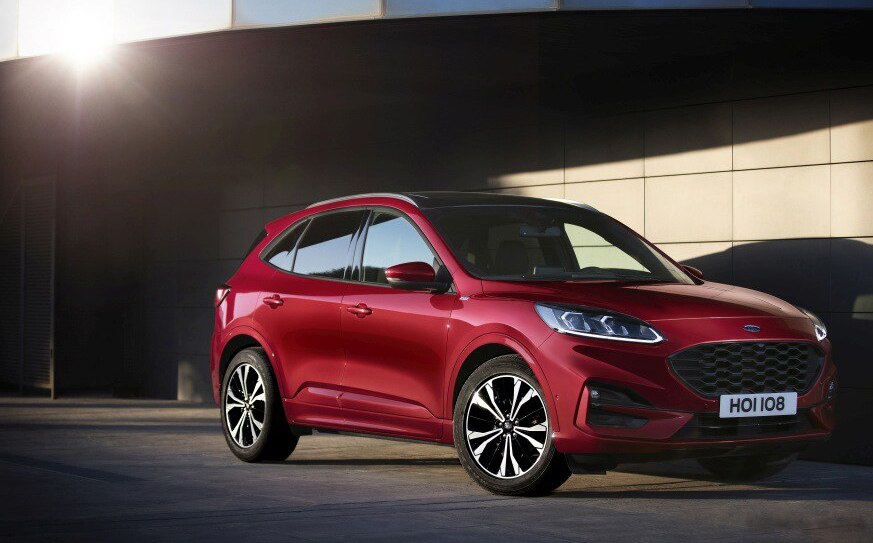
The Ford Kuga III 1.5 EcoBlue (120 hp) represents a significant entry point into the third generation of Ford’s popular compact SUV, launched in September 2019 and continuing through September 2022. Positioned as a fuel-efficient and practical option within the Kuga III range, this variant aimed to appeal to buyers prioritizing economy and everyday usability over outright performance. It slots into the lineup below the more powerful gasoline and diesel options, offering a balance between cost and capability. The Kuga III itself is built upon Ford’s C2 platform, shared with the Focus, and represents a move towards increased practicality, technology, and a more refined driving experience compared to its predecessors.
Technical Specifications
| Brand | Ford |
| Model | Kuga |
| Generation | Kuga III |
| Type (Engine) | 1.5 EcoBlue (120 Hp) |
| Start of production | September, 2019 |
| End of production | September, 2022 |
| Powertrain Architecture | Internal Combustion engine |
| Body type | SUV |
| Seats | 5 |
| Doors | 5 |
| Combined fuel consumption (WLTP) | 5.1-5.2 l/100 km (46.1 – 45.2 US mpg, 55.4 – 54.3 UK mpg, 19.6 – 19.2 km/l) |
| CO2 emissions (WLTP) | 133-137 g/km |
| Fuel consumption (economy) – urban (NEDC) | 4.7-4.8 l/100 km (50 – 49 US mpg, 60.1 – 58.9 UK mpg, 21.3 – 20.8 km/l) |
| Fuel consumption (economy) – extra urban (NEDC) | 3.8-3.9 l/100 km (61.9 – 60.3 US mpg, 74.3 – 72.4 UK mpg, 26.3 – 25.6 km/l) |
| Fuel consumption (economy) – combined (NEDC) | 4.2-4.3 l/100 km (56 – 54.7 US mpg, 67.3 – 65.7 UK mpg, 23.8 – 23.3 km/l) |
| CO2 emissions (NEDC) | 109-111 g/km |
| Fuel Type | Diesel |
| Acceleration 0 – 100 km/h | 11.7 sec |
| Acceleration 0 – 62 mph | 11.7 sec |
| Acceleration 0 – 60 mph | 11.1 sec |
| Maximum speed | 180 km/h (111.85 mph) |
| Emission standard | Euro 6d-TEMP |
| Weight-to-power ratio | 12.5 kg/Hp, 79.9 Hp/tonne |
| Weight-to-torque ratio | 5 kg/Nm, 199.9 Nm/tonne |
| Power | 120 Hp @ 4000 rpm |
| Power per litre | 80.1 Hp/l |
| Torque | 300 Nm @ 1750-2250 rpm (221.27 lb.-ft. @ 1750-2250 rpm) |
| Engine layout | Front, Transverse |
| Engine Model/Code | ZTDA |
| Engine displacement | 1499 cm3 (91.47 cu. in.) |
| Number of cylinders | 4 |
| Engine configuration | Inline |
| Cylinder Bore | 75 mm (2.95 in.) |
| Piston Stroke | 84.8 mm (3.34 in.) |
| Compression ratio | 16.4:1 |
| Number of valves per cylinder | 4 |
| Fuel injection system | Diesel Commonrail |
| Engine aspiration | Turbocharger, Intercooler |
| Valvetrain | DOHC |
| Engine oil capacity | 6.2 l (6.55 US qt | 5.46 UK qt) |
| Coolant | 8.7 l (9.19 US qt | 7.65 UK qt) |
| Kerb Weight | 1501 kg (3309.14 lbs.) |
| Max. weight | 2085 kg (4596.64 lbs.) |
| Max load | 584 kg (1287.5 lbs.) |
| Trunk (boot) space – minimum | 435 l (15.36 cu. ft.) |
| Trunk (boot) space – maximum | 1534 l (54.17 cu. ft.) |
| Fuel tank capacity | 54 l (14.27 US gal | 11.88 UK gal) |
| Max. roof load | 75 kg (165.35 lbs.) |
| Permitted trailer load with brakes (12%) | 1500 kg (3306.93 lbs.) |
| Permitted trailer load without brakes | 750 kg (1653.47 lbs.) |
| Permitted towbar download | 100 kg (220.46 lbs.) |
| Length | 4614-4629 mm (181.65 – 182.24 in.) |
| Width | 1883 mm (74.13 in.) |
| Width with mirrors folded | 2000 mm (78.74 in.) |
| Width including mirrors | 2178 mm (85.75 in.) |
| Height | 1666-1680 mm (65.59 – 66.14 in.) |
| Wheelbase | 2710 mm (106.69 in.) |
| Front track | 1597 mm (62.87 in.) |
| Rear (Back) track | 1588 mm (62.52 in.) |
| Ride height (ground clearance) | 146-191 mm (5.75 – 7.52 in.) |
| Minimum turning circle (turning diameter) | 11.38 m (37.34 ft.) |
| Front brakes | Ventilated discs, 308-330 mm |
| Rear brakes | Disc, 302 mm |
| Tires size | 225/65 R17; 225/60 R18; 225/55 R19; 245/45 R20 |
| Wheel rims size | 7J x 17; 7.5J x 18; 7.5J x 19; 7.5J x 20; 8.0J x 20 |
| Number of gears and type of gearbox | 6 gears, manual transmission |
Powertrain & Engine Architecture
The heart of the Kuga III 1.5 EcoBlue (120 hp) is the ZTDA engine, a 1.5-liter inline four-cylinder diesel. This engine is part of Ford’s EcoBlue family, designed for improved fuel efficiency and reduced emissions. It utilizes a common-rail direct fuel injection system, operating at a high pressure to ensure fine atomization of the fuel for cleaner combustion. The engine features a turbocharger with an intercooler, boosting power output and torque. The valvetrain employs a Double Overhead Camshaft (DOHC) configuration with four valves per cylinder, optimizing gas flow for enhanced performance. The 16.4:1 compression ratio is relatively high for a diesel, contributing to thermal efficiency. This particular variant was typically paired with a six-speed manual transmission, although an eight-speed automatic was also available as an option. The engine benefits from a particulate filter to reduce soot emissions, meeting stringent Euro 6d-TEMP emission standards.
Driving Characteristics
The 120 hp EcoBlue engine, coupled with the manual transmission, delivers adequate performance for everyday driving. Acceleration from 0-60 mph takes around 11.1 seconds, and top speed is limited to 111.85 mph. While not particularly sporty, the engine provides sufficient torque (300 Nm / 221 lb-ft) from 1750-2250 rpm, making it reasonably responsive in typical driving situations. The gear ratios are tuned for fuel economy, meaning the engine can feel somewhat strained when accelerating hard or climbing hills. Compared to the more powerful 1.5 EcoBlue 150 hp version, or the gasoline engines, this variant offers a more relaxed driving experience, prioritizing fuel efficiency over outright speed. The manual transmission provides a more engaging driving experience than the optional automatic, allowing for greater control over gear selection.
Equipment & Trim Levels
The Kuga III 1.5 EcoBlue (120 hp) was typically offered in lower to mid-range trim levels, such as Zetec and Titanium. Standard equipment generally included air conditioning, a touchscreen infotainment system with Apple CarPlay and Android Auto compatibility, alloy wheels, and a suite of safety features including lane-keeping assist and automatic emergency braking. Higher trim levels added features like a larger touchscreen, heated seats, a panoramic sunroof, and adaptive cruise control. Interior upholstery was typically cloth, with options for leather upgrades on higher trims. The dashboard layout was modern and functional, with a focus on ease of use.
Chassis & Braking
The Kuga III utilizes independent suspension all around, with MacPherson struts at the front and multi-link suspension at the rear. This setup provides a comfortable ride quality and decent handling characteristics. The front brakes are ventilated discs, measuring 308-330mm in diameter, while the rear brakes are solid discs measuring 302mm. ABS (Anti-lock Braking System) is standard. The suspension tuning is geared towards comfort rather than sporty handling, prioritizing ride quality over sharp cornering. Stabilizer bars are fitted front and rear to reduce body roll.
Market Reception & Comparison
The Kuga III 1.5 EcoBlue (120 hp) was generally well-received by critics as a practical and fuel-efficient option. It was praised for its comfortable ride, spacious interior, and good value for money. However, some reviewers noted that the engine could feel underpowered, particularly when fully loaded or driving uphill. Compared to the 1.5 EcoBlue 150 hp variant, the 120 hp version offered better fuel economy but at the expense of performance. The gasoline engines provided more responsive acceleration but were less fuel-efficient. In terms of reliability, the EcoBlue engines have generally proven to be robust, although owners should be mindful of maintaining the diesel particulate filter.
Legacy
The Ford Kuga III 1.5 EcoBlue (120 hp) remains a popular choice in the used car market, offering a compelling combination of practicality, fuel efficiency, and affordability. The EcoBlue engine has proven to be relatively reliable, although regular servicing and maintenance are essential. The Kuga III’s spacious interior and comfortable ride continue to appeal to buyers looking for a versatile family SUV. While not the most exciting vehicle to drive, it represents a sensible and well-rounded option for those prioritizing everyday usability and running costs.