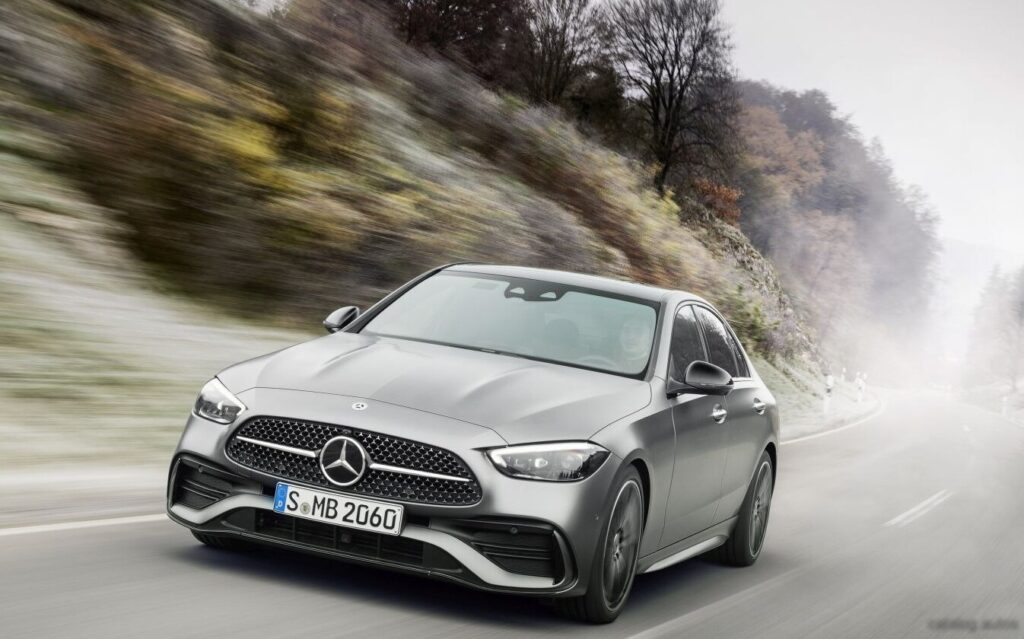
The Mercedes-Benz C 200, equipped with a 204 horsepower EQ Boost system and a 9G-TRONIC automatic transmission, represents a key entry point into the fifth-generation C-Class (W206) introduced in 2021. Positioned as a mainstream luxury sedan, the C 200 balances performance, efficiency, and technology within the broader C-Class lineup. This variant aimed to appeal to buyers seeking a refined driving experience with modern features, while remaining relatively accessible in terms of price compared to the more powerful C 300 or AMG-tuned models. The W206 C-Class marked a significant evolution from its predecessor, incorporating a more digital-focused interior and a sophisticated mild-hybrid powertrain.
Technical Specifications
| Brand | Mercedes-Benz |
| Model | C-class |
| Generation | C-class (W206) |
| Type (Engine) | C 200 (204 Hp) EQ Boost 9G-TRONIC |
| Start of production | 2021 |
| Powertrain Architecture | MHEV (Mild Hybrid Electric Vehicle) |
| Body type | Sedan |
| Seats | 5 |
| Doors | 4 |
| Combined fuel consumption (WLTP) | 6.3-7.2 l/100 km (37.3 – 32.7 US mpg, 44.8 – 39.2 UK mpg, 15.9 – 13.9 km/l) |
| CO2 emissions (WLTP) | 143-163 g/km |
| Fuel consumption (economy) – urban (NEDC) | 8.7-9.1 l/100 km (27 – 25.8 US mpg, 32.5 – 31 UK mpg, 11.5 – 11 km/l) |
| Fuel consumption (economy) – extra urban (NEDC) | 4.7-5.1 l/100 km (50 – 46.1 US mpg, 60.1 – 55.4 UK mpg, 21.3 – 19.6 km/l) |
| Fuel consumption (economy) – combined (NEDC) | 6.2-6.6 l/100 km (37.9 – 35.6 US mpg, 45.6 – 42.8 UK mpg, 16.1 – 15.2 km/l) |
| CO2 emissions (NEDC) | 141-150 g/km |
| Fuel Type | Petrol (Gasoline) |
| Acceleration 0 – 100 km/h | 7.3 sec |
| Acceleration 0 – 62 mph | 7.3 sec |
| Acceleration 0 – 60 mph | 6.9 sec |
| Maximum speed | 246 km/h (152.86 mph) |
| Emission standard | Euro 6d-ISC-FCM |
| Weight-to-power ratio | 7.7 kg/Hp, 129.5 Hp/tonne |
| Weight-to-torque ratio | 5.3 kg/Nm, 190.5 Nm/tonne |
| Gross battery capacity | 0.9 kWh |
| Battery voltage | 48 V |
| Battery technology | Lithium-ion (Li-Ion) |
| Electric motor power | 20 Hp |
| Electric motor Torque | 200 Nm (147.51 lb.-ft.) |
| Electric motor location | Between the combustion engine and the transmission |
| Power | 204 Hp @ 5800-6100 rpm |
| Power per litre | 136.4 Hp/l |
| Torque | 300 Nm @ 1800-4000 rpm (221.27 lb.-ft. @ 1800-4000 rpm) |
| Engine layout | Front, Longitudinal |
| Engine Model/Code | M 254.915 |
| Engine displacement | 1496 cm3 (91.29 cu. in.) |
| Number of cylinders | 4 |
| Engine configuration | Inline |
| Cylinder Bore | 80.4 mm (3.17 in.) |
| Piston Stroke | 73.7 mm (2.9 in.) |
| Compression ratio | 10:1 |
| Number of valves per cylinder | 4 |
| Fuel injection system | Direct injection |
| Engine aspiration | Twin-scroll turbo, Intercooler |
| Valvetrain | DOHC |
| Engine oil capacity | 6 l (6.34 US qt | 5.28 UK qt) |
| Kerb Weight | 1575 kg (3472.28 lbs.) |
| Max. weight | 2265 kg (4993.47 lbs.) |
| Max load | 690 kg (1521.19 lbs.) |
| Trunk (boot) space – minimum | 455 l (16.07 cu. ft.) |
| Fuel tank capacity | 50 l (13.21 US gal | 11 UK gal) |
| Max. roof load | 100 kg (220.46 lbs.) |
| Permitted trailer load with brakes (12%) | 1800 kg (3968.32 lbs.) |
| Permitted trailer load without brakes | 750 kg (1653.47 lbs.) |
| Permitted towbar download | 75 kg (165.35 lbs.) |
| Length | 4751 mm (187.05 in.) |
| Width | 1820 mm (71.65 in.) |
| Width including mirrors | 2033 mm (80.04 in.) |
| Height | 1437 mm (56.57 in.) |
| Wheelbase | 2865 mm (112.8 in.) |
| Front track | 1582 mm (62.28 in.) |
| Rear (Back) track | 1594 mm (62.76 in.) |
| Front overhang | 800 mm (31.5 in.) |
| Rear overhang | 1086 mm (42.76 in.) |
| Drag coefficient (Cd) | 0.24 |
| Minimum turning circle (turning diameter) | 10.64 m (34.91 ft.) |
| Front brakes | Ventilated discs |
| Rear brakes | Ventilated discs |
| Number of gears and type of gearbox | 9 gears, automatic transmission G-TRONIC |
Powertrain & Engine Architecture
The C 200’s heart is the M 254.915 1.5-liter inline-four cylinder engine. This engine utilizes direct fuel injection and a twin-scroll turbocharger to deliver a balance of power and efficiency. Crucially, it incorporates Mercedes-Benz’s 48-volt EQ Boost mild-hybrid system. This system features a 20 horsepower electric motor integrated between the engine and the 9G-TRONIC automatic transmission. The electric motor provides assistance during acceleration, allowing for smoother starts and improved responsiveness, while also enabling features like coasting with engine shut-off to enhance fuel economy. The 9G-TRONIC transmission itself is a nine-speed automatic known for its smooth shifts and wide gear ratio spread, contributing to both performance and efficiency. The engine’s valvetrain employs a Double Overhead Camshaft (DOHC) configuration with four valves per cylinder, optimizing airflow for increased power output.
Driving Characteristics
The C 200, with its 204 hp and 300 Nm (221 lb-ft) of torque, offers a comfortable and capable driving experience. While not as overtly sporty as the C 300, it provides sufficient power for everyday driving and highway cruising. The EQ Boost system noticeably improves low-end responsiveness, mitigating some of the turbo lag often associated with smaller displacement engines. The 9G-TRONIC transmission is well-tuned, providing seamless gear changes and keeping the engine in its optimal power band. Compared to a manual transmission equipped C-Class (not typically offered with this engine), the 9G-TRONIC prioritizes comfort and ease of use over outright driver engagement. Acceleration from 0 to 60 mph takes approximately 6.9 seconds, making it competitive within its segment. The mild-hybrid system contributes to a refined driving experience, particularly in city traffic, where the electric motor assists with smooth starts and stops.
Equipment & Trim Levels
The C 200 typically came standard with a generous array of features, reflecting its position as a premium sedan. Standard equipment generally included Mercedes-Benz User Experience (MBUX) infotainment system with a large touchscreen display, a digital instrument cluster, automatic climate control, and a suite of driver-assistance systems such as automatic emergency braking and lane-keeping assist. Interior upholstery was typically MB-Tex artificial leather, with options for genuine leather upgrades. Optional extras included a panoramic sunroof, premium sound system, heated and ventilated seats, and advanced driver-assistance packages offering features like adaptive cruise control and parking assist. Trim levels often varied by market, but generally offered packages that bundled popular options together.
Chassis & Braking
The W206 C-Class features a sophisticated chassis design aimed at balancing comfort and handling. The front suspension utilizes a multi-link setup with coil springs and a transverse stabilizer bar, while the rear suspension employs an independent multi-link spring suspension, also with a stabilizer bar. This configuration provides a comfortable ride while maintaining good body control. The C 200 is equipped with ventilated disc brakes on all four wheels, providing ample stopping power. Anti-lock Braking System (ABS) is standard, along with other electronic stability control systems. The suspension tuning is generally geared towards comfort, but the chassis is capable of handling spirited driving.
Market Reception & Comparison
The C 200 EQ Boost was generally well-received by automotive critics. Reviewers praised its refined driving experience, fuel efficiency, and advanced technology. However, some noted that its performance wasn’t as exhilarating as the more powerful C 300. Compared to the C 300, the C 200 offered a more affordable entry point into the C-Class range, appealing to buyers who prioritized efficiency and comfort over outright performance. Fuel economy figures, ranging from 6.3 to 7.2 l/100 km (37.3 – 32.7 US mpg), were competitive within its class. Reliability reports have been generally positive, with the M 254 engine proving to be a robust and dependable unit.
Legacy
The C 200 EQ Boost represents an important step in Mercedes-Benz’s transition towards electrified powertrains. The integration of the 48-volt mild-hybrid system demonstrated the brand’s commitment to improving fuel efficiency and reducing emissions. On the used car market, the W206 C 200 is becoming increasingly popular due to its combination of luxury, technology, and relatively affordable price point. The M 254 engine is expected to remain a reliable and durable powertrain for years to come, making the C 200 a sensible choice for buyers seeking a well-rounded and modern luxury sedan.