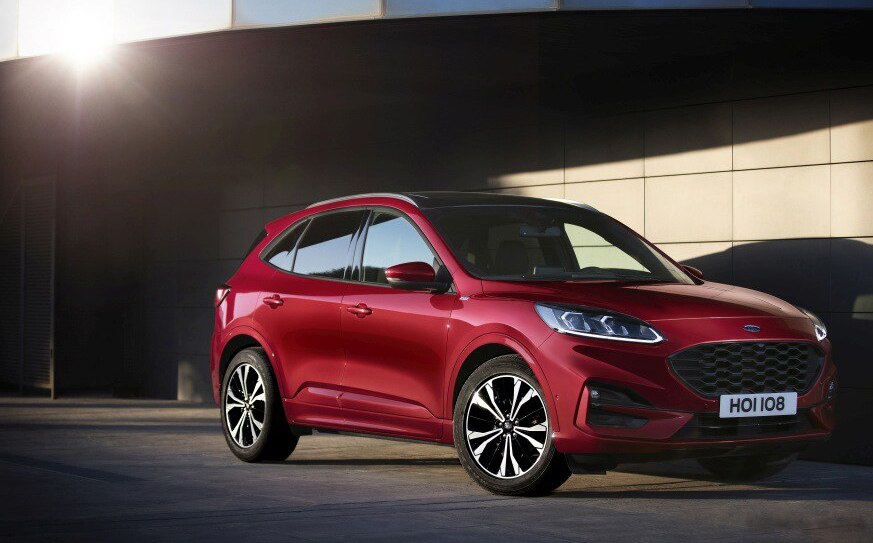
The Ford Kuga III 1.5 EcoBoost (120 hp) represents an entry-level powertrain option within the third generation of Ford’s popular compact SUV, the Kuga. Introduced in September 2019 and continuing through September 2022, this variant was primarily aimed at buyers seeking a balance between affordability, fuel efficiency, and practicality. Positioned below the more powerful EcoBoost and diesel options, the 120 hp model served as the gateway to the Kuga III range, particularly in European markets where smaller displacement engines are favored. It utilizes the Ford C2 platform, shared with the Ford Focus, and represents a significant update over the previous Kuga generations in terms of technology, safety features, and interior refinement.
Technical Specifications
| Brand | Ford |
| Model | Kuga |
| Generation | Kuga III |
| Type (Engine) | 1.5 EcoBoost (120 Hp) |
| Start of production | September, 2019 |
| End of production | September, 2022 |
| Powertrain Architecture | Internal Combustion engine |
| Body type | SUV |
| Seats | 5 |
| Doors | 5 |
| Combined fuel consumption (WLTP) | 6.7-6.9 l/100 km (35.1 – 34.1 US mpg, 42.2 – 40.9 UK mpg, 14.9 – 14.5 km/l) |
| CO2 emissions (WLTP) | 152-156 g/km |
| Fuel consumption (economy) – urban (NEDC) | 6.8-6.9 l/100 km (34.6 – 34.1 US mpg, 41.5 – 40.9 UK mpg, 14.7 – 14.5 km/l) |
| Fuel consumption (economy) – extra urban (NEDC) | 4.9-5.1 l/100 km (48 – 46.1 US mpg, 57.6 – 55.4 UK mpg, 20.4 – 19.6 km/l) |
| Fuel consumption (economy) – combined (NEDC) | 5.6-5.8 l/100 km (42 – 40.6 US mpg, 50.4 – 48.7 UK mpg, 17.9 – 17.2 km/l) |
| CO2 emissions (NEDC) | 127-130 g/km |
| Fuel Type | Petrol (Gasoline) |
| Acceleration 0 – 100 km/h | 11.6 sec |
| Acceleration 0 – 62 mph | 11.6 sec |
| Acceleration 0 – 60 mph | 11 sec |
| Maximum speed | 184 km/h (114.33 mph) |
| Emission standard | Euro 6d-TEMP |
| Weight-to-power ratio | 12.4 kg/Hp, 80.6 Hp/tonne |
| Weight-to-torque ratio | 6.2 kg/Nm, 161.2 Nm/tonne |
| Power | 120 Hp @ 5500 rpm |
| Power per litre | 80.2 Hp/l |
| Torque | 240 Nm @ 1600-3000 rpm (177.01 lb.-ft. @ 1600-3000 rpm) |
| Engine layout | Front, Transverse |
| Engine Model/Code | UNDA |
| Engine displacement | 1497 cm3 (91.35 cu. in.) |
| Number of cylinders | 3 |
| Engine configuration | Inline |
| Cylinder Bore | 84 mm (3.31 in.) |
| Piston Stroke | 90 mm (3.54 in.) |
| Compression ratio | 11:1 |
| Number of valves per cylinder | 4 |
| Fuel injection system | Direct injection |
| Engine aspiration | Turbocharger, Intercooler |
| Valvetrain | DOHC |
| Engine oil capacity | 5.05 l (5.34 US qt | 4.44 UK qt) |
| Coolant | 7.2 l (7.61 US qt | 6.34 UK qt) |
| Kerb Weight | 1489 kg (3282.68 lbs.) |
| Max. weight | 2075 kg (4574.59 lbs.) |
| Max load | 586 kg (1291.91 lbs.) |
| Trunk (boot) space – minimum | 435 l (15.36 cu. ft.) |
| Trunk (boot) space – maximum | 1534 l (54.17 cu. ft.) |
| Fuel tank capacity | 54 l (14.27 US gal | 11.88 UK gal) |
| Max. roof load | 75 kg (165.35 lbs.) |
| Permitted trailer load with brakes (12%) | 1600 kg (3527.4 lbs.) |
| Permitted trailer load without brakes | 750 kg (1653.47 lbs.) |
| Permitted towbar download | 100 kg (220.46 lbs.) |
| Length | 4614-4629 mm (181.65 – 182.24 in.) |
| Width | 1883 mm (74.13 in.) |
| Width with mirrors folded | 2000 mm (78.74 in.) |
| Width including mirrors | 2178 mm (85.75 in.) |
| Height | 1666-1680 mm (65.59 – 66.14 in.) |
| Wheelbase | 2710 mm (106.69 in.) |
| Front track | 1597 mm (62.87 in.) |
| Rear (Back) track | 1588 mm (62.52 in.) |
| Ride height (ground clearance) | 146-191 mm (5.75 – 7.52 in.) |
| Minimum turning circle (turning diameter) | 11.38 m (37.34 ft.) |
| Front brakes | Ventilated discs, 308-330 mm |
| Rear brakes | Disc, 302 mm |
| Tires size | 225/65 R17; 225/60 R18; 225/55 R19 |
| Wheel rims size | 7J x 17; 7.5J x 18; 7.5J x 19 |
Powertrain & Engine Architecture
The Kuga III 1.5 EcoBoost (120 hp) is powered by Ford’s UNDA engine code, a 1.5-liter turbocharged inline-three cylinder gasoline engine. This engine is part of the EcoBoost family, known for combining direct fuel injection with turbocharging to deliver improved power and efficiency. The UNDA engine utilizes a single-scroll turbocharger and intercooler to enhance performance. The direct injection system allows for precise fuel delivery, optimizing combustion and reducing emissions. The engine features a double overhead camshaft (DOHC) valvetrain with four valves per cylinder, contributing to its responsive nature. The engine is paired with a six-speed automatic transmission, designed to provide smooth gear changes and contribute to overall fuel economy. This transmission is a conventional torque-converter automatic, prioritizing comfort and ease of use over outright performance.
Driving Characteristics
The 120 hp EcoBoost engine, coupled with the six-speed automatic, delivers adequate performance for everyday driving. Acceleration from 0-60 mph takes approximately 11 seconds, and the top speed is around 114 mph. While not particularly sporty, the engine provides sufficient torque (240 Nm) from 1600-3000 rpm, making it reasonably capable for overtaking and merging onto highways. Compared to the more powerful 1.5 EcoBoost variants (150 hp) or the diesel options, the 120 hp version feels noticeably less energetic, particularly when fully loaded or tackling steep inclines. The automatic transmission is tuned for fuel efficiency, often prioritizing higher gears at lower speeds. This can sometimes result in a slight hesitation when requesting sudden acceleration. The gear ratios are optimized for cruising, contributing to a comfortable ride on long journeys.
Equipment & Trim Levels
The 1.5 EcoBoost 120 hp variant was typically offered in lower to mid-range trim levels, such as Zetec and Titanium. Standard equipment generally included air conditioning, a touchscreen infotainment system with Apple CarPlay and Android Auto compatibility, alloy wheels, and a suite of safety features including lane-keeping assist and automatic emergency braking. Higher trim levels added features like a larger touchscreen, heated seats, a panoramic sunroof, and adaptive cruise control. Interior upholstery was typically cloth, with options for leather upgrades on higher trims. Dashboard configuration was consistent across the Kuga III range, featuring a modern and user-friendly design.
Chassis & Braking
The Kuga III utilizes a front-wheel-drive chassis as standard, with all-wheel drive available as an option. The suspension consists of MacPherson struts at the front and a multi-link setup at the rear, providing a comfortable and controlled ride. Braking is handled by ventilated discs at the front and solid discs at the rear. Anti-lock Braking System (ABS) and Electronic Stability Control (ESC) are standard safety features. The 120 hp variant, being lighter than some of its more powerful siblings, generally benefits from slightly improved braking performance and handling agility.
Market Reception & Comparison
The Kuga III 1.5 EcoBoost (120 hp) was generally well-received by critics as a practical and affordable option within the compact SUV segment. Its fuel economy, averaging between 34.1 and 35.1 US mpg, was a key selling point. However, some reviewers noted that the engine could feel underpowered, particularly when compared to the more potent EcoBoost and diesel alternatives. Compared to the 1.5 EcoBoost 150 hp model, the 120 hp version offered a lower purchase price but sacrificed performance. The diesel variants provided superior fuel economy and torque but came with a higher initial cost and potential concerns regarding diesel emissions regulations.
Legacy
The 1.5 EcoBoost (120 hp) powertrain has proven to be relatively reliable, with few widespread mechanical issues reported. The engine’s direct injection system and turbocharger require regular maintenance, including oil changes and inspection of the timing chain. On the used car market, the Kuga III 1.5 EcoBoost (120 hp) represents a good value proposition for buyers seeking a well-equipped and fuel-efficient SUV. Its affordability and practicality make it a popular choice for families and commuters. However, potential buyers should be aware of the engine’s limitations in terms of outright performance and ensure that the vehicle has been properly maintained.