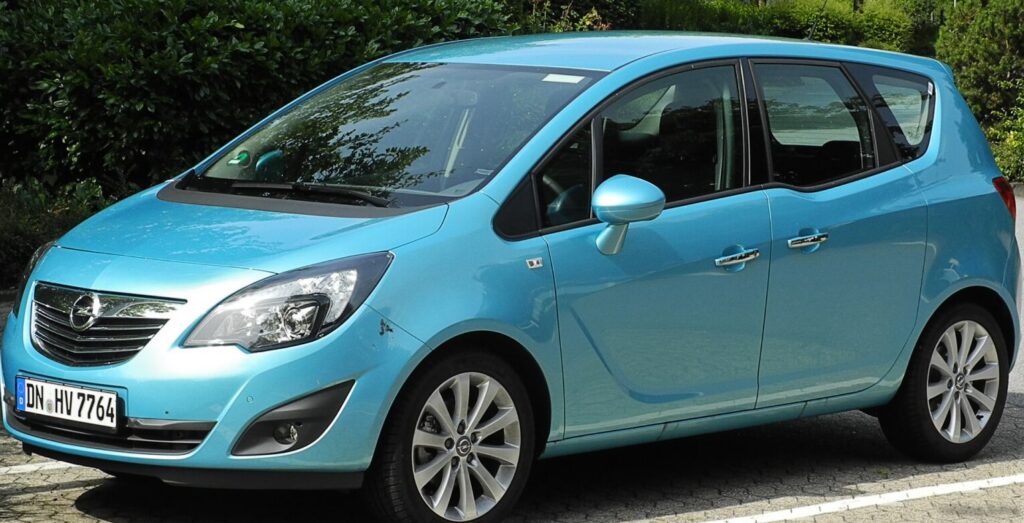
The Opel Meriva B 1.3 CDTI, producing 75 horsepower, was a key variant in the second generation of Opel’s popular compact minivan. Introduced in June 2010 and continuing through October 2013, this model occupied the entry-level position in the Meriva B lineup, offering an economical and practical option for families and urban drivers. It was primarily marketed in Europe, where the Meriva competed with vehicles like the Renault Modus, Fiat Qubo, and Citroën Berlingo First. This variant aimed to provide a balance between affordability, fuel efficiency, and the Meriva’s renowned versatility.
Technical Specifications
| Brand | Opel |
| Model | Meriva |
| Generation | Meriva B |
| Type (Engine) | 1.3 CDTI (75 Hp) |
| Start of production | June, 2010 |
| End of production | October, 2013 |
| Powertrain Architecture | Internal Combustion engine |
| Body type | Minivan |
| Seats | 5 |
| Doors | 5 |
| Fuel consumption (urban) | 5.9 l/100 km (39.9 US mpg, 47.9 UK mpg, 16.9 km/l) |
| Fuel consumption (extra urban) | 4.3 l/100 km (54.7 US mpg, 65.7 UK mpg, 23.3 km/l) |
| Fuel consumption (combined) | 4.9 l/100 km (48 US mpg, 57.6 UK mpg, 20.4 km/l) |
| Fuel Type | Diesel |
| Acceleration 0 – 100 km/h | 16.9 sec |
| Acceleration 0 – 62 mph | 16.9 sec |
| Acceleration 0 – 60 mph | 16.1 sec |
| Maximum speed | 160 km/h (99.42 mph) |
| Emission standard | Euro 5 |
| Weight-to-power ratio | 19 kg/Hp, 52.5 Hp/tonne |
| Weight-to-torque ratio | 7.9 kg/Nm, 126.1 Nm/tonne |
| Power | 75 Hp @ 4000 rpm |
| Power per litre | 60.1 Hp/l |
| Torque | 180 Nm @ 1750-2500 rpm (132.76 lb.-ft. @ 1750-2500 rpm) |
| Engine layout | Front, Transverse |
| Engine Model/Code | A13DTC |
| Engine displacement | 1248 cm3 (76.16 cu. in.) |
| Number of cylinders | 4 |
| Engine configuration | Inline |
| Cylinder Bore | 69.6 mm (2.74 in.) |
| Piston Stroke | 82 mm (3.23 in.) |
| Compression ratio | 16.8:1 |
| Number of valves per cylinder | 4 |
| Fuel injection system | Diesel Commonrail |
| Engine aspiration | Turbocharger, Intercooler |
| Valvetrain | DOHC |
| Engine oil capacity | 3.5 l (3.7 US qt | 3.08 UK qt) |
| Coolant | 6.2 l (6.55 US qt | 5.46 UK qt) |
| Kerb Weight | 1428 kg (3148.2 lbs.) |
| Max. weight | 2025 kg (4464.36 lbs.) |
| Max load | 597 kg (1316.16 lbs.) |
| Trunk (boot) space – minimum | 400 l (14.13 cu. ft.) |
| Trunk (boot) space – maximum | 1500 l (52.97 cu. ft.) |
| Fuel tank capacity | 54 l (14.27 US gal | 11.88 UK gal) |
| Length | 4288 mm (168.82 in.) |
| Width | 1812 mm (71.34 in.) |
| Width including mirrors | 1994 mm (78.5 in.) |
| Height | 1615 mm (63.58 in.) |
| Wheelbase | 2644 mm (104.09 in.) |
| Front track | 1488 mm (58.58 in.) |
| Rear (Back) track | 1509 mm (59.41 in.) |
| Minimum turning circle | 11.06 m (36.29 ft.) |
| Drivetrain Architecture | Front wheel drive |
| Number of gears and type of gearbox | 5 gears, manual transmission |
| Assisting systems | ABS (Anti-lock braking system) |
| Steering type | Steering rack and pinion |
INTRODUCTION
The Opel Meriva B, launched in 2010, represented a significant step forward for the Meriva nameplate. Moving away from the more conventional MPV shape of its predecessor, the B-series adopted a more dynamic and sculpted design, along with the innovative FlexDoors – rear-hinged rear doors that greatly improved access to the cabin, particularly in tight parking spaces. The 1.3 CDTI 75 hp variant was positioned as the entry point to the Meriva B range, appealing to budget-conscious buyers who still desired the practicality and space of a compact minivan. It was built on the General Motors Gamma platform, shared with other models like the Opel Corsa D and Fiat Punto Evo.
Powertrain & Engine Architecture
At the heart of the Meriva B 1.3 CDTI was the A13DTC engine, a 1.3-liter inline-four cylinder diesel engine. This engine was part of Opel/Fiat’s family of small-displacement diesel engines, known for their fuel efficiency. The A13DTC featured a common rail direct injection system, delivering fuel directly into the combustion chamber at extremely high pressure for optimized combustion. A turbocharger with an intercooler was employed to boost power output, overcoming the limitations of the small displacement. The engine utilized a double overhead camshaft (DOHC) valvetrain with four valves per cylinder, enhancing breathing and contributing to improved performance. The 75 horsepower output was achieved at 4000 rpm, while peak torque of 180 Nm (132.76 lb.-ft.) was available between 1750 and 2500 rpm. This engine was typically paired with a five-speed manual transmission, although an automated manual transmission (Easytronic) was also available as an option. The Easytronic, while offering some convenience, was often criticized for its slow and jerky shifts.
Driving Characteristics
The 1.3 CDTI 75 hp Meriva B was not designed for outright performance. Acceleration was modest, taking around 16.1 seconds to reach 60 mph and 16.9 seconds to reach 100 km/h. The focus was firmly on fuel economy and drivability in urban environments. The engine provided adequate torque for everyday driving, but overtaking maneuvers required careful planning. Compared to the more powerful 1.7 CDTI variants, the 1.3 CDTI felt noticeably slower, particularly when fully loaded with passengers and luggage. The five-speed manual transmission was well-matched to the engine’s characteristics, offering a reasonable spread of gears. The gear ratios were optimized for fuel efficiency rather than spirited driving. The steering was light and easy, making it maneuverable in city traffic, but lacked the feel and precision of some competitors.
Equipment & Trim Levels
The 1.3 CDTI typically came with a relatively basic level of equipment, reflecting its position as the entry-level model. Standard features generally included air conditioning, power steering, electric front windows, and a basic audio system with MP3 compatibility. Safety features such as ABS, front airbags, and seatbelt pretensioners were also standard. Higher trim levels, such as Enjoy and Cosmo, added features like alloy wheels, cruise control, rear parking sensors, and upgraded interior trim. Interior upholstery was typically cloth, with a functional and durable design. Optional extras included a panoramic sunroof, navigation system, and leather upholstery.
Chassis & Braking
The Meriva B utilized a MacPherson strut front suspension and a torsion beam rear suspension. This setup provided a comfortable ride quality, absorbing bumps and imperfections in the road surface effectively. The torsion beam rear suspension was a cost-effective solution, but it didn’t offer the same level of sophistication as a fully independent rear suspension. Braking was typically accomplished with disc brakes on the front wheels and drum brakes on the rear wheels. ABS (Anti-lock Braking System) was standard, enhancing braking performance and stability. The chassis was designed to prioritize safety and practicality, rather than sporty handling. Stabilizer bars were fitted to both the front and rear axles to reduce body roll during cornering.
Market Reception & Comparison
The Opel Meriva B 1.3 CDTI was generally well-received by critics for its fuel efficiency, practicality, and spacious interior. However, the engine’s limited power output was a common criticism. Compared to the 1.7 CDTI variants, the 1.3 CDTI offered significantly lower running costs but at the expense of performance. Fuel economy was a strong point, with combined figures averaging around 4.9 l/100 km (48 US mpg). Reliability was generally good, although some owners reported issues with the diesel particulate filter (DPF) and the Easytronic automated manual transmission. The FlexDoors were a unique selling point, praised for their convenience and accessibility.
Legacy
The Opel Meriva B 1.3 CDTI remains a popular choice in the used car market, particularly for buyers seeking an affordable and economical family vehicle. The A13DTC engine, while not particularly powerful, has proven to be relatively durable and reliable when properly maintained. Regular servicing, including oil changes and DPF maintenance, is crucial to ensure long-term reliability. The Meriva B’s spacious interior and versatile seating arrangements continue to appeal to families. While newer compact MPVs offer more advanced technology and features, the Meriva B 1.3 CDTI remains a practical and cost-effective option for those seeking a no-frills, fuel-efficient minivan.